

From about what age is it good to start playing the piano? This is something many people struggle with, isn’t it?
- By Age: Enjoy Music with Instrument Play! Plus DIY Instrument Ideas
- Recommended musical instruments for children's lessons
- 5 Things to Keep in Mind Before a Child’s Piano Recital
- Recommended digital pianos for active childcare workers and those aspiring to become childcare workers
- How can you help a child develop perfect pitch?
- Children's costumes that make you want to imitate at a recital
- Recommended Songs to Try on the Melodica for Kindergarten Seniors
- [Make Music Education More Fun] The Appeal of Eurhythmics, Where You Can See Children’s Growth
- Japanese music education is wrong, because…
- Five important ways to share the joy of music with children
- [Latest] Nursery Teacher Exam Piano Set Pieces | Thorough Prep with 2023 Selections and Past Pieces!
- [Childcare] A collection of recommended melodica (pianica) songs for 4-year-olds
- I Want to Sing at the Kindergarten Seniors’ Recital! A Collection of Moving Song Ideas That 6-Year-Olds Can Sing with All Their Heart
If they can count to 10 and roughly read hiragana, that’s OK!
Some say “the earlier, the better,” while others believe “ages 4 to 5 are the best time.”
It also depends on whether it’s a group lesson or a private lesson.
Among those who believe that “the earlier, the better,” there was someone who applied for a one-and-a-half-year-old girl.
As expected, that’s quick.
I do offer lessons for children as young as three, but it’s not because they’re three years old.
「If they can count to 10 and roughly read hiragana, that’s OK!」
is doing; is making; intends to; is said to be (depending on context)
That means it’s fine as long as they can do this even at a year and a half.
Among the geniuses of the world, there are kids like this, but for now I don’t think there are any in my neighborhood.
So, if you’re hoping for a decent level of improvement, I think the best time to start is before entering elementary school.
Of course, starting early makes it easier to develop a good ear and sense of rhythm, but there’s also a separate, practical issue: once they enter elementary school, “studying” and “homework” come into the picture, and kids get busy.
Therefore,During the slightly more relaxed period in kindergarten or nursery school, starting something new doesn’t feel very burdensome.It seems.
It’s a common pattern, but when sisters both play the piano, it’s really quite often that the younger one has the better sense of pitch.
At first they’re just tagging along to their older sister’s piano lessons, but even that alone naturally trains their ear.
Kids who are a bit interested will sing along to their older sister’s piano, and when we’re doing rhythm practice, they imitate us by banging on the desk.
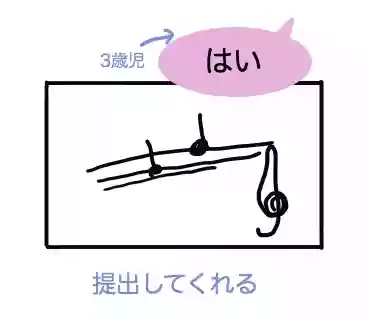
Motivated kids, even though they haven’t learned it, bring their own tote bags and sketchbooks and sit in the corner drawing things that look like musical notes and treble clefs.
I don’t often notice it myself, but I give a big flower mark and a sticker to kids who proudly show off and say, “I was able to do it!”
Children who have been coming to our place since they were babies often have developed some sense of pitch by the time they actually start lessons.
From this, I do think it’s best to start early for developing a sense of pitch, but it also means that you can acquire a general sense of pitch without doing anything particularly difficult.
Of course, starting lessons right away is wonderful, but it’s also very important to first create an atmosphere at home where you sing together, play fun music and let your child hear lots of it, and enjoy it together—so they feel, “Mom just loves the piano!”