

This time, I’d like to explain the basics of reading sheet music: the quarter note.
- Recommended for piano beginners! 10 sheet music picks that adults can enjoy too
- The basics of how to read sheet music, made easy to understand
- How can a beginner pianist learn to play chords easily?
- Mastering quintuplets on the piano
- Basic fingerings for piano beginners
- [Master it in 1 Month] Learn to Play Gen Hoshino's 'SUN' on Piano! Rhythm Practice Edition
- [Super Easy] Piano Sheet Music Beginners Can Play | Available for Immediate Download!
- Even a tipsy old guy can play it! The basics of piano chords
- [Must-See for Beginners] How to Start Learning Piano on Your Own: A Clear, Step-by-Step Guide!
- [For 4-year-olds] Recommended pieces for a piano recital!
- Piano is easy! A selection of sheet music that beginners can play with both hands
- [J-POP] It's like free sheet music! Easy songs you can play on the piano while watching the video
- [Nogizaka46] Introducing popular songs perfect for piano performance, along with sheet music!
How long is a quarter note?
When I was first asked this question, I was honestly surprised.
Because I had never even thought about it until I became a teacher.
At the same time, I could really understand people who say, “Sheet music is difficult and I don’t get it.”
I see—if you're thinking about it from that angle, it's no wonder you wouldn't understand.
So, this is what a quarter note looks like to start with.
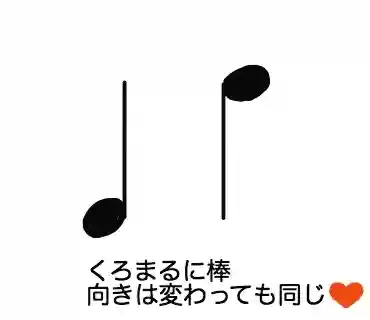
Surprisingly, a quarter note doesn’t have a fixed length!
For now, if there are four lined up, try tapping them with your hand four times.
But if you’re like, “I need some criteria or I’m in trouble!” then…
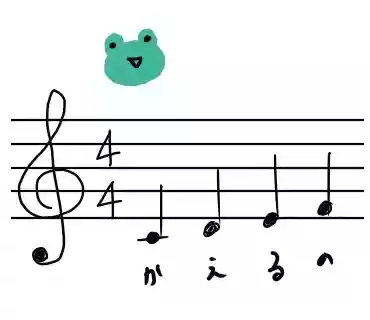
Let's clap our hands to the tune of 'Kaeru no Uta' (The Frog Song).
If it still doesn’t click, just try marching in place right there.
We'll use a pace that is neither particularly rushed nor deliberately slow as the standard.
Children also begin by learning with a vague sense of a tempo that’s easy to tap and easy to count.
As you sing the Frog Song, did you notice that the “ga———” in “ka–e–ru–no–u–ta–ga———” is long?
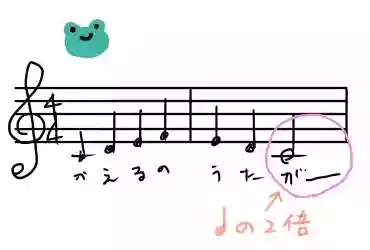
The “white circle with a bar” in this “gaーー” will be twice as large compared to our previous version.
Exactly twice.
It's not about making it longer for no particular reason.
For example, if a quarter note is 1 second, then a whole note is 2 seconds.
Once the criteria are established like this, you are not permitted to arbitrarily choose any length based on your own judgment.
“But in the end, it’s a problem if we don’t have a standard!” “Are quarter notes really that vague?” That’s when the metronome—the piano’s (and every instrument’s) important lifelong friend—makes its entrance.
Let's use a metronome!
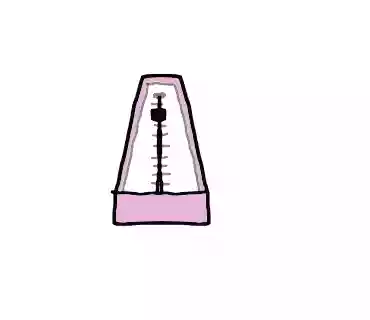
It's like this.
Sorry for my poor drawing.
Actually, the speed is determined to some extent depending on the song.
In that case, there are scores where a marking like “♩ = 60” is displayed at the very beginning of the sheet music.
This number “60” represents the number of ticks per minute.
↧ (Displayed example: 60 not found)
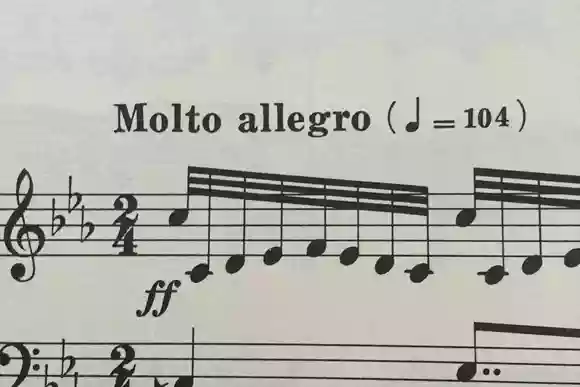
If it rings 60 times in one minute, that means each ring is one second, right?
If it’s 120, that means 0.5 seconds.
So who decides the tempo? As mentioned earlier, sometimes it’s indicated in the score, and other times the teacher decides it on the spot based on the individual student.
As a supplement, the score above indicates (♩=104), but to its left it says “Molto allegro.” In Japanese, this means “very fast.”
We’ll also incorporate things like this as information about speed.
For now, don’t overthink it—just think of a quarter note ♩ as “tan ❤.”