

![Bedřich Smetana Popular Songs Ranking [2026]](https://i.ytimg.com/vi_webp/BM_51ss16KI/maxresdefault.webp)

Bedřich Smetana was a composer regarded as a pioneer who developed the national school of music in his homeland, the Czech lands.
Hailed as the father of Czech music, he is also well known in Japan as the composer of “The Moldau,” often sung in choral settings.
It is said that he was also highly skilled as a performer, having given a piano recital at the age of six.
This time, we present a ranking of Bedřich Smetana’s most popular works—why not immerse yourself in his music, which is celebrated internationally?
- Bedřich Smetana: A selection of famous and representative works!
- Dmitri Kabalevsky Popular Song Rankings [2026]
- Yamada Kōsaku Popular Song Rankings [2026]
- Jean Sibelius Popular Songs Ranking [2026]
- Bartók Béla Popular Song Ranking [2026]
- Johann Nepomuk Hummel Popular Song Rankings [2026]
- Mily Balakirev Popular Songs Ranking [2026]
- Carl Maria von Weber Popular Song Rankings [2026]
- Cécile Chaminade Popular Song Rankings [2026]
- Johann Burgmüller Popular Song Rankings [2026]
- Dmitri Shostakovich Popular Songs Ranking [2026]
- César Franck Popular Songs Ranking [2026]
- Scott Joplin Popular Song Rankings [2026]
Bedřich Smetana Popular Song Rankings [2026] (1–10)
From the symphonic poem cycle My Fatherland, No. 2: The MoldauBedřich Smetana1rank/position

The Czech composer Bedřich Smetana strongly desired freedom and independence for his homeland, which was under the rule of the Austrian Empire in the 19th century, and he devoted himself to elevating Czech national consciousness through music.
The second piece of his symphonic poem cycle Má vlast, “Vltava” (The Moldau), depicts the flow of the river that represents the Czech lands.
It vividly conveys the nature of Smetana’s beloved homeland and the spirit of its people.
This masterpiece, which compels us to feel Smetana’s profound patriotism reaching into the very soul of the nation, has been cherished in various arrangements and is frequently featured in piano concerts.
Two Polkas: From Memories of Bohemia in the form of a Polka, Op. 12-2; and From Three Salon Polkas, Op. 7-2Bedřich Smetana2rank/position

Two Polkas: In E minor, Op.
12-2, from Memories of Bohemia in the Form of Polkas (Vzpomínky na Čechy ve formě polek), and In F minor, Op.
7-2, from Three Salon Polkas (Tři salonní polky).
One senses lyricism, vitality, and the richness of Bohemia’s natural landscape.
Piano: Maria Jenina.
Fragment of a Sonata, Movement I, and Rondo of Youth for Two Pianos, Eight HandsBedřich Smetana3rank/position
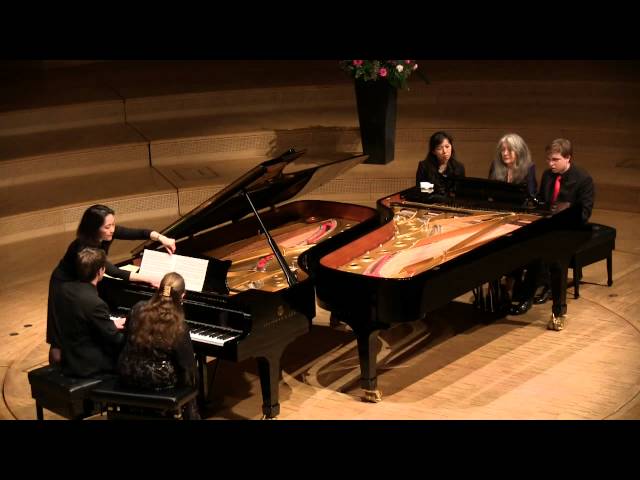
Fragment of a Sonata in one movement (Sonátová věta) in E minor and Rondo for Youth (Rondo pro mládež) in C major for two pianos, eight hands.
Performed by Martha Argerich, Lilya Zilberstein, Daniel Gerzenberg, and Anton Gerzenberg.
First piece from Three Album LeavesBedřich Smetana4rank/position

From Three Album Leaves (Tři lístky do památníku): No.
1: To Robert Schumann (Robertu Schumannovi).
No.
2: The Traveler’s Song (Píseň pocestného).
No.
3: Hissing, Roaring, Rustling, and Ringing (Je slyšet sykot, hukot, a svist…).
Piano: Filip Martinka.
Three Salon-Style Polkas, Op. 7Bedřich Smetana5rank/position

This collection of three short pieces is a captivating work that presents the Czech national dance, the polka, in a refined form.
Smetana composed them between 1848 and 1854, and they were published in Prague in 1855.
Each piece has its own character: the first features a bright and brilliant melody, the second a poignant, melancholic theme, and the third a light, lively rhythm.
A masterpiece that blends Czech national character with the elegance of salon music.
Highly recommended not only for piano enthusiasts but also for anyone interested in Czech music.
Three Poetic Polkas, Op. 8Bedřich Smetana6rank/position

Three Poetic Polkas, Op.
8, by the great Czech composer Bedřich Smetana, fuse virtuosity with national elements.
No.
1 is lively and rhythmic; No.
2, in a minor key, has a reflective mood; and No.
3 is bright and energetic.
Each of the three pieces has its own key and character, vividly reflecting the young Smetana’s sensibility and Czech national identity.
With its distinctive atmosphere and rhythms, as well as Smetana’s refined craftsmanship, this work is recommended not only for piano enthusiasts but also for anyone who wants to ride along with its buoyant pulse.
Op. 8 No. 2 from Three Poetic PolkasBedřich Smetana7rank/position

This work is striking for its lively piano and refreshing melody.
While grounded in a polka rhythm, it blends romantic lyricism to create a style that is both elegant and passionate.
Composed in 1855, it was frequently performed in the salons of the upper classes at the time.
One can sense the composer’s intention to elevate the Czech folk dance polka to an artistic level.
Merging delicate sensibility with nationalistic fervor, this piece is recommended not only for piano enthusiasts but also for those interested in Czech music.