

Takashi Hosokawa Popular Song Rankings [2026]

He, who can be considered a grand master among Japanese enka singers, is a certified performer of the Min’yō Mihashi school and also goes by the name Michitaka Mihashi.
Renowned for his overwhelming vocal prowess, he produced numerous hit songs such as “Yagiri no Watashi” and “Naniwabushi Dayo Jinsei wa.”
Here is a collection of his popular tracks.
- Takashi Hosokawa Popular Song Rankings [2026]
- Hiroshi Itsuki Popular Songs Ranking [2026]
- Popular Songs Ranking of Saburo Kitajima [2026]
- Mitsuhiro Mihashi Popular Song Rankings [2026]
- Hikawa Kiyoshi Popular Songs Ranking [2026]
- [Treasure of Powerful Enka] Takashi Hosokawa’s Easy-to-Sing Songs
- Karaoke Popular Song Ranking of Ikuzo Yoshi [2026]
- Kohei Fukuda Popular Song Ranking [2026]
- Enka Karaoke Popularity Rankings [2026]
- Sayuri Ishikawa Popular Song Ranking [2026]
- Classic enka songs you’ll want to sing at karaoke: recommended popular tracks
- Yukio Hashi’s Popular Song Rankings [2026]
- Masaaki Sen’s Popular Song Rankings [2026]
Takashi Hosokawa Popular Songs Ranking [2026] (21–30)
Brother ShipsHosokawa Takashi22rank/position

The tuna-fishing shows that air around New Year really get your blood pumping just by watching, don’t they? Some crews even head out with fathers and sons or with brothers, and you can feel that unspoken “breath” of perfect timing that only family shares.
This song, Kyōdai-bune (Brother Ship), was the debut single of the well-known Ichirō Toba.
It’s a classic that has since been covered by many singers.
Steering the boat inherited from their father and going out to fish as brothers—it truly sings of the way of life of men of the sea, and it shakes your soul.
Takashi Hosokawa’s version has just as much power as the original, so enjoy comparing them, especially the differences in their vocal ornamentation (kobushi).
winter stormHosokawa Takashi23rank/position

Let us introduce a classic enka masterpiece that portrays the harshness of northern winters and the subtleties of the human heart.
This song features the striking sound of the Tsugaru shamisen and poignantly sings of bittersweet emotions set against the backdrop of a snowstorm-swept northern sea.
Released in May 2019, the piece resonates deeply with listeners, enhanced by Mr.
Hosokawa’s powerful vocals.
It is also included in the album “Takashi Hosokawa Complete Collection: Winter Storm,” and has garnered strong support from many enka fans.
It’s a song that sinks even deeper into the heart when heard in the cold season.
How about humming along with older adults? It’s sure to bring a heartwarming moment filled with fond memories.
North GobanchoHosokawa Takashi24rank/position

Set in a snowy northern town, this is a compassionate song by Takashi Hosokawa that portrays the longing for company and the warmth of human connection.
It paints, with Hosokawa’s powerful yet sultry voice, the feelings that deepen on a freezing night and the festive scenes of friends cheerfully making a racket as they talk about their dreams.
Blending the spirit of traditional enka with a modern, urban arrangement, the song offers a charming mix of nostalgia and sophistication.
Released as a single in August 2001, it marks yet another collaboration with composer Tetsuya Gen, with whom Hosokawa has produced many classics, including Koi no Sake.
The track is also included on the album Takashi Hosokawa Zenkyokushū / Kita no Gobanchō.
Listen to it on a long winter’s night as you reminisce about the past or chat the night away with close friends, and you’ll surely feel a warm light kindle in your heart.
Kinosaki Love SongHosokawa Takashi25rank/position
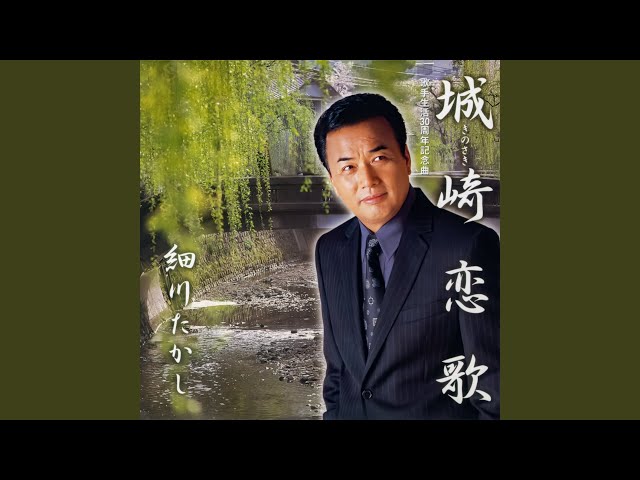
This is a signature ballad by Takashi Hosokawa, marking the milestone of his 30th anniversary as a singer.
Set in Kinosaki Onsen, a famed hot spring in Hyogo Prefecture, it poignantly sings of memories of a lost love fading beyond the steam.
Local words like “straw craft” intertwine with the protagonist’s helpless emotions, gently soaking into the listener’s heart.
Released in January 2005, the song also served as the title track of that year’s album, “Takashi Hosokawa Complete Collection: Kinosaki Koi-uta (Love Song).” A monument to the song stands at the site itself, and it is cherished as a classic that stirs the spirit of travel.
Dream-Drunk PersonHosokawa Takashi26rank/position

In recent years, Takashi Hosokawa has not only been releasing enka songs with formidable difficulty, but also simple, catchy tracks that the general public can enjoy.
Among them, the one I especially recommend is Yumesui-bito.
While it’s a bona fide enka number with a fair amount of kobushi ornamentation, the chorus is shaped into a melody that leans quite close to pop.
The kobushi themselves aren’t particularly difficult, so if you’re accustomed to singing enka, you should be able to handle it without any trouble.

Woman’s Crossroads: A Night I Might Lose Myself to YouHosokawa Takashi27rank/position

Takashi Hosokawa’s famous song “Onna no Jujiro: Anata ni Mayoiso na Yoru” carries a touch of wistfulness even within its brightness.
Because it features Hosokawa’s signature upward-lifting vibrato, you might find it difficult—but that’s not the case.
Aside from the final part of the chorus, there are no challenging kobushi (ornamental turns).
The overall melody is similar to “Kita Sakaba,” so if you can sing “Kita Sakaba” without trouble, you should be able to handle this one as well.
Be sure to add it to your repertoire.
YakushimaHosokawa Takashi28rank/position

It sings of wishing to be like the Jomon Sugi, a World Heritage–listed cedar.
Yakushima, though a small island, is rugged, mystical, and full of diverse qualities.
It feels like an island where the desire to be manly and dignified comes together.
I think I understand the feeling of wishing to be that way.