

![Manuel de Falla Popular Song Rankings [2026]](https://i.ytimg.com/vi/AYpdUo__dM8/hqdefault.jpg)
Manuel de Falla Popular Song Rankings [2026]

Despite being buffeted by events such as World War I and the Spanish Civil War, the musician Manuel de Falla continued his activities as a composer.
Known for works like the opera La vida breve and the ballet music El amor brujo, he kept engaging with his music until the very end, continuing to compose large-scale cantatas even after going into exile in Argentina in 1939.
This time, we’re introducing a ranking of Manuel de Falla’s most popular pieces—so listen while imagining the circumstances of the era!
Manuel de Falla Popular Songs Ranking [2026] (1–10)
Four Spanish Pieces: No. 1, “Aragonesa”Manuel de Falla1rank/position
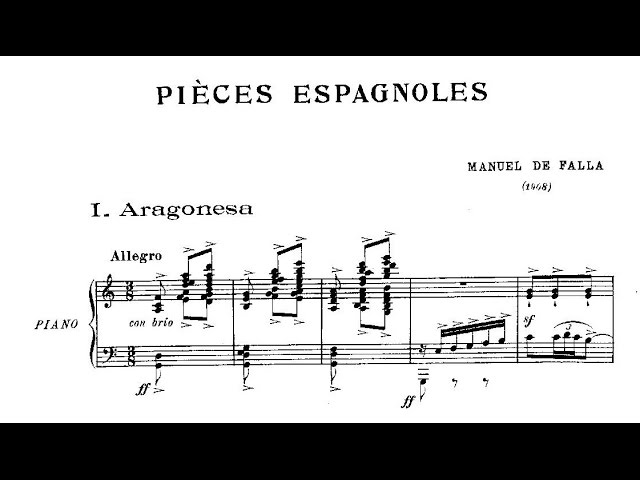
Manuel de Falla, a Spanish composer active in the early 20th century, refined the folk music of various regions of Spain into classical music while studying in Paris and deepening his ties with composers such as Dukas and Ravel.
Four Spanish Pieces is an early masterpiece in which Falla depicts the landscapes and scenes of his homeland.
The first piece, Aragonesa, is a captivating miniature that weaves together glittering arpeggios and passionate rhythms, inspired by the traditional dance of the Aragon region.
This is a work where you can savor Falla’s unique world, a fusion of Spain’s distinctive musical character with Impressionism.
Highly recommended for those who want to experience the allure of far-off lands and feel a longing to travel to Spain through music!
Four Spanish Pieces, No. 4: AndalusaManuel de Falla2rank/position
Manuel de Falla, a master of classical music who was active in the early 20th century, is known for his distinctive style that fuses nationalism and Impressionism, and at times reflects the influence of Stravinsky’s neoclassicism.
The fourth piece, “Andaluza,” from his Four Spanish Pieces, is a work that expresses Andalusia in southern Spain through music.
Characterized by Gypsy flamenco rhythms, colorful guitar-like figurations, and a melancholic melody, it conveys the rich culture and emotive spirit of Andalusia.
Please enjoy this passionate piano work imbued with the fragrance of Spain!
Seven Spanish Folksongs, No. 7 “Polo”Manuel de Falla3rank/position

Manuel de Falla’s song cycle Seven Spanish Folksongs distills the passion of Spain into song and music.
The seventh piece, Polo, is a masterpiece that vividly reflects the influence of flamenco, swirling with intense romantic feelings and anger at betrayal.
Its lyrics convey the protagonist’s burning passion and poignant sorrow.
This expressive work fuses the Spanish color of modal harmonies with Falla’s distinctive refinement.
It’s a piece I recommend not only to classical music enthusiasts but to anyone captivated by passionate music.
Serenata of AndalusiaManuel de Falla4rank/position

Manuel de Falla, a composer who epitomizes 20th-century Spain, began studying piano in his childhood and later studied composition in Madrid and Paris.
During his time in Paris, he deepened his connections with Debussy and Ravel, establishing a unique musical style that fused Spanish folk music with the influence of French Impressionism.
Serenata Andaluza, an early landmark work composed in his early twenties, is notable for melodies and rhythms rich with the spirit of his native Andalusia.
Featuring a gracefully flowing, serenade-like melody interspersed with passionate flamenco rhythms, this piece is a celebrated work that fully showcases the piano’s rich sonorities and dynamic expressive range.
Spanish Dance No. 1Manuel de Falla5rank/position
The works of the Spanish impressionist composer Manuel de Falla are known for their distinctive style, which skillfully incorporates elements of folk music.
Composed between 1904 and 1913, this piece—an excerpt from the opera La vida breve—depicts a scene from a tragic love story set in Granada.
Its brilliant melodies, influenced by Andalusian music, particularly flamenco and cante jondo, captivate listeners and won’t let go.
Infused with Falla’s desire to express the soul of Spain through music while drawing on his experiences in Paris, this work is a perfect recommendation for anyone who wants to fully savor the allure of Spanish music.
In Praise of DebussyManuel de Falla6rank/position

Through the triangular trade with the Americas and Africa, Latin music began to blend with the music of Africa and of Central and South America, and this in turn influenced classical music.
Debussy’s adoption of the habanera rhythm from Cuba is well known, but this piece was the one that brought that rhythm into guitar music, marking the starting point of Central and South America’s emergence as a great powerhouse of the guitar.
Three Dances from the Ballet The Three-Cornered Hat, No. 1: Dance of the NeighborsManuel de Falla7rank/position

Manuel de Falla, a composer from Cádiz, Spain.
His music had a profound impact on the development of Spanish national music, establishing a unique style that fused nationalism and impressionism.
His representative ballet score The Three-Cornered Hat is a lively, rhythmic work that incorporates the rhythms of the traditional dance seguidilla.
In particular, “The Neighbors’ Dance” is beloved as a bright and passionate piece that captivates listeners.
Falla’s colorful, rhythmically vibrant music is recommended not only for classical music fans but for anyone seeking passionate music.