

[Satisfying When Solved] Challenging Quizzes Recommended for Elementary School Students!

For all elementary school students who love quizzes, we’re introducing a whole bunch of tough questions this time!
If regular quizzes are a breeze for you and you’re looking for a new challenge, give these a try.
We’ve gathered quizzes ranging from Math Olympiad problems and entrance exam questions from competitive junior high schools to puzzle-like brainteasers and tricky riddles.
With every question, once you see the answer you’ll think, “Oh, that’s what it was!”—and maybe feel a bit frustrated—but we believe it’s a great way to discover how fun learning can be.
If you find a quiz you like, we also recommend sharing it with everyone at school.
- [For Elementary School Students] Recommended Riddle Collection
- [Advanced Level] Difficult Riddles for Elementary School Students
- Fun quizzes for elementary school kids: a collection of questions everyone can enjoy together
- Math quiz for elementary school students
- [Trick Quiz] Quiz Questions That Excite Everyone from Kids to Adults
- [Easy] Quizzes That Elementary School Students Can Solve! A Collection to Nurture Wisdom
- Easy Riddles for Elementary School Students
- Genius if you can solve it? Super-difficult Quiz Collection
- How many can you solve? Brain-flexing math riddle quiz
- [For Elementary School Students] Cipher Quiz: Fun Puzzle Riddles
- [Challenging and Fun!] Quizzes & Riddles for Adults
- How many can you answer? A collection of fun school-related quiz ideas to guess and enjoy
- [Interesting] Collection of Matchstick Quiz Problems
[Satisfying When You Solve Them] Challenging Riddles for Elementary Schoolers! (21–30)
Only 3% of adults get it right! A 4th grade elementary school math problem
@mayeexuw6q1 A fourth-grade math problem with a 3% correct answer rate among adults
♬ original sound – mayeexuw6q1 – mayeexuw6q1
When you’re suddenly given just this information—“A pencil and a notebook together cost 100 yen, and the pencil is 40 yen cheaper than the notebook”—it’s not uncommon to panic and answer that the pencil costs 60 yen.
But that’s incorrect.
Saying “40 yen cheaper” doesn’t mean the notebook costs 40 yen.
You need to find prices where the difference between the pencil and the notebook is 40 yen.
With problems that have a bit of a trick like this, it’s important not to blurt out an answer right away, but to pause for a moment.
Try shifting your way of thinking, and you’ll start to see the numbers differently.

Use symbols to make four numbers equal 10.
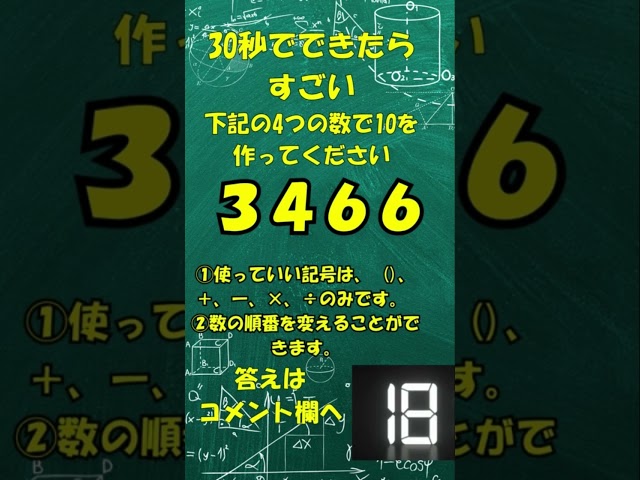
Insert one of the symbols +, −, ×, or ÷ between four randomly arranged numbers to make the final result 10—this makes a perfect brain-training activity! If you use parentheses, you can freely change the order of operations, so children who have learned parentheses should actively incorporate them.
Also remember that multiplication and division are performed before addition and subtraction, so keep that in mind as you complete your expressions.
Once you get used to it, it might be fun for parents and friends to take turns making problems for each other!
[Satisfying When You Get It] Challenging Riddles Recommended for Elementary School Students! (31–40)
Today is Monday. Tomorrow is Tuesday. What day is the day after tomorrow?
@20ennochoco Share voiceVoice LibraryFountain pen
♬ Slow and comical BGM(1083863) – Blanket
When trying to answer this question, wouldn’t most people say, “You’re supposed to answer Wednesday, but the trick is that the answer is Thursday!”? That’s what common sense suggests, right? In fact, if a small child answered that way, I’d be tempted to mark it correct—they’re being clever.
However, the answer is actually neither Wednesday nor Thursday.
The key to finding the answer is to focus on the word “asatte” in the problem statement.
Look closely: while “today” and “tomorrow” are written in kanji, “asatte” is written in hiragana… What does that imply?

[Math Quiz] 5-Yen Coin Savings
![[Math Quiz] 5-Yen Coin Savings](https://i.ytimg.com/vi/E2SfqU5cTnM/sddefault.jpg)
This is a 5-yen coin saving quiz that’s also effective as brain training.
In this quiz, there’s a boy who saves 5 yen every day.
Since his piggy bank was small, he would exchange coins as follows: when he had two 5-yen coins, he exchanged them for a 10-yen coin; when he had five 10-yen coins, he exchanged them for a 50-yen coin; when he had two 50-yen coins, he exchanged them for a 100-yen coin; and when he had five 100-yen coins, he exchanged them for a 500-yen coin.
Based on these conditions, let’s determine the coin amounts at specific counts.
The trick is to think in terms of the smallest possible denominations.

An IQ 100-level question that 84% of elementary school students and 78% of adults solved

I don’t think most people ever get the chance to actually measure their IQ score.
For those people, how about this video? If you can solve the problem in it, they say your IQ is over 100.
And guess what—I solved it! So it seems my IQ is over 100 (lol).
It made me a little happy, and I recommend you and your child give it a try too.
A brain-teaser with a 58% correct answer rate among elementary school students

This is a type of problem where you find the answer through associations.
Elementary school students love questions like these.
They learn lots of facts, enjoy showing what they know, and come to discover the fun of studying—those children, I think, tend to achieve excellent results.
I believe these kinds of problems are very effective for developing the ability to have flashes of insight.
Matchstick puzzle: Using 12 matches, create six enclosures of equal size.

See the answer
Make it a regular hexagon
Imagine pens that hold one animal each, and think about building them with 12 matchsticks. We tend to try making them as squares, but let’s shift that thinking. A triangular pen only needs three matchsticks, so… with a clever combination, you can form a regular hexagon. It’s a surprisingly tricky puzzle!