

Math quiz for elementary school students

Elementary school math gets harder with each grade, and in the end you start seeing problems that even adults find a bit tricky, right?
But it’s a shame to think, “I hate math” because of that.
So in this article, we’ve picked out items that are recommended even for kids who aren’t very confident in math.
They’re all quiz-style problems that are a bit different from the formulas you learn at school—puzzles you solve by thinking them through—so kids should be able to enjoy the challenge.
It might even help them overcome their dislike of math.
It’s also great as brain training—why not try tackling them together as a parent-child activity?
Math quiz for elementary school students (1–10)
Fun Study Drill Workbook
These are recommended addition and subtraction problems for new first graders.
Like a drill, there are plenty of questions, so elementary school students who want to practice repeatedly and get used to addition and subtraction should definitely give them a try! In this workbook, you basically add and subtract three numbers like “1+2+1=4,” and the answers go up to 10.
If you understand the concept of numbers from 1 to 10, you can take on these problems.
There’s lots of variety too, such as adding zero or subtracting before adding! Kids who are good at math might also enjoy racing with friends to see who can answer faster.

How many horse mackerel are there?

This is a problem that can be solved with the math knowledge of a third-grade elementary school student.
At the same time, it’s also an extremely difficult problem that was given in the Math Olympiad, where the correct answer rate was under 20%! You go to a fish shop, buy various kinds of fish, and pay the bill.
You know the total amount you paid and the price of each fish, but you don’t know how many of each fish you bought.
In this situation, the problem is to find how many of one particular type of fish you bought.
At first glance it may look like you can figure it out right away, but it’s surprisingly tough! Put your math skills, knowledge, and intuition to work and give it a try!
A shape that looks easy but is surprisingly hard to solve

Something a fourth grader can solve! It’s a problem about finding the perimeter of a shape.
If it were just a rectangle, you could get the answer by adding up the lengths of all the sides, but in this problem part of the rectangle is bumpy, and there are sections whose lengths aren’t given.
At first glance it looks really difficult, but try connecting the unknown parts together.
Then they’ll match the lengths of the known parts, right? With some addition skills and a bit of insight, even lower-grade students who are good at math might be able to solve it!
[Arithmetic Puzzle] 3 Maze Problems in Total
![[Arithmetic Puzzle] 3 Maze Problems in Total](https://i.ytimg.com/vi/AW-Y8F2T1vg/sddefault.jpg)
This is a math quiz recommended for elementary school students who love mazes! The problem works like a maze from start to goal, and you have to reach the goal—or guess where the goal is—while following set rules such as “You can’t use the same path twice” and “Each door can only be opened once.” Unlike problems with letters or numbers, you can progress visually while thinking it through, so it’s great fun to get together with a few friends and solve it as a group! Read the rules carefully and figure out the correct route!
Sum of areas
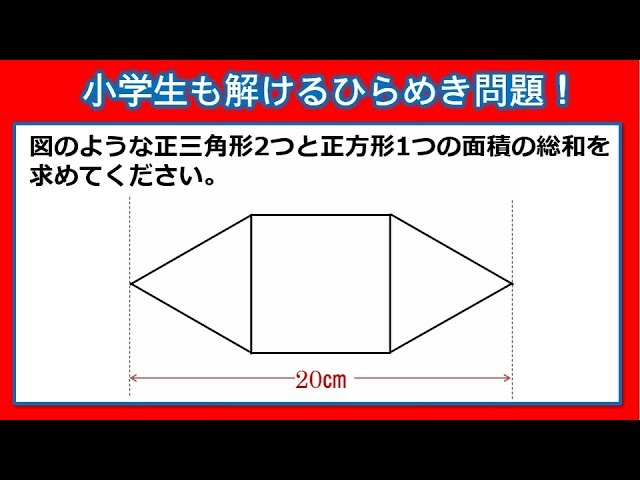
This is a problem asking for the sum of the areas of two equilateral triangles and one square.
Elementary school students who struggle with math often feel lost as soon as multiple shapes appear.
But let’s calm that anxiety a bit and focus on the lengths we can determine.
The first key point in this problem is that, because we’re dealing with a combination of equilateral triangles and a square, all the side lengths are the same.
Make use of auxiliary lines as needed, and start by considering the height of the equilateral triangle and half the length of its base.
A puzzle that puts your creativity to the test!

This quiz is a puzzle that tests your quick wits.
A mysterious symbol—whose meaning isn’t obvious at first glance—is drawn in eight of the nine squares of a 3×3 grid.
Only the bottom-right square is blank, and the task is to answer which symbol belongs there.
The symbols vary—combinations of hearts, circles, triangles, something that looks like the Roman letter M, and more—so the pattern isn’t clear at first glance.
However, if you look carefully, you should notice something! The hint is: don’t view them as combinations of individual shapes or the letter M, and remember that there are nine squares in total.

A common basic-knowledge geometry problem in junior high school entrance exams

A classic geometry problem that frequently appears in arithmetic classes.
Inside a rectangle with a height of 10 cm, there are two overlapping sectors.
Let A be the area outside the two sectors and I be the area where the two sectors overlap, and A and I have the same area.
If you know how to find the area of a sector and the area of a rectangle, the key to the solution is how you set up the equations.
Geometry problems test not only your knowledge of area formulas but also your reasoning, so the key is to practice a lot!