

Math quiz for elementary school students

Elementary school math gets harder with each grade, and in the end you start seeing problems that even adults find a bit tricky, right?
But it’s a shame to think, “I hate math” because of that.
So in this article, we’ve picked out items that are recommended even for kids who aren’t very confident in math.
They’re all quiz-style problems that are a bit different from the formulas you learn at school—puzzles you solve by thinking them through—so kids should be able to enjoy the challenge.
It might even help them overcome their dislike of math.
It’s also great as brain training—why not try tackling them together as a parent-child activity?
- How many can you solve? Brain-flexing math riddle quiz
- [For Elementary School Students] Cipher Quiz: Fun Puzzle Riddles
- Fun quizzes for elementary school kids: a collection of questions everyone can enjoy together
- [Interesting] Collection of Math Quiz Problems
- [Easy] Quizzes That Elementary School Students Can Solve! A Collection to Nurture Wisdom
- [Satisfying When Solved] Challenging Quizzes Recommended for Elementary School Students!
- A math quiz for adults. Can you solve it?
- [For Elementary School Students] Recommended Riddle Collection
- A game where you can learn the multiplication table while playing
- Quiz for elementary school students: Easy! Fun! Question collection
- Easy Riddles for Elementary School Students
- [Get Friendly with Games] Math Games, Apps, and Activities
- [Interesting] Collection of Matchstick Quiz Problems
Math quiz for elementary school students (11–20)
A math quiz that tests 3D spatial recognition skills

It’s a problem where diagrams of a certain solid are shown from various angles—top, left, front, and so on—and you’re asked to find its volume.
It can be quite challenging because it tests your ability to visualize the solid in your head.
I’ve heard that people who are good at these kinds of problems also tend to be good with maps.

One question from Kaisei Junior High School’s 2018 entrance exam

This is an entrance exam question from Kaisei Junior High School for the 2018 academic year.
For a top-tier junior high school, the difficulty level is relatively low, so elementary school students preparing for entrance exams might find it easy to solve.
The figure looks simple and easy, but without knowing the solution pattern, it can be hard to instantly come up with the method to solve it.
20 column-style arithmetic problems for 3rd-grade elementary school students

In long subtraction, there are 20 problems involving three-digit numbers without borrowing.
Adults can try solving them mentally, while children can copy the equations into their notebooks and use long subtraction to find the answers.
Work through many problems and steadily improve your subtraction speed.
Pursuit problems

This is a problem where you calculate when two people, starting from different locations and walking at different speeds, will meet.
Problems like this often appear in math from middle school onward.
People who aren’t good at arithmetic or math might feel like saying, “Why don’t they just leave at the same time?” But if you watch this video and learn how to solve it, you’re sure to get better at it!
One math quiz that children can solve but adults cannot

This video features an entrance exam question from a highly selective elementary school, where you need to find a pattern and derive the answer.
It only uses addition and multiplication, but it’s a math puzzle that can’t be solved with rigid thinking.
Loosen up your mind and give it a try!
Math puzzles that children excel at but adults struggle with
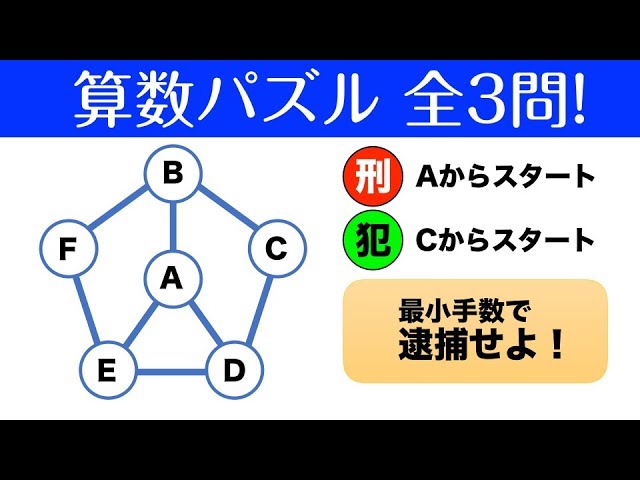
There are problems that use playing cards and ones where you fill in numbers in blanks like a crossword.
Kids with flexible thinking often solve these surprisingly easily, but adults tend to struggle.
It’s fun to compete with your family.
Math Quizzes for Elementary School Students (21–30)
Crane and Tortoise Problem

This is a quiz where, given the total number of cranes and turtles and the total number of legs, you calculate how many of each there are.
From middle school onward, this is solved using simultaneous equations, but in elementary school this type of problem is called the “crane and turtle” problem.
It appears frequently on junior high school entrance exams, so be sure to master it.