


A math quiz for adults. Can you solve it?


In this article, we’re showcasing plenty of math quizzes that we want adults to try!
We’ve gathered everything from puzzles you can solve with a flash of insight—but can be tricky if you’re too rigid—to serious problems that have appeared in the Math Olympiad.
They’re perfect for killing time and training your brain.
You can enjoy them with other math-loving adults, or challenge your child to see who can solve them faster—it sounds fun either way.
Give them a try with a game-like mindset!
Math quiz for adults. Can you solve it? (1–10)
A math problem that even adults get wrong

Is the answer to “9×9÷9×9” 81 or 1? It’s just a simple string of numbers and basic multiplication and division symbols… and yet it’s confusing, isn’t it? Especially if you haven’t done arithmetic in a long time, you might find yourself thinking, “What order am I supposed to calculate this in again?” The key point is that there are no parentheses.
Whether or not parentheses are used changes the order of operations.
If you’ve read this far, it might have reminded you of your math classes back in the day.

Genius if you can do it? An interesting math problem that seems easy but trips you up

There’s an amusing puzzle that divides people into “science-brained” and “arts-brained.” The question goes: “You have 300 yen.
If you buy a 180-yen juice, how much change do you get?” It’s said that arts-brained people answer 120 yen, while science-brained people answer 20 yen.
With that in mind, let’s all enjoy solving “simple-looking but tricky math problems.” A common example is: “A melon and an apple cost 1,100 yen in total, and the price difference between the melon and the apple is 100 yen.
How much is each?” The answer is melon 1,050 yen and apple 50 yen.
It could be fun to come up with our own original problems, too!
A problem that children can solve but adults struggle with
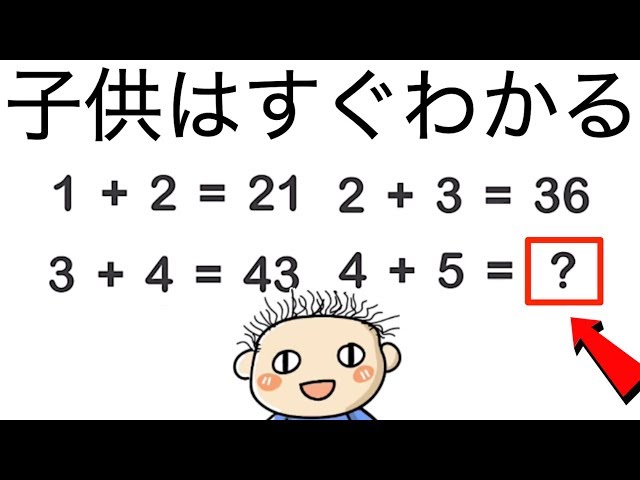
Have you ever played the games created by Noda Crystal from Magical Lovely? Just like the tagline “a party game you can play forever,” every game has simple rules and is exquisitely fun.
Sometimes there are a few mischievous games too, which turn into hilarious punchlines.
So I’d love for all the adults to tap into their inner child and try some of these “problems kids can solve but adults struggle with,” which also include a few trick questions.
For example: “Cat, giraffe, bear, parrot—what’s the tallest?” The answer might be the cat, because it’s drawn at the top, and everyone ends up chattering and laughing over these riddles that aren’t so straightforward.
Even the tricky questions—answer them with a smile!
Mathematics Probability Problem

The prisoner’s paradox, often explained in the context of solving the Monty Hall problem posed in probability theory.
It’s a quiz that asks whether your chances of survival increase if, among three prisoners with only one destined to be spared, you learn in advance who will not be spared.
Although it’s a problem themed around mathematical probability, there’s no need to think in a complicated way.
By following your intuition, you can arrive at the correct answer.
It’s an extremely challenging puzzle packed with the allure of paradoxes—where seemingly sound logic leads to an unsettling conclusion.

Let’s find the angles of the triangle.

It’s a problem where you have a figure made by putting two triangles together, and you’re asked to find the angle x.
You work through it using information such as another angle being 15 degrees, another being 30 degrees, and the presence of a median that bisects the base.
The interesting point of this problem is that there are many ways to look at it.
For example, you might use the fact that the angles in a triangle sum to 180 degrees, or draw an auxiliary line to create another triangle—several approaches are possible.
Applying your own ideas—in other words, giving your brain a workout—is what makes it fun.
Let’s try to find the height of the building.

It seems easy but isn’t… This is a math quiz that plays tricks on your eyes.
A child stands on top of a building and an adult stands on the ground; the height from head to head is 5 meters.
Next, an adult stands on top of the building and a child stands on the ground; the height from head to head is 6 meters.
So, what is the height of the building? You might first be confused, wondering, “Why does the height change just by swapping the child and the adult?” The key to solving it is to stack the two diagrams one above the other!
Square Puzzle

This is an arithmetic puzzle where you find the area of a smaller quadrilateral drawn inside a square.
Looking only at the diagram, with lines drawn diagonally across the square, you might wonder, “How am I supposed to solve this?” The key to the problem is that the inner figure is formed by lines connecting the vertices and the trisection points of each side.
If you shift and extract parts of the figure to turn it into a different, easier-to-calculate shape, the answer should naturally follow.
Approach it with flexible thinking!