


For piano, once you first learn the A, B, C, D, E, F, and G chords, it starts to come together.
As we discussed beforeAssuming the accompaniment plays the root (A, B, C, D, E, F, G correspond to La, Si, Do, Re, Mi, Fa, So, right?), the next challenge is the melody.
To play a melody, you first have to know what notes it consists of.
To do that, you'll either have to transcribe it by ear or buy the sheet music.
Since very few people can hear a piece from the start and immediately play it on the piano, you'll begin by reading the sheet music.
This time, I’ll talk about the basic way to read sheet music that you should at least know.
- Basic fingerings for piano beginners
- The meaning of key signatures and how to write the chord symbols
- [Must-See for Beginners] How to Start Learning Piano on Your Own: A Clear, Step-by-Step Guide!
- [For Piano Beginners] Let's learn useful chords!
- How to play piano accompaniment using simple chords
- Even a tipsy old guy can play it! The basics of piano chords
- I want to sing and play the piano! How to use auto-accompaniment features and melody sheets with chord symbols
- How can a beginner pianist learn to play chords easily?
- What is a quarter note?
- [Children’s Song] Easy Even for Piano Beginners! Introducing Nursery Rhymes with Simple Chords
- For piano beginners: an easy-to-understand way to practice chord changes
- Recommended for piano beginners! 10 sheet music picks that adults can enjoy too
- A must-see for anyone who wants to try piano-and-vocal performances through code! From nostalgic oldies to the latest hits, all introduced at once.
On the piano, it's Do Re Mi Fa Sol on the grand staff.
Piano scores, which are often played with both hands, are written on a grand staff.
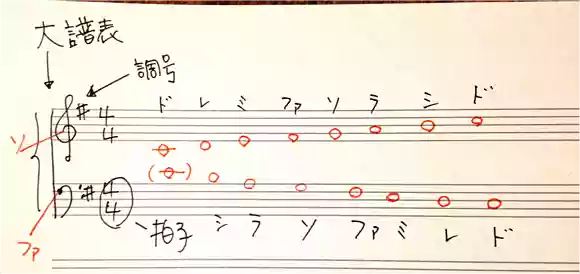
In this image, the top staff uses the treble clef and the bottom staff uses the bass clef, but sometimes both the top and bottom are the same.
This symbol written at the beginning determines which note corresponds to each line and space on the staff.
In the treble clef, the second line from the bottom is G, and in the bass clef, the second line from the top is F.
Which pitch it is is determined by which line of the staff the note is written on.
A note is made up of elements like the notehead, stem, flag, and beam, but you can tell the pitch by the position of the notehead.
Length of sound
While the five lines indicate pitch, the shapes of notes—such as stems and flags—represent duration.
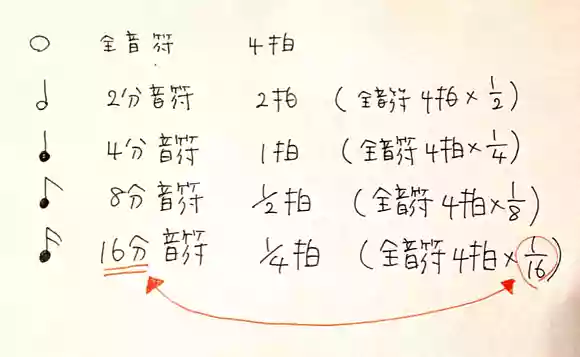
To read sheet music, you just need to look at which shapes of notes are written on which lines.
A sixteenth note has a duration that is one sixteenth of a whole note.
You can tell the length of the sound by looking at the name.
A simple white circle becomes shorter in duration when a stem and a flag are added to it.
In terms of how the sheet music looks, when there’s more black on the page, it means the notes are moving more intricately.
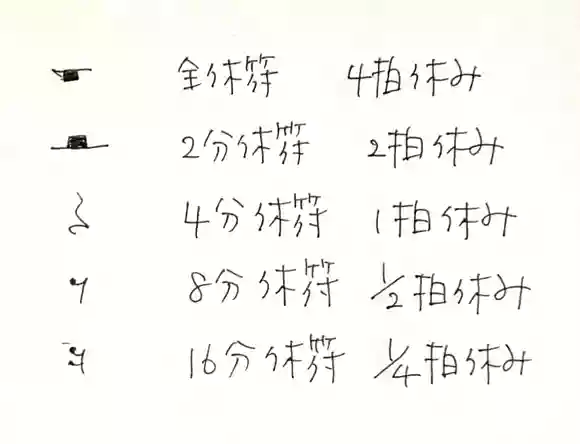
The lengths of rests and notes are linked, like “whole note (4 beats) = whole rest (4 beats of silence).”
Time signature and key signature
Now, if you look at the staff, the symbols written after the treble clef or bass clef are called key signatures, which indicate the key of the piece, and they are written on each staff line.
Next, there is something called a time signature written, but it is written only on the first staff.
A meter refers to a grouping of beats, and if you think of the '3-3-7 clapping pattern,' it might make sense.
In 4/4 time, the four beats form one unit; in 3/4 time, the three beats form one unit.
Time signatures and key signatures can change in the middle of a piece, and when they do, they are written each time.
Key signatures and accidentals
If there are sharps (#) or flats (♭) in the key signature, you must apply the sharp or flat to every note to which it is assigned, regardless of the pitch height.
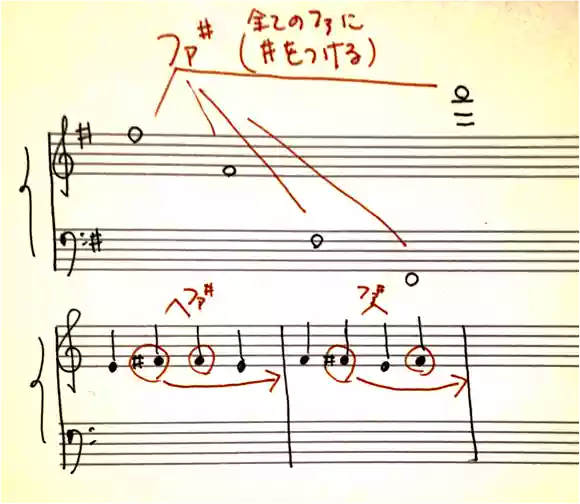
In the key of G major, which has a sharp on F, every F at any pitch becomes F-sharp.
As in the lower part of the image above, there are cases where sharps or flats are attached directly to the notes rather than indicated in the key signature.
In this case, sharps and flats are placed to the left of the note, and only the pitch they are attached to is valid within that measure.
It may be easier to understand if you think of it as applying only to that note.
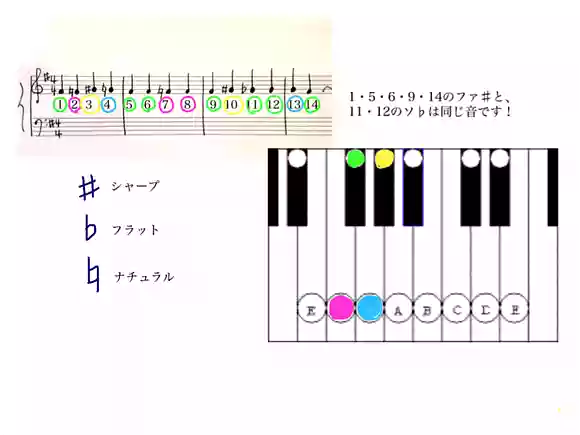
The natural sign, which means to return to the original pitch, is used in the same way as sharps and flats.
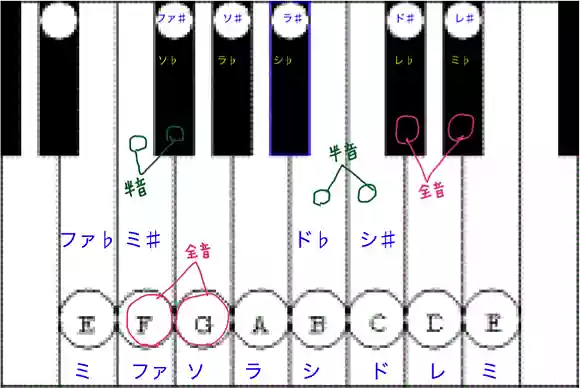
The sharp (♯) means to raise a note by a half step, and the flat (♭) means to lower it by a half step. A half step and a whole step refer to the positional relationships shown in the diagram below. On a piano keyboard, adding a sharp changes the note to the one immediately to the right (including black keys), and adding a flat changes it to the one immediately to the left.
What is rhythm?
I think pitch is relatively easy to understand, including sharps and flats, but note lengths are a bit harder to grasp.
The length of the sounds was explained in the figure above, but since it’s relative, it will be easier to understand if you think of it in larger chunks.
If you divide length into several chunks, it becomes what’s called a “rhythm,” and you just need to map pitches onto that rhythm.
It might be easier to understand when combined with words.
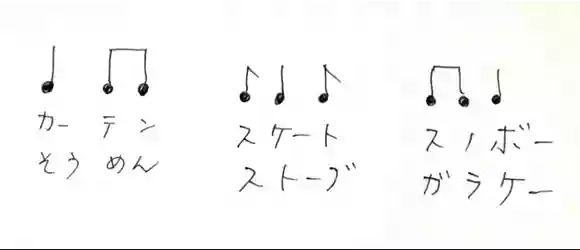
Knowing the pitch and duration alone doesn’t make it music, but for now you should at least be able to identify the notes written on the score.
Even in popular music, an 8-beat and a 16-beat are different even though both are in 4/4, and in classical music, not everything in triple meter is a waltz.
That part is quite difficult to tackle through self-study, but if it’s a song you know, you should be able to give it a try as you learn how to read sheet music.