

[Learn with a Quiz] Quiz Questions about the SDGs

Words like SDGs and sustainable have become common in recent years.They’re frequently featured on TV and elsewhere, but many people still aren’t quite sure what they actually are.To put it simply, it’s about “achieving 17 goals by 2030 so that people around the world can continue to live peacefully and with dignity.”In this article, we present a selection of items from those 17 SDGs as a quiz.It’s a multiple-choice quiz with three options, so even those who aren’t familiar with the SDGs can give it a try.Why not deepen your understanding of the issues we must face—and the knowledge we need—while solving the quiz?
- [For Elementary School Students] Learn about the SDGs by Answering Quizzes!
- Surprisingly unknown? Trivia Quiz [Multiple Choice: 3 Options]
- [For Seniors] Let's Enjoy Learning about the SDGs through Quizzes!
- Games with an SDGs theme: A roundup of board and card games
- [May 2026] Current Affairs Quiz: A roundup of news questions that will be immediately useful for interviews and entrance exams
- Aim for a perfect score! A three-choice common knowledge quiz that deepens your understanding
- Stimulate your intellectual curiosity! Fascinating trivia quizzes that you’ll want to share with others
- [For Kids] Today’s Quiz Roundup. Let’s play quizzes about today! [May 2026]
- How Much Do You Know? Food Quiz for Elementary School Students
- [Play Right Away!] Multiple-Choice Quiz Questions for Lower-Grade Elementary School Students
- How many can you get right? A tricky 3-choice trivia quiz you'll want to tell someone about
- A multiple-choice quiz with three options for upper elementary students. Fun questions that build thinking skills.
- A multiple-choice quiz with three options for upper elementary students. Questions you can enjoy between classes or at home.
[Learn with Quizzes] Quiz Questions about the SDGs (1–10)
Which countries have more female lawmakers than male lawmakers—where women are especially prominent in politics?

- Rwanda
- Norway
- Peru
See the answer
Rwanda
Japan often has the image of politics and the National Diet being male-dominated, but in Rwanda, the number of female lawmakers surpassed that of men in 2017, and many women have continued to play active roles since then. As for the proportion of female legislators, Japan ranked 150th out of 196 countries in the world in 2023, at just 15.5%. The goal of “achieving gender equality” includes increasing the number of women in management positions and reviewing employment conditions and treatment to promote equality between men and women.

What are the most effective measures to reduce carbon dioxide emissions?
- Reduce each family member’s shower time by one minute
- Unplug the TV while you're not watching it.
- Turn off the rice cooker's keep-warm function.
See the answer
Reduce each family member’s shower time by one minute
In the section “Concrete Measures Against Climate Change,” the main goal is to reduce greenhouse gas emissions and halt global warming. To achieve this, small efforts at home are necessary. If every family member reduces their shower time by one minute, it can cut annual carbon dioxide emissions by about 69 kilograms.
How many young people aged 15 to 24 in the world are neither in school nor employed?

- One in three
- One in five people
- One in seven people
See the answer
One in five people
“Decent Work and Economic Growth” aims for a society where everyone can find fulfillment in their work and engage in dignified, humane employment. Around the world, one in five young people are neither attending school nor working, often helping at home. Approximately 267 million people are in situations where they cannot attend school or go to work.
[Learn with Quizzes] Quiz Questions on the SDGs (11–20)
Out of the world’s 196 countries, how many are called “developing countries”?
- 46 countries
- 97 countries
- 146 countries
See the answer
146 countries
The term “developing countries” refers to nations that are still in the process of growth, with low levels of economic and industrial development. However, many of these countries are far from achieving development, suffering from poverty and hunger, and experiencing conflicts. The goal of “reducing inequalities within and among countries” aims for equality that is not influenced by a person’s country, race, gender, or other attributes.
When will Japan’s landfills and final disposal sites reach their limits?
- the year 2040
- the year 2060
- the year 2080
See the answer
the year 2040
Just as resources are limited, so too are the places where we can dispose of the waste we consume and throw away. In Japan, it is said that final landfill sites for waste will reach their limits by 2040. One of the goals of “Responsible Consumption and Production” is to balance excessive production and disposal, and to achieve sustainable production and responsible consumption.
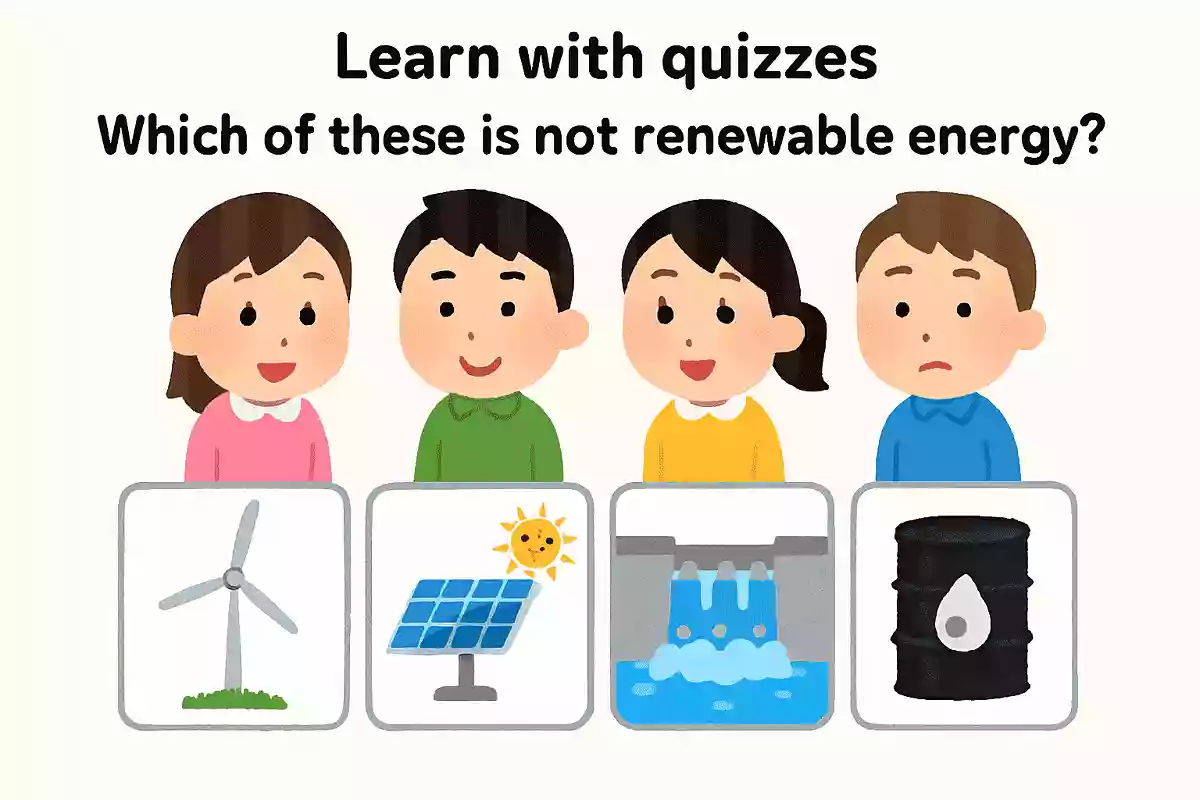
Which of these is not a renewable energy source?
- geothermal energy
- biomass
- natural gas
See the answer
natural gas
The energy sources currently dominant are oil, coal, and natural gas. These lead to air pollution, climate change, and global warming. Under the goal of “Ensure access to affordable, reliable, sustainable and modern energy for all,” the aim is to increase clean, renewable energy such as hydropower, wind power, biomass, and geothermal, and to enable a stable supply of electricity and other energy worldwide.
What is the target percentage for reducing all people living in poverty in all its dimensions according to national definitions by 2030?
- 10%
- 30%
- 50%
See the answer
50%
Under the “No Poverty” goal, we are working toward the target of halving by 2030 the proportion of men, women, and children of all ages living in poverty in all its dimensions as defined by each country. When it comes to poverty, many people may think it has little to do with Japan, but it is by no means just an issue for other countries.