

[Songs from the Showa Era] Introducing classic tracks that are easy to sing at karaoke.


Have you ever wanted to sing classic Showa-era hits to match the mood of the moment? In fact, many songs from the Showa period have simple, easy-to-remember melodies and are comfortable to sing without straining your voice! In this article, we introduce a wide range of Showa songs that feel great to sing at karaoke.
From nostalgic favorites to timeless classics loved across generations, you’re sure to find a song that becomes your go-to number!
- A collection of iconic, cool Showa-era kayōkyoku classics sung by male vocalists
- When you can’t decide what to sing at karaoke: Easy-to-sing classic hits from the Showa era
- [Karaoke] A roundup of songs that are easy for women to sing!
- A collection of nostalgic hits from the ’70s to 2000s that are perfect for livening up karaoke
- Recommended for women in their 60s! Easy-to-sing Japanese karaoke songs
- [Classic Showa Kayō Hits] The captivating Showa-era pop songs beloved even by younger generations
- Easy-to-sing songs recommended for men in their 80s: Showa-era classics to perform at karaoke
- [For People in Their 50s] Ranking of Easy-to-Sing Karaoke Songs [2026]
- Cool songs from the Showa era. Masterpieces from Showa that shine with sensuality, passion, and rugged charm.
- [Nostalgic Hits] Smash Hits with the Showa Generation! Classic and Popular Songs Sung by Female Vocalists
- Timeless classics only! Showa-era hit songs perfect for acoustic sing-alongs
- [Revisited] A roundup of popular and classic Showa-era songs that are trending now [2026]
- Evokes the charm of the good old days. Showa-era inspirational songs that are still loved today.
[Songs from the Showa Era] Introducing Easy-to-Sing Karaoke Classics (21–30)
loveMatsuyama Chiharu

It’s a love ballad by Chiharu Matsuyama, and it’s the kind of song where you really need to be mindful of the “silence” between phrases or you won’t quite catch the groove.
Just reading the lyrics might make you want to sing line after line, but if you place each phrase carefully and leave a lingering aftertaste, it will heighten the sense of poignancy.
The overall vocal range is C3–G4, so it’s not too high and there’s no need to belt.
When the chorus comes, projecting your voice with clear dynamics and singing with confidence will make it land stylishly.
That way, even listeners who don’t know the song will recognize where the chorus is and get into the music with you!

Love is overŌyō Fifi

Fei-Fei Ouyang’s signature song, “Love Is Over.” Among Showa-era ballads, it stands out overwhelmingly as a masterpiece of farewell.
Although Fei-Fei is known for her husky voice, I think you can convey enough poignancy in this song without deliberately singing in a lower register.
If you project your voice straight and clear, it will resonate deeply, so it’s best to sing without hesitation.
If you’re comfortable, adding a slight vibrato on the sustained notes can work well.
One caution: don’t let the emotion overflow so much that your voice turns into a sob!
[Songs from the Showa Era] Introducing classic tracks that are easy to sing at karaoke (31–40)
freezing rainHino Mika

Akio Kayama’s classic “Hisame” has been covered by many singers and continues to be loved today as a mood-kayō style enka.
Among the various versions of “Hisame,” the one I especially recommend is Mika Hino’s.
She sings it with a more subdued, reflective atmosphere than the original.
Enka tends to have many challenging elements, but if you imitate her singing style, I think you can perform it well.
It’s recommended for anyone who wants to sing a mature, mood-rich number.

Strawberry Statement, Once Morebanban

Lyrics and composition by Yumi Arai.
The title “Ichigo Hakusho” (The Strawberry Statement) is said to refer to the American film released in 1970.
It’s a folk ballad that seems to preserve, just as it was, the bittersweetness of youth, the afterglow of the student movement, and memories of love—the very atmosphere of the times! To be honest, although I knew the title, I had never actually listened to the song properly.
I’d like to take this opportunity to learn it well.
First, the melody line is very simple, so even casually humming it helps you memorize the song and makes it easier to sing by improving your breath—two birds with one stone! Because of its wistful mood, it might be best not to overdo it; try placing a hand on your chest and singing while feeling the resonance.
Swim! Taiyaki-kunShimon Masato

Released on December 25, 1975, it spent 11 consecutive weeks at No.
1 on the Oricon chart and ranked No.
1 for all of 1976, marking one of the biggest sales in Japanese history! While it may fall under the category of a children’s song, surprisingly many people sing it at karaoke.
It’s a monstrous Showa-era hit that includes social satire and humor.
There are some slightly comical parts, so it’s best to sing it confidently without feeling shy! If you make sure to hit each note of the melody line clearly and project your voice, it will add accents and help you sing like Shimon-san.
Look up at the stars in the nightSakamoto Kyu

Kyu Sakamoto, the singer who released numerous hit songs such as “Ue o Muite Arukō (Sukiyaki)” and “Ashita ga Aru sa,” passed away suddenly in a plane crash in 1985.
“Miagete Goran Yoru no Hoshi o,” a cover of a musical’s theme song first performed in 1960, is also known for having been covered by many artists across generations.
Its melody and tempo are both gentle, and with relatively few notes overall it’s easy to sing; however, if you sing it too flatly, the mood changes, so be mindful of dynamics.
As a classic everyone knows, it’s an easy number to sing at karaoke with people of any generation.

Keiko’s Dream Opens at NightFuji Keiko
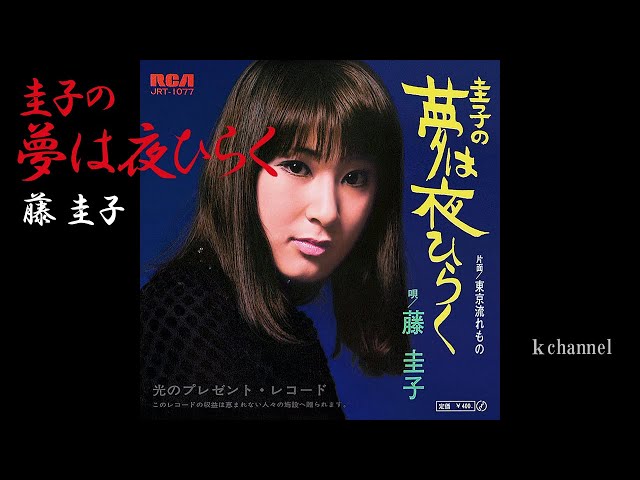
Keiko Fuji, a singer who was also known as the mother of Hikaru Utada and who passed away suddenly in 2013.
Her third single, “Keiko no Yume wa Yoru Hiraku,” based on the kayōkyoku song “Yume wa Yoru Hiraku,” was a massive hit, winning the first Japan Song Grand Prize.
Although its vocal range is narrow and the tempo is relaxed, it features many distinctive delays (ma), so be careful in karaoke as it’s easy to lose the rhythm.
It’s a classic with a moody feel rarely found in modern popular music, making it a refreshing song to sing at karaoke even today.