

Games for conversation practice: a collection of ideas everyone can enjoy

“I can’t keep a conversation going.” “I’m not good at talking with people I’ve just met.” Do you have these conversation-related worries? In fact, games are perfect for practicing conversation! Simple rules naturally spark dialogue—and laughter too! In this article, we introduce games that let everyone enjoy practicing conversation together.
From telephone (whisper-down-the-lane) and finding common ground to coordination/communication games, they’re all easy to use as workplace icebreakers or at get-togethers with friends.
Your communication skills will naturally improve through these games, so give them a try!
- Games you can play with just conversation. Classic and popular activities you can enjoy without any props!
- Fun two-player games recommended that you can play using conversation only
- Games that get everyone excited without any equipment! A collection of simple ideas everyone can enjoy
- Icebreaker Ideas and Games Collection
- Big fun with no props! A collection of party game ideas
- Party games you can play without any props! A collection of ideas everyone can enjoy together
- Fun games recommended for making friends with people you’ve just met
- A collection of icebreakers you can enjoy with a small group
- [Conversation Skills] Get the Crowd Going! A Collection of Talk Theme Ideas
- Guaranteed to boost team power! A collection of fun training game ideas
- Liven up even first meetings! A collection of fun games perfect for welcome parties
- Games that get the whole family excited! A collection of ideas you can start right away with no equipment
- Games for three people with no equipment: Fun activities that get lively using only conversation and your bodies
Games for conversation practice. A collection of ideas everyone can enjoy (1–10)
Who did what, when, and where game
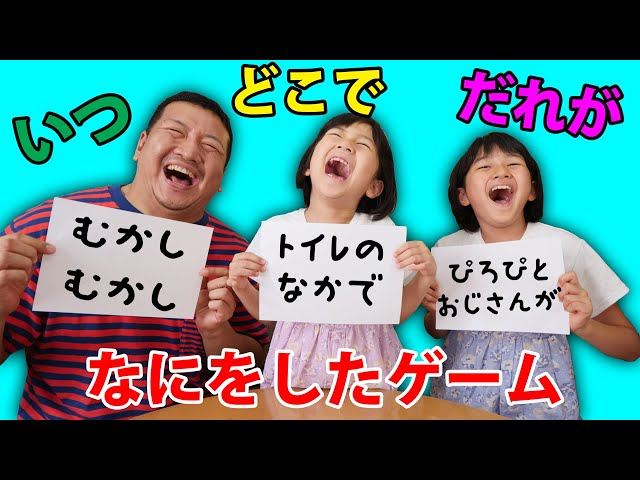
The “When, Where, Who, Did What” game is a very simple game! Participants take turns, each being responsible for one of the four keywords—“When,” “Where,” “Who,” or “Did What”—and write an answer on a piece of paper that fits their keyword.
Any content is fine, but using the participants’ names for the “Who” part tends to make it more exciting.
Once everyone has written their parts, you reveal them in order and enjoy the sentence that emerges.
Because everyone writes their answers freely, the sentences connect but the content turns out wonderfully bizarre and funny.
It’s sure to spark lively conversation.

Talking Game

If you want to develop your ability to listen to others and to express your thoughts, I recommend the “Talking Game.” You simply flip over a card with a prompt and talk based on it, so it’s enjoyable for both children and adults.
Since there’s no time to think about the topic in advance, it seems like a great way to train your quick thinking and summarizing skills—what to say and how to structure it.
The game naturally gets conversation flowing, making it perfect for practicing conversation! It also gives you a chance to get to know the other person—two birds with one stone!
Bibliobattle

A Bibliobattle is an intellectual book review showdown.
Each participant brings one favorite book and takes turns presenting it, conveying what makes the book appealing.
After everyone has presented, choose the one book you most want to read and announce your choice.
The book presented by the person with the most votes is the champion! It’s an especially recommended game for book lovers, but it’s also delightful when people who don’t usually read say, “I want to try that.” As you talk about the books’ contents, the conversation naturally expands—it’s a fun idea with lots of potential.
A game for practicing conversation. A collection of ideas everyone can enjoy (11–20)
Marshmallow Challenge

The classic “Marshmallow Challenge” is a staple of icebreakers and team-building.
It’s a simple game where a team works together to build a marshmallow tower—but it’s surprisingly deep.
The tower is complete once you can place a marshmallow at the very top.
However, there are restrictions: you can’t secure the base with tape, and cutting the marshmallow is not allowed.
Besides the marshmallow, the only materials you may use are spaghetti, tape, and string.
Discuss with your team how to proceed so you can successfully complete the tower.
Telephone game

The telephone game is a classic recreation activity.
Starting with the person at one end of a single line, they pass a prompt word to the next person so that no one else can hear.
It continues in order—so that no one else can hear—to the next person, and then the next…
and you enjoy seeing whether the message makes it all the way to the end correctly.
Because everyone whispers quietly into each other’s ears, the low volume often makes it hard to communicate clearly, so the message frequently gets garbled.
But that’s part of the fun—it gets everyone laughing and really livens things up.

Commonality-Finding Game

It’s a perfect game to kick off a conversation by looking for commonalities among the participants.
However, since the goal is to find something everyone has in common, it can be brutally never-ending in some cases.
It’s important to identify topics that are likely to overlap—for example, narrowing the genre and asking about favorites, or conversely focusing on things people dislike.
The difficulty increases as the number of members grows, so it’s recommended to start with rules like “clear if it applies to a certain number of people,” and gradually make it harder.

Communication game

A communication game where each person contributes one character at a time to collectively produce a single answer that matches the prompt. For example, if the prompt is “a red fruit” and you want to align on “ringo” (apple), players would present り, ん, and ご one character at a time; if the word comes together perfectly, you succeed.
しかし、「り」や「ち」や「ご」のように有効な単語にならないものになってしまったら失敗です。
The number of characters in the answer changes depending on the number of players, so be careful.
It’s best with a small group of about 2–5 people.
You can enjoy it with close friends, coworkers, or family.
