


Games for conversation practice: a collection of ideas everyone can enjoy

“I can’t keep a conversation going.” “I’m not good at talking with people I’ve just met.” Do you have these conversation-related worries? In fact, games are perfect for practicing conversation! Simple rules naturally spark dialogue—and laughter too! In this article, we introduce games that let everyone enjoy practicing conversation together.
From telephone (whisper-down-the-lane) and finding common ground to coordination/communication games, they’re all easy to use as workplace icebreakers or at get-togethers with friends.
Your communication skills will naturally improve through these games, so give them a try!
Games for conversation practice. A collection of ideas everyone can enjoy (1–10)
NASA game
Would you like to enjoy the classic consensus-building “NASA Game” as conversation practice? It’s an activity where you solve problems while building agreement within your team, so conversation is essential.
All participants take on the role of astronauts as the game progresses.
On the way back to the mothership, a mechanical failure forces an emergency landing… You must find a way to return to the mothership.
To reach it safely, rank the 15 intact items in order of importance.
First, think on your own, then discuss with your teammates and decide on the final ranking.

Cat & Chocolate

Let me introduce “Cat & Chocolate,” a card game where you overcome predicaments using the items in your hand.
Each participant is dealt three item cards.
Players take turns revealing an event card and explaining how they would use their item cards to get out of the pinch.
The other players judge whether the attempt succeeds or fails.
It’s a fun game to listen to as well, since you get to hear what kinds of solutions everyone comes up with.
It’s sure to spark conversation and smiles—“Wait, how does that work?”
GOOD&NEW

“GOOD & NEW” is a game where everyone shares a recent good thing or a new topic.
There’s no winning or losing—just talk about whatever you want.
Since it’s GOOD, though, it’s nice to share topics that everyone can appreciate.
This game is a great way to get to know each other, and if you talk about things you’re both interested in, you’ll likely find common ground.
That makes the conversation flow naturally and turns into useful practice.
Relax and have fun while sharpening your conversation skills!
Werewolf game

Werewolf is a game where players split into werewolves and villagers, making negotiation and debate essential—perfect for practicing conversation! First, participants divide into werewolves disguised as villagers and genuine villagers.
During the day, players discuss among themselves and choose one suspected werewolf to execute.
At night, the werewolves launch an attack, and any villager they target is eliminated from the game.
If the werewolves are executed, the villagers win; if the werewolves reduce the number of villagers to equal their own through night attacks, the werewolves win.
Ten people, ten colors game

The key to this “Ten People, Ten Colors” game is how well you know the person.
For a given question, one respondent silently thinks of an answer.
The other participants then have two chances to ask questions and try to guess what the respondent is thinking.
The questions can be anything, like “What’s your favorite food?” Just try to keep the answers short and to the point.
Think carefully about what to ask so you can get closer to the answer.
If there are many participants, it might be better to split into groups.
You’ll need to discuss what to ask within your group, which should help the conversation flow.
Shape Transmission Game

In this game, the describer explains the target figure using only words, and the responder listens to the explanation and draws the figure on a whiteboard or paper.
It’s a game where the choice of words and the order in which the describer explains the shapes are crucial; a single mistake can result in a figure completely different from the target.
It’s also important for the responder to resolve uncertainties through conversation.
There’s no limit on the number of questions, so ask as many as you need when something isn’t clear.
The challenge is successful if the responder draws a figure that matches the target exactly!
LEGO Serious Play
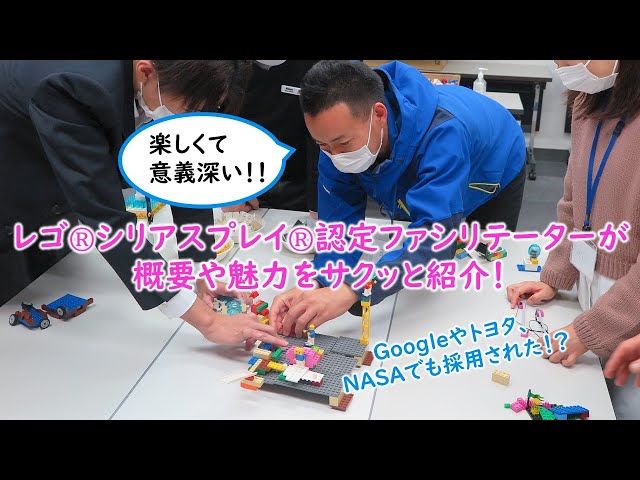
An educational program using Lego bricks called “LEGO Serious Play.” Build models with Lego bricks based on a given prompt, then present your creation.
After that, you’ll engage in dialogue by answering questions from participants.
Any prompt is acceptable, but abstract and open-ended ones are considered ideal—for example, “What challenges does our team face?” or “What is the ideal team?” Thoughts and visions that are hard to put into words can be conveyed through Lego models.
Through dialogue, you can also strengthen team cohesion.