


In live music venues, what do “kamite” (stage right) and “shimote” (stage left) mean?

Have you ever heard the terms kamite (stage right) and shimote (stage left)? You might have a vague idea but not know their precise meanings.
I used to feel the same way.
This time, I’d like to explain these somewhat tricky terms.
What are kamite (stage right) and shimote (stage left)?
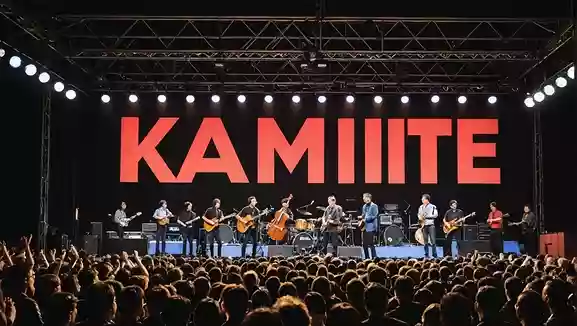
“Kamite” and “shimote” are terms that indicate the left and right sides of a stage; they’re specialized jargon used in live music venues and theater.
From the customer's perspective,Stage right is called 'kamite' in Japanese.、Stage left is called shimote (しもて) in Japanese.It is called … / This is what it’s called.
In live music venues, stage right is the position where guitarists are often found, while stage left is the position where bassists are often located.
Why do you say it like that?
During rehearsal sound checks, the PA staff will almost always use phrases like “Guitar, stage right, please,” or “Mic, stage left, please.”
If it’s the guitar on the stage right, you could say “the guitar on the right,” and if it’s the microphone on the stage left, you could say “the mic on the left,” couldn’t you? But there’s actually a reason behind this.
If you refer to skillfulness and unskillfulness as right and left,The direction changes depending on whether it’s left and right from the PA’s perspective or from the band members’ perspective.。
In other words, if we say right and left, they get mirrored depending on whether you’re looking from the band members’ perspective on stage or from the audience’s or sound engineer’s side, and it becomes confusing.
Thus, the expressions “kamite” (stage left, upper side) and “shimote” (stage right, lower side) came into being.
When conducting rehearsals, it seems things will proceed more smoothly if everyone has a solid understanding of stage right and stage left.
Origin of the etymology
In Japanese theater, the basic rule is to place high-ranking characters on the audience’s right and, conversely, low-ranking characters on the left.
That’s what’s called the upper and lower seats (kamiza and shimoza).
It's also a basic point of etiquette when dealing with someone senior to you.
I think this distinction between the upper and lower seats is probably the origin of the terms “stage right” (kamite) and “stage left” (shimote).
Lastly
Has the mystery about skillfulness and unskillfulness been resolved?
For those who aren’t very involved in the music industry, it might be an unfamiliar term.
I think this is something people who are about to start a band should remember, so please use it as a reference.