

The Appeal of 80s Techno Kayō: Classic and Popular Technopop Songs

As you delve into the Japanese music scene of the 1980s, many of you have probably come across the term “techno kayō” in disc guidebooks and the like.
From the late 1970s to the early 1980s, forward-thinking artists—centered around YMO—developed sounds that incorporated elements of techno, and when those elements were applied to mainstream pop, the result was “techno kayō.”
Some tracks became massive hits, while others went largely unnoticed at the time and were later reappraised—making it a genre that becomes more enjoyable the more you learn about it.
In this article, we’ve carefully selected and will present some of the finest techno kayō classics.
You might even discover, “Wait, was this song techno kayō?”
- From Japan! Technopop masterpieces and recommended popular tracks
- Classic and popular tracks in Japanese techno
- Masterpieces and hit songs of 80s Japanese pop (kayōkyoku)
- A special feature on classic and hit songs by bands that were active in the 1980s
- Dance music in Japanese (J-pop) that people in their 50s used to listen to. Nostalgic classic hits.
- Classic and hit Japanese pop songs from the nostalgic 80s
- Recommended Japanese techno bands. Popular and signature songs with technopop sound.
- Ranking of Popular House and Techno Songs
- A heartbreak song that was a hit in the 1980s. A classic and popular track in Japanese music.
- Revival among the youth? Japanese dance music that was a hit in the 1980s. Showa-era dance tracks.
- [Happy!!] A classic track of psychedelic trance. Recommended popular songs.
- Classic tracks of Detroit techno: famous and popular songs you should listen to first
- Popular Nostalgic Hits and Classics Ranking [1980s Japanese Music Ranking]
The Appeal of 80s Techno Kayō: Classic and Popular Technopop Songs (11–20)
Forbidden Rouge MagicImagawa Kiyoshiro + Sakamoto Ryuichi

While it’s a hugely popular song within the techno kayō (techno-infused pop) sphere, it also deserves to be called a historically epoch-making classic for how it broke through various taboos.
Born from the collaboration between the legendary figure who left his mark on Japanese rock history, Kiyoshiro Imawano, and Ryuichi Sakamoto—YMO’s “Professor”—‘Ikenai Rouge Magic’ was created as the theme song for Shiseido’s spring 1982 campaign.
Although Shiseido had proposed a tentative title, ‘Suteki na Rouge Magic’ (Lovely Rouge Magic), Imawano and Sakamoto unilaterally decided on the current title.
For Imawano, it effectively served as his debut solo single, and upon its 1982 release it topped the Oricon chart, becoming one of the defining hits of the 1980s.
As noted at the outset, it’s highly regarded as a techno kayō track—a killer tune that’s almost always included on techno kayō compilation albums.
And with its shocking music video featuring the two, in makeup, sharing a kiss, there’s no doubt that its free-spirited ethos had a profound influence on later J-pop.

Love is run-run.Itō Tsukasa

A classic track collected on the 2005 omnibus album “Yellow Magic Kayōkyoku,” which gathered technopop songs from the ’80s that the three members of YMO were involved in producing! It appears on Tsukasa Ito’s second album, “Sayonara Konnichiwa,” released in 1982—she was a popular ’80s idol who also thrived as an actress—and the composition and arrangement were handled by Ryuichi Sakamoto.
The title alone screams full-on idol, and while it’s an idol song that even includes Ito’s cute spoken lines, the track itself is almost pure YMO sound—an appeal unique to that era.
The album as a whole is highly regarded as a techno-kayō work: it features songs contributed by an all-star lineup of writers such as Taeko Onuki, Yuko Hara, and Akiko Yano, as well as Mariya Takeuchi, with production by figures including Sakamoto of course, plus Nobuyuki Shimizu and Kenji Omura.
Definitely worth checking out too!
Playful Paradisehyōkin direkutāzu
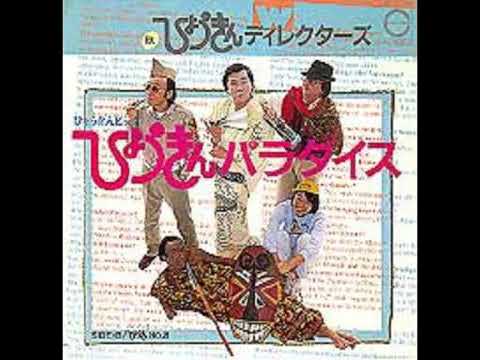
First broadcast in 1981, the comedy variety show “Oretachi Hyokin-zoku” became a beloved national sensation.
With big names like Takeshi Kitano (Beat Takeshi), Sanma Akashiya, and Shinsuke Shimada as regulars, it hardly needs saying that the show had a tremendous influence on later comedy programs.
The directors who worked on “Oretachi Hyokin-zoku” even formed a unit under the straightforward name “Hyokin Directors” and went so far as to release a song—this is the “Hyokin Paradise” introduced here.
Issued as a 7-inch single in 1982, it’s a curious gem that vividly conveys the atmosphere of the 1980s: cheap electronic sounds and blatantly amateurish vocals embodying a kind of spirited, good-natured fooling around that perfectly reflects Fuji TV’s motto at the time, “If it’s not fun, it’s not TV.” The track was later included on various compilation albums of techno kayō, and it’s highly regarded among aficionados.
The joy of digging up discoveries like this is part of what makes the techno kayō genre so fascinating.
Last Pretenderpinku redii

Pink Lady, who churned out one national, era-defining hit after another in Japanese pop history—Pepper Keibu, Nagisa no Sindbad, and UFO among them—has reunited periodically over the years, so even younger generations know their name.
They’re a powerhouse female duo still very much in the game.
What’s less widely known is that Pink Lady also has a hidden techno kayō gem.
Last Pretender, released in 1981 as their 21st single, was composed and arranged by Yukihiro Takahashi of YMO and occupies the notable position of being released after the decision had been made for Pink Lady’s first breakup.
The idea of Pink Lady singing an unmistakably YMO-esque technopop track is truly fascinating.
Pink Lady themselves had been pushing cutting-edge sounds within the kayōkyoku format, and considering the fact that YMO’s early classic Technopolis was born from analyzing Pink Lady’s sound, this track can be appreciated from a very different perspective.
I’m definitely a technician.Bīto Takeshi

People who don’t know might be surprised to hear, “Beat Takeshi released a song?” And the title is the outrageously intense ‘Ore wa Zettai Technician’ (“I’m Absolutely a Technician”)—a very Takeshi-like debut single from 1981.
To explain: it was the debut single of Two Beat, the manzai duo formed by Takeshi and Beat Kiyoshi.
Each of them sang a solo track, and the songs were released together as a 7-inch single.
As you can tell from Takkyu Ishino performing a cover of it in 2018, it’s a rare gem highly regarded as a classic of technopop/techno kayō.
The songwriting team was luxurious: lyrics by Etsuko Kisugi and composition by Kenji Endo.
Takeshi delivers the outrageous lyrics not so much by singing as in a rap-like spoken style, which is hilariously entertaining.
The sound itself is pure techno kayō, and it’s worth noting that the word “techno” pops up repeatedly in the lyrics.
MarinIijima Mari

Among anime fans, Mari Iijima is best known for playing Lynn Minmay in The Super Dimension Fortress Macross and for singing many of its insert songs.
But in fact, Iijima debuted as a remarkably talented singer-songwriter, and her early albums from the 1980s have been widely reappraised in later years, especially from a city pop perspective.
The song I’m introducing here, “Marin,” is a gem from her 1983 debut album Rosé, produced by none other than Ryuichi Sakamoto.
It’s astonishing that Iijima, just 20 at the time, wrote both the lyrics and music for every track—such precocious talent.
While the Professor’s production skillfully draws out her abilities, “Marin” is the album’s most techno-kayō-leaning track.
Its digital sound, making extensive use of the then state-of-the-art YAMAHA DX-7 synthesizer, remains dreamy and gentle, serving to build a whimsical, fairy-tale sonic world.
The song stands strong on its own, of course, but do give the entire album a listen!
The Charm of 80s Techno Kayō: Classic and Popular Technopop Songs (21–30)
SHADOWS ON THE GROUNDYellow Magic Orchestra

It’s a sophisticated number that skillfully incorporates elements of mature AOR and bossa nova.
Its distinctive “trompe-l’oeil” rhythmic structure makes it hard to tell where the downbeat is at first listen, revealing a highly advanced musical design.
Co-written by Ryuichi Sakamoto and Yukihiro Takahashi, it appears on the album “SERVICE,” released in December 1983.
The lyrics delicately depict warmth found amid the bleak scenery of November, along with the interplay of light and shadow.
As a masterpiece that captures the mature atmosphere just before YMO’s breakup, it’s perfect for listening alone on a quiet night, taking it in with full attention.