


From Japan! Technopop masterpieces and recommended popular tracks

Even if you have a vague image of the music genre “techno-pop,” only those quite knowledgeable about music likely know its actual origins and definition.
In fact, it’s a coined term that was created in Japan to introduce the legendary German electronic group Kraftwerk, and from the late 1970s to the early 1980s it also became a musical trend—centered around YMO—as a genre in its own right.
In this article, we’ve gathered classic tracks born during the heyday of techno-pop, which can be considered a Japan-originated movement.
The lineup also includes great contemporaneous tracks from overseas synth-pop and electro-pop, so please take a look!
From Japan! Technopop Masterpieces: Recommended Popular Songs (1–10)
TECHNOPOLISYellow Magic Orchestra

One of YMO—Yellow Magic Orchestra’s—signature songs, and a towering legacy not only of technopop but of Japanese music history as a whole.
Written and composed by Ryuichi Sakamoto, its approach—technopop with a kayōkyoku (Japanese pop) flavor—had a profound impact on later artists.
Of course, even without that historical context, with its sparkling synths, irresistibly catchy main motif, and the famously ubiquitous “TOKIO” voice sample, it’s an innovative, timeless track that naturally became a hit.
As member Yukihiro Takahashi put it, “The Professor wrote it with the concept of ‘What if Kyōhei Tsutsumi composed a song for YMO?’”—a line that seems to say it all.
If you want to dive into technopop, start with this track!

It’s the person we met at the museum, right?P-MODEL
No ordinary person would ever come up with a title like this.
Formed in 1979, P-MODEL was one of the so-called “Techno Big Three,” and today, in the 2020s, continues as Susumu Hirasawa’s solo project “Kaku P-MODEL,” with Hirasawa himself handling vocals and guitar.
Their influence extends beyond music into wider culture—for example, the main characters’ surnames in the popular series K-On! and the band parts they play are said to draw from P-MODEL members.
P-MODEL’s major-label debut single, “Bijutsukan de Atta Hito da ro” (“You’re the One I Met at the Museum”), as mentioned at the outset, fuses Hirasawa’s enigmatic, brilliant lyrics; the bleepy, techno-pop-style electronics; a danceable rhythm; and a seemingly nonchalant yet almost runaway power rivaling that of a punk band.
The result is a masterpiece that stands as a world-class example of Japanese new wave.
It’s a classic in the context of techno-pop, yet at the same time can also be described as an incisive track emblematic of contemporaneous post-punk and new wave.
The RobotsKraftwerk
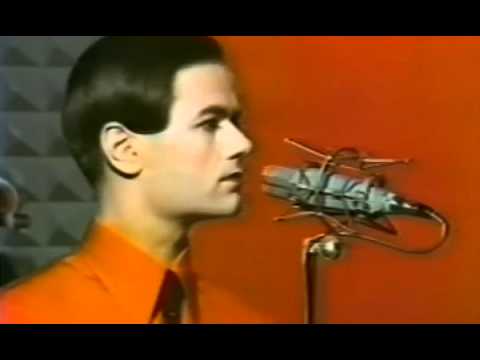
If the article’s theme is “techno-pop,” we absolutely have to mention Kraftwerk’s classic masterpiece The Robots, the source of the term itself.
It’s said that in Japan the neologism “techno-pop” began to be used in reference to their 1978 masterwork album The Man-Machine, which includes this track.
The greatness of this song can’t be summed up in a few sentences, but its qualities—the distinctly German, somewhat earnest, hard-edged beat associated with so-called Krautrock; the slightly cheap-sounding electronic tones; and the melody sung through a vocoder—each feel of their time yet add up to an incredibly poppy, catchy number.
Already towering innovators in electronic music in the ’70s, Kraftwerk keenly registered the surge of the then-emerging new wave and neatly distilled it into their own sound—nothing short of remarkable.
Their influence on YMO is a given, and if we call them the forebears of Perfume, does that convey just how extraordinary they are?
HallogalloNeu!

Alongside Kraftwerk, another indispensable name when discussing the history of technopop is the German band Neu!.
Among the experimental German artists known as krautrock, they boldly employed electronic sounds and exerted a profound influence on later electropop and new wave musicians, as well as bands from the alternative generation.
One of their signature tracks featured here, “Hallogallo,” appears on their self-titled debut album released in 1972.
Despite being highly experimental—with a rhythm guitar calmly ticking along with a wah effect, another guitar spinning psychedelic phrases, the distinctive “motorik” beat characterized by an eight-on-the-floor kick drum, and a ten-minute structure with no conventional rise-and-fall—it’s hypnotically pleasant, with a mysterious quality that feels like it could carry you off to somewhere other than here.
The mere fact that a piece like this existed years before technopop was born is astonishing in itself.
PikeHikashū

At the start of their career, Hikashu were dubbed one of the “Techno Big Three” alongside P-MODEL and Plastics, and they earned high acclaim for avant-garde activities that went far beyond that label.
Centered around the multi-talented artist Koichi Makigami, Hikashu formed in 1977, and one of their signature songs, Pike—also released as a single in 1980—is a masterpiece with an unforgettable impact: a synth-driven main riff that lodges in your ears at first listen, a beat from a cheap rhythm box, and Makigami’s vocals boldly delivering inscrutable lyrics.
It’s quintessentially new wave, and its twisted, quirky pop sensibility still feels fresh even in the 2020s.
There’s also the curious fact that it served as the image song for the Japanese release of the 1980 horror film The Changeling.
If you want to explore the innovation and unique creativity of Japanese music of that era, be sure to check it out!
Sports MenHosono Haruomi

Haruomi Hosono is a great artist who has made an enormous contribution to the development of Japanese popular music and continues to command immense respect.
It’s impossible to fully discuss the impact Hosono has had on the world here, but since this article focuses on technopop, the song we’re featuring this time is Sports Men from his solo album Philharmony, released in 1982 when YMO was at the height of its popularity.
It’s a catchy number with a breezy beat, sparkling electronic sounds, a gentle vocal and melody—Hosono’s pop sensibilities bursting at the seams—yet with a hint of wistfulness that feels just right.
Many will also remember how, in recent years, he performed it live with a completely reworked arrangement.
One could say it’s precisely because of Hosono’s outstanding songwriting that the piece became a magnificent classic capable of shining in any arrangement.
PopmuzikM

When it comes to iconic hits from the late 1970s synth-pop/technopop era, it has to be “Pop Muzik,” the classic by M, the project led by UK musician Robin Scott.
Released in 1979, it soared to No.
2 on the charts in the UK and even reached No.
1 on the U.S.
Billboard chart.
Although he’s often remembered as a one-hit wonder due to the lack of subsequent hits, there’s no doubt this track is indispensable when discussing technopop of the time.
With its blurred, chant-like title hook, disco-style beat, and deliberately cheap electronic sounds, it exudes a peculiar charm—truly a killer tune that could be called a symbolic “technopop” track overseas.
By the way, the Japanese title wasn’t “Pop Music” but “Pop Myūjikku,” which somehow feels just right.