

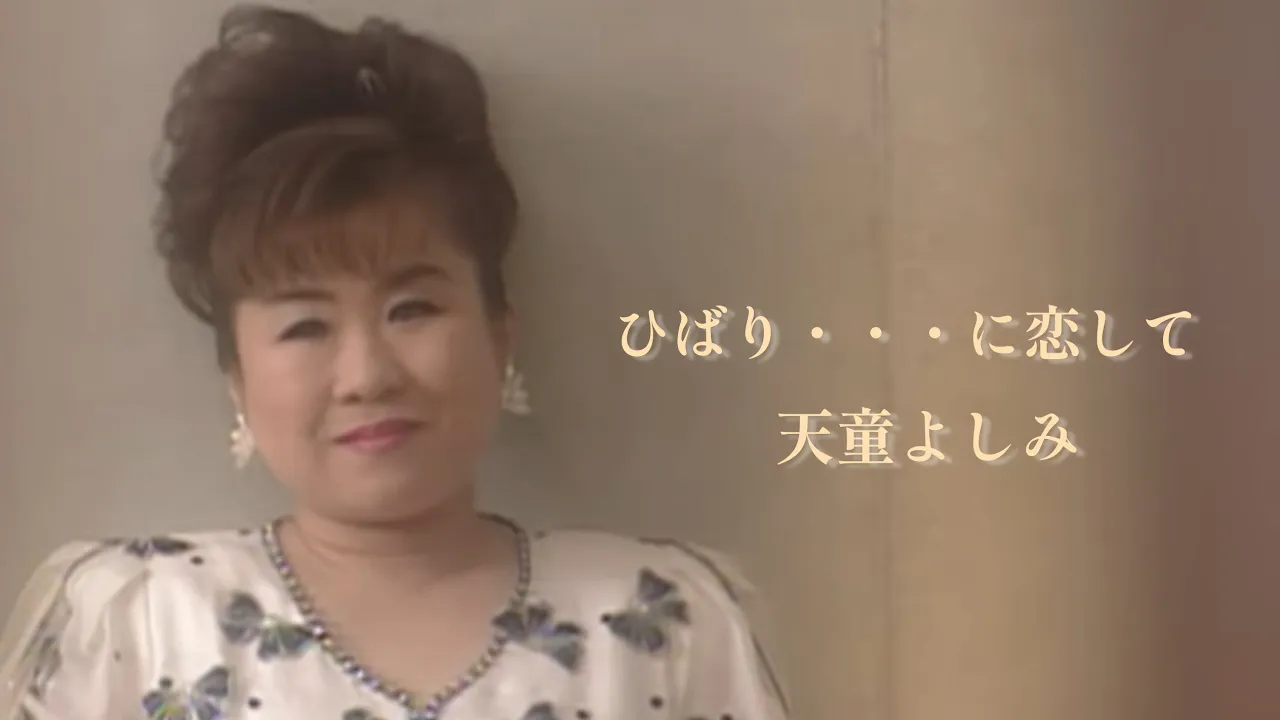

Yoshimi Tendo, the great enka singer born in Osaka.
Despite her very small stature, she’s known for her powerful voice and exceptional vocal ability, and she has produced many classic songs over the years.
However, because she’s such a skilled enka singer, most of her hit songs are inevitably quite difficult…
You want to sing her songs, but they’re beyond your current ability.
I imagine many people feel that way.
So this time, we’ve picked out some of Yoshimi Tendo’s songs that are especially easy to sing!
- Queen of Enka: A roundup of Aki Yashiro’s easy-to-sing songs
- [Queen of Enka] A Collection of Easy-to-Sing Songs by Sayuri Ishikawa [2026]
- Queen of Local Songs: Kaori Mizumori's Easy-to-Sing Tracks
- [Heisei-born, Showa-raised] Oe Yutaka’s easy-to-sing songs
- [Enka] Songs that are easy to sing even for those who are tone-deaf [Female singers edition]
- [For Beginners] Recommended Enka Classics for Karaoke — Women Singers Edition
- [The Pinnacle of Modern Enka] Shimazu Aya’s Easy-to-Sing Songs
- [People・Songs・Heart] A Collection of Miyuki Kawanaka’s Easy-to-Sing Songs [2026]
- [Asian Songstress] A Collection of Teresa Teng’s Easy-to-Sing Songs
- [Wakayama’s Treasure] Fuyumi Sakamoto’s Easy-to-Sing Songs
- The Most Idol-Like Star in the Enka World: Easy-to-Sing Songs by Kiyoshi Hikawa
- [Treasure of Powerful Enka] Takashi Hosokawa’s Easy-to-Sing Songs
- [2026] Easy Enka Songs for Karaoke: Recommended Picks — Women Singers Edition
[Songstress Born in Osaka] Yoshimi Tendo’s Easy-to-Sing Songs (1–10)
In Love with the Skylark…Tendō Yoshimi

Released as the B-side to the classic “Jindo Monogatari,” “Hibari… ni Koishite” is often cited as one of Yoshimi Tendo’s hidden gems.
Since this song sits between enka and kayōkyoku, it doesn’t feature the ornate kobushi ornamentations that require complex pitch bends.
The tempo is moderate, so you won’t have to worry about running out of breath or struggling to keep up with pitch changes.
The chorus may feel a bit high, but because the vocal line is fairly simple, you should be able to sing it without trouble as long as you choose an appropriate key.

Osaka RainTendō Yoshimi

Speaking of Yoshimi Tendo, works set in her hometown of Osaka are popular, aren’t they? Among them, the song I especially recommend as easy to sing is “Osaka Rain.” This piece features an impressive Latin-influenced sound and is classified as kayōkyoku (Japanese pop).
As such, it doesn’t include the complex vibrato and ornamentation typical of enka.
While the vocal range isn’t particularly narrow, it’s not especially wide either, so you should be able to sing it comfortably if you choose the right key.
Consider adding it to your repertoire.
Osaka… dreams, hope, and loveTendō Yoshimi

Speaking of Yoshimi Tendo, in addition to her emotionally rich songs, her works themed around her hometown of Osaka are also popular.
Among them, the one I especially recommend for its ease of singing is “Osaka…
Dreams, Hopes, and Love.” This piece is pure pop, with a gentle yet bright vocal line that doesn’t have many dramatic shifts.
Its vocal range is quite narrow for a Yoshimi Tendo song, so anyone with basic singing skills should be able to perform it without difficulty.
Showa spiritTendō Yoshimi

Speaking of Yoshimi Tendo, she’s not only renowned for her overwhelming vocal power but also for the emotional richness of her singing.
Among her works, “Showa Gokoro” stands out as especially full of emotion and, moreover, easy to sing.
While many people may find it powerful, its range is surprisingly narrow, so even those with a lower or limited vocal range can sing it comfortably.
The kobushi (ornamental vocal turns) are also relatively easy, making it a great addition to the repertoire of enka beginners.
A single plum blossomTendō Yoshimi

Among Yoshimi Tendo’s songs, the standout classic Ume Ichirin is especially memorable for its strikingly stylish melody.
While the piece is rooted in kayōkyoku (Japanese popular song), the track also incorporates plenty of pop elements.
There are moments with an enka flavor as well, but there’s no vibrato-heavy kobushi, and the vocal line as a whole is crafted to be easy to sing.
That said, because it lacks the typical enka-style difficulty, it does present pop-specific challenges—most notably the falsetto in the chorus—so be mindful of those aspects when you sing it.
Mantenboshi ~Dōdan~Tendō Yoshimi

The song “Mantenboshi ~Doudan~” is characterized by its gently soothing melody.
While the piece conveys a strong enka feel throughout, its vocal line is structured more like a kayōkyoku (Japanese pop) style.
As a result, it doesn’t feature kobushi—the intricate pitch bends that are a hallmark of enka.
It preserves the essence of enka while incorporating simpler, pop-like vocal lines, making it an exceptionally approachable song for beginners to enka.
Consider adding it to your repertoire.
Jindo MonogatariTendō Yoshimi

Jindo Monogatari is a famous song by Yoshimi Tendo, based on a folk tale from Jindo.
If you know Yoshimi Tendo, you’ve probably heard it at least once.
Since the piece sits between enka and kayōkyoku, it features little of the advanced enka technique known as kobushi (melismatic turns).
There’s a slightly high phrase near the end of the chorus, so if you can hit those notes accurately, you can aim for a high karaoke score.
Consider adding it to your repertoire.