

Summary of ethnic musical instruments originating in Africa

How much do you know about African musical instruments?
Starting with popular folk instruments like the asalat (asalato) and the kalimba, even the djembe—well-loved as a hand-played percussion instrument—originated in Africa.
But Africa is home to many, many more traditional instruments.
In this article, we’ll introduce a wide range of African folk instruments all at once—from relatively well-known ones like the ones mentioned above to those rarely seen in Japan.
If you enjoy music with an exotic vibe, or if you’d like to try playing folk instruments yourself, be sure to take a look.
- List of Okinawan instruments: Folk instruments of Ryukyuan music
- [World Music] A Guide to Folk Music: A Collection of Traditional Songs from Around the Globe
- [Rock] Easy Band-Style Vocaloid Songs for Beginners [Simple]
- Masterpieces of ambient music. Recommended popular tracks.
- What Is This? A Collection of Rare and Unique Musical Instruments from Around the World
- Popular Afrobeats Songs | Featuring the Latest Tracks
- [Basics of Wotagei] What is “Kechya”?
- Classic and popular recommendations in ethnic music
- Summary of French music genres
- [2026] Brazil’s National Music! A Collection of Iconic and Popular Samba Songs
- Masterpieces of contemporary (art) music. Recommended popular pieces.
- [2026] A Roundup of Recommended Western Songs for Jam Sessions
- Music of Passion: A Roundup of Artists Representing Latin Music
Summary of ethnographic musical instruments originating in Africa (1–10)
caxixi

The caxixi is a percussion instrument played in Africa by holding it in the hand and shaking it, similar to maracas.
Its bell-shaped, basket-like body contains large beads or seeds, which strike against a hard bottom to produce sound.
The bottom is made of gourd.
Thanks to this hard base, changing the instrument’s orientation while shaking allows you to vary the timbre—not just “shaka-shaka,” but also sharp clicks like “ka.” This feature is unusual among shaker-type instruments.
It can also be played with one in each hand.

Hey!

The kora is a lute-type stringed instrument that originated in West Africa and has been handed down for over 300 years as a traditional instrument in countries such as Mali, Senegal, and Gambia.
It is sometimes said to be a precursor to the harp and the guitar.
It has a long neck and a body made from a calabash gourd about 40–50 cm in diameter that has been cut in half, with 21 strings attached.
The cut surface of the gourd is covered with animal skin fastened with tacks, and the strings are typically made of nylon, such as fishing line.
The kora is played by hereditary professional musicians in West Africa known as griots; in the past, ordinary people were not even allowed to touch it, and even today it is said that most non-griot West Africans seldom handle griot instruments.
Adung
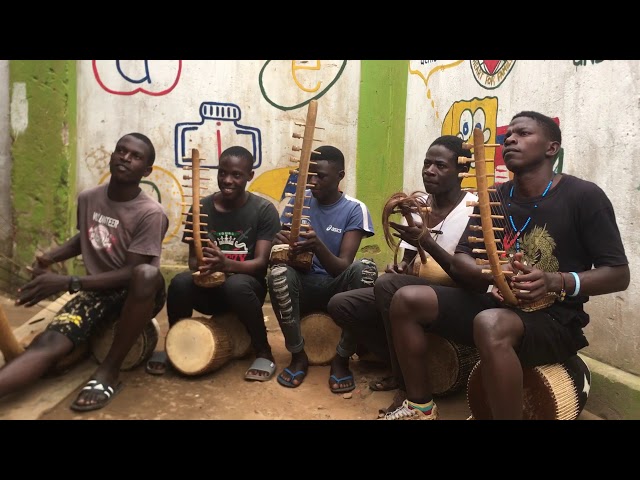
The adungu is a string instrument of the Alur people in northwestern Uganda.
It is typically bow-shaped and comes in sizes that usually have between 7 and over 10 strings.
There are various sizes, and as with common string instruments, the larger the instrument, the lower the pitch.
Large versions that play bass notes are performed while sitting on the instrument, while smaller ones are played suspended by a strap or placed on the lap.
Notable performers include Ugandan musician James Makubuya and American artist Crystal Bright.
Summary of traditional musical instruments originating in Africa (11–20)
Bread logo

The panlogo is a traditional ethnic percussion instrument of the Ga people in Ghana, West Africa.
Said to be a precursor to the conga, it is played standing with the drum placed on the ground, much like the conga.
Its wooden shell is hollowed out, and antelope hide is fastened with cords and pegs.
Goat or sheep skin is used for the drumhead, and tuning is done by hammering the pegs.
It is characterized by a deep, rich tone and can produce a wide variety of rhythms and timbres depending on the playing technique.
Each instrument is carved with Adinkra symbols.
balafon

The balafon is a xylophone used by the Gwan people of West Africa at occasions such as weddings, funerals, and other ceremonies.
It features wooden bars fixed onto a wooden frame, with gourds underneath that act as resonators.
In traditional balafons, the insides are covered with a thin membrane made from spider webs or bat wings.
This is intended to vibrate and produce a distinctive buzzing sound through the mirliton effect.
The instrument is considered a root of Western instruments like the xylophone and marimba.
It is also an instrument traditionally performed only by hereditary professional musicians known as griots.
Shekere

The shekere is a traditional percussion instrument of the Yoruba people of West Africa.
It is used in many African countries, including the Republic of Mali, Ghana, and Kenya.
The instrument consists of a large hollow gourd encased in a woven net threaded with seeds, beans, beads, or shells.
It can be played in multiple ways: striking the bottom to produce low tones, or shaking it as a shaker.
By playing the bottom and the top simultaneously, performers can produce both the deep bass from the bottom and the shaker’s timbre at the same time.
Udo

The udu is a percussion instrument used in West Asia, including countries like Nigeria and Iran.
It is played by striking the surface of the pot and its openings.
Its distinctive form resembles a pot about 50 centimeters tall with a hole on the side.
Made from clay and fired, it is played by tapping, producing a low bass tone when the large hole is struck quickly.
There is also a technique that changes the pitch depending on the position of the hand over the top opening.
Thanks to its unique “pow-pow” timbre, it is also used in contemporary ambient music.