

Fun two-player games recommended that you can play using conversation only


All you need are your voices! Here are two-player games you can play using conversation alone.
We’ve gathered games you can enjoy with a friend, a partner, or a parent and child—any time there are two of you.
No props required, so they’re perfect for spare moments or even during a call! From classics like word-chain games to language-based challenges that make you think a little, there’s plenty to choose from.
If the two of you take your time and enjoy these conversation-only games, you’re sure to grow closer! Pick your favorites and give them a try!
- Games you can play with just conversation. Classic and popular activities you can enjoy without any props!
- Recommended games for two people that you can enjoy without any equipment
- Perfect for killing time! Games you can play with two people.
- Games you can play over the phone: fun activities to liven up calls with friends or a partner
- [For 2 Players] Easy Pen-and-Paper Time-Killing Game
- [Lovey-Dovey] Couple’s Challenge! Question Game Roundup
- Brain-teasing game roundup
- Questions to deepen your bond as a couple! Conversation topics that will get lovers talking
- Challenge together! A roundup of word games for adults
- [Talk] Interesting! Hilarious! A Collection of Silly Questions
- A collection of questions that will liven up conversations with friends. Talk themes to deepen your bond.
- With friends or couples! A set of questions perfect for penalty games
- [Ultimate Either-Or] A great conversation starter and a chance to get to know each other!
Shiritori, Wordplay, and Language (1–10)
Tongue Twister Game

Tongue twisters—everyone’s tried them at least once, right? They’re simple, but surprisingly exciting! Kids and adults alike can enjoy them anytime, anywhere, with anyone.
Plus, speaking them gives your tongue a workout and makes for great vocal practice—there are even health benefits.
Because they’re quick and easy to get into, they’re perfect for a fun boost during calls or while on the go.
Why not deepen your connection with someone while sharing smiles through tongue twisters? You’re sure to have a great time!
Restricted Shiritori

This is a game where you add rules to the classic wordplay game shiritori to increase the thinking element.
Start with simple additional rules like limits on the number of characters or time restrictions, and gradually raise the difficulty.
Once you’ve gotten used to it, combining multiple rules—like “three-letter animals”—could make it even more exciting.
You’re free to add rules at any timing, so it might be interesting to have the rules change as the game progresses.

Myanmar Game

Let’s play a hilarious game that’ll have everyone cracking up—the Myanmar Game.
Try saying “Myanmar.” It’s pretty hard to pronounce, right? In this game, two people take turns saying that tricky word back and forth.
Each time you switch turns, the number of times you have to say the word increases by one.
As you keep repeating “Myanmar, Myanmar,” your tongue starts getting all twisted, which makes it funny for both the speaker and the listeners, leading to fits of laughter.
It’s a high-energy game that’s impressive if you can say it smoothly.
Give the Myanmar Game a try when you have a little free time!

Shiritori, Wordplay, and Language-related (11–20)
Yamanote Line game

The Yamanote Line game is where you answer things that fit a given theme to a rhythm.
It’s a party-game staple, but if you play it with just two people, you can enjoy a different kind of fun than usual.
With a small group your turn comes around quickly, so it turns into a game that demands focus on the theme and quick reflexes.
It’s exciting enough to simply decide a winner and loser, but it also sounds fun to set a wide range of themes and see how long you can keep the rally going.
[Translation feature] A game you win when the sentence makes sense
![[Translation feature] A game you win when the sentence makes sense](https://i.ytimg.com/vi/4DWx4weVVBo/sddefault.jpg)
This is a fun game that uses Google Translate.
Use a voice translation service and speak in a way that sounds like Chinese.
If it turns into a comprehensible sentence, you win.
If it becomes a weird sentence or can’t be translated, you lose.
Because the translation feature is quite accurate, it will surprisingly translate even if you don’t know Chinese and just speak something that sounds like it.
Don’t overthink it—aiming for that borderline of “probably untranslatable” might make it even more exciting.
Give it a try!

No-Katakana Game
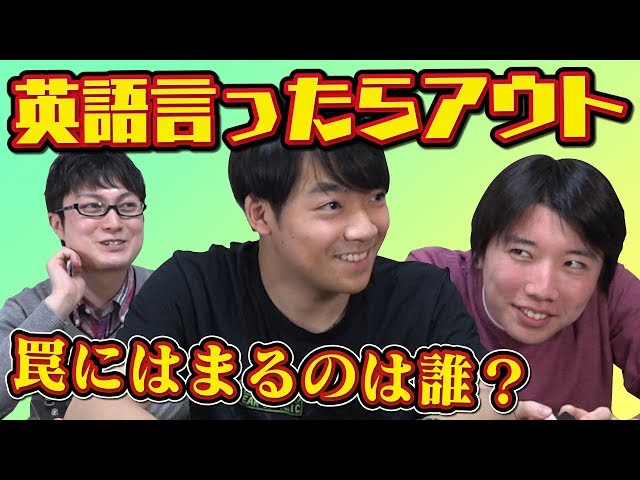
The “no katakana” game is a fun activity that makes you realize how often you casually use katakana words.
For example, you might replace “smartphone” with “mobile phone,” or “television” with “electric image device,” making you think carefully about word choices.
Since you’re engaging your brain while conversing, it helps you improve your communication skills while having fun.
Coming up with words together also deepens your connection with the other person.
It’s easy to enjoy in short breaks or even during phone calls, so why not try adding it to conversations with friends, partners, or family? You’re sure to discover new words and the joy of conversation.
Ogiri (Japanese improv-style comedy wordplay game)

Do you know “oogiri”? It’s a classic conversation game you can enjoy with someone else.
You think up funny answers to a prompt—kind of like improvising comedy bits together.
Unlike word-association games where you trade hints to guess an answer, the appeal here is that you can freely expand on the prompt with your own ideas.
It’s sure to liven things up with friends, partners, or even parents and kids! If you play with a touch of humor, you’ll feel much closer to each other.
You can enjoy it in little breaks or even during phone calls, so give it a try.
It’s a great brain workout and lets you get a feel for the other person’s sense of humor—two birds with one stone!