

Ideas for indoor play, physical activities, and games suited to the development of 2-year-olds

Around the age of two, children’s vocabularies grow and they begin to assert their feelings more strongly.
As their walking stabilizes, they’re also able to perform a variety of whole-body movements.
Here, we’ll introduce recommended indoor activities that suit the physical and mental development of two-year-olds.
From active, full-body movement games to group games that involve playing with friends, and activities that let children freely express themselves—there are plenty of options that give kids a sense of accomplishment and satisfaction from “I did it by myself!”
Use these ideas as a reference and enjoy a fun time together indoors.
Ideas for indoor play, physical activities, and games suited to the development of 2-year-olds (1–10)
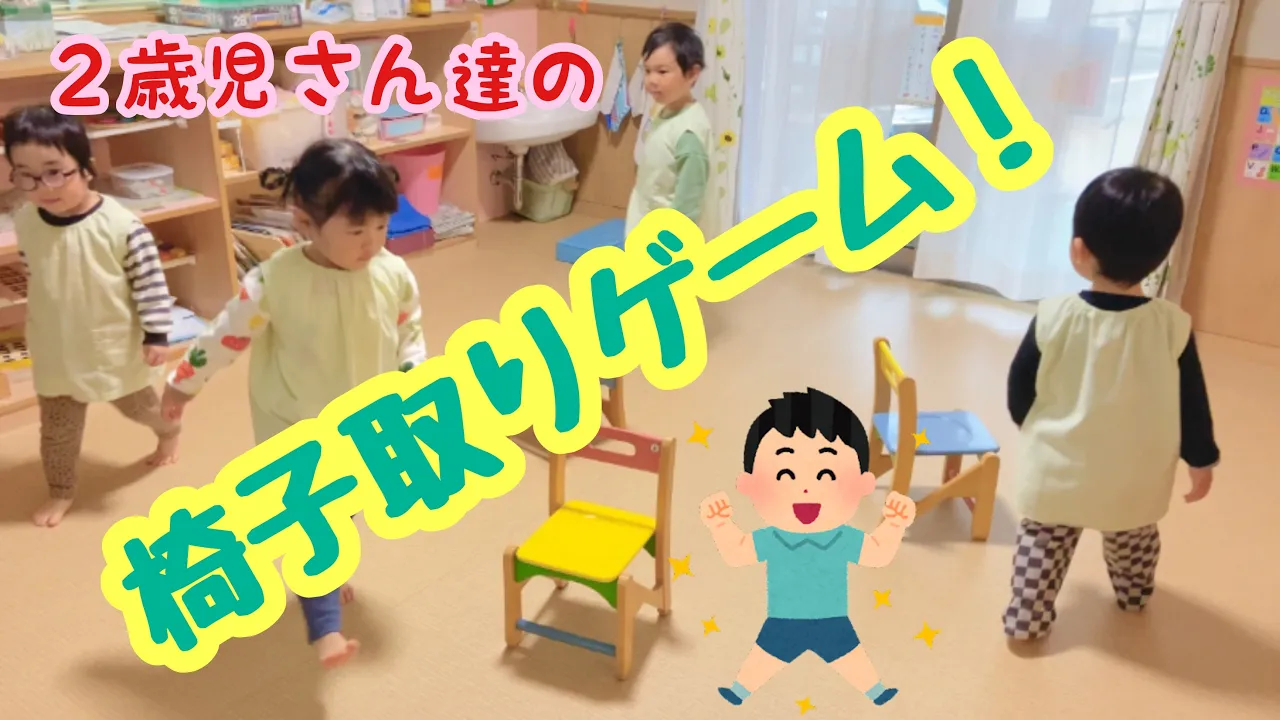
Musical Chairs

Let me introduce a musical game of musical chairs.
There are many variations of the rules, but for this version we’ll focus on two points suited to the age group: “walk while listening to the music” and “sit on a chair when the music stops.” Musical chairs is often thought of as a competitive game, but when playing with two-year-olds, it’s recommended to enjoy it as a movement game in time with the music.
Play songs the children love and get them excited!

Balloon play

A play activity using balloons, which are often used to decorate indoor parties and events.
Children can enjoy the feel of lightly floating balloons by touching or tossing them, while also encouraging their free imagination.
It’s a good idea to make some preparations to prevent balloons from popping, such as placing them in pre-inflated bags.
There are many ways to play, like touching suspended balloons or playing peekaboo.
Why not incorporate these items, which can brighten up a rainy day indoors, into your childcare setting?

Train play

“Train play” recommended from around age two, when kids start walking! There aren’t any strict rules, so let them play freely.
If you make something to serve as the train cars—like a hula hoop or a square loop made from cardboard—the kids will get excited.
If you pretend mats or balance beams are the tracks, a simple game suddenly becomes much more fun!

circuit

Here’s an idea for a circuit where kids can enjoy various activities all at once.
It’s similar to an obstacle course: children move through the course while completing different challenges.
Recommended activities include crawling through a tunnel made from mats, tossing balls into a basket, stepping over and avoiding blocks, and jumping forward like in hopscotch.
It’s great if they can move their bodies to the fullest and have fun.
Let’s start by coming up with events that they’re likely to enjoy.
Color ball play

Here’s a set of colorful balls that kids can play with safely and happily.
Because the balls are soft, they’re highly safe, and their variety of colors makes them especially appealing to children.
Kids can freely enjoy grabbing and throwing the balls, and it’s great that they can come up with their own ways to play.
Also, if the teacher throws a ball far away and the children imitate that by throwing theirs far too, playing while copying the teacher’s movements can make everyone feel excited and have fun together!

Building a cardboard house

Let’s build a cardboard house together with your two-year-old, a time when “I want to try it!” moments are on the rise.
If you shape the cardboard into a house beforehand, then all you need to do is set out paints, brushes, and cardboard stamps, and let them paint however they like.
To spark their imagination, it’s helpful to have photos of colorful houses on hand.
What kind of house will be finished depends on the children’s ideas! To let them work freely and without worry, it’s best to do this outdoors where getting messy is okay.
Once the paint dries and the house is complete, they can of course play with it.
Have fun making a cardboard house together!

Tail tag

The tail-tag game looks so much fun! Just watching the kids move around is enough to make you excited too.
It’s great that you can prepare it easily with headbands or cloth.
You can get plenty of exercise indoors, so it’s perfect even on rainy days.
It’s also wonderful to see the children learn the rules while cooperating with each other.
They’ll naturally build concentration and decision-making skills as well.
It’s amazing that everyone can have fun together while developing a variety of abilities! It also seems like a great chance for parents to join in and strengthen their bond with their children.