

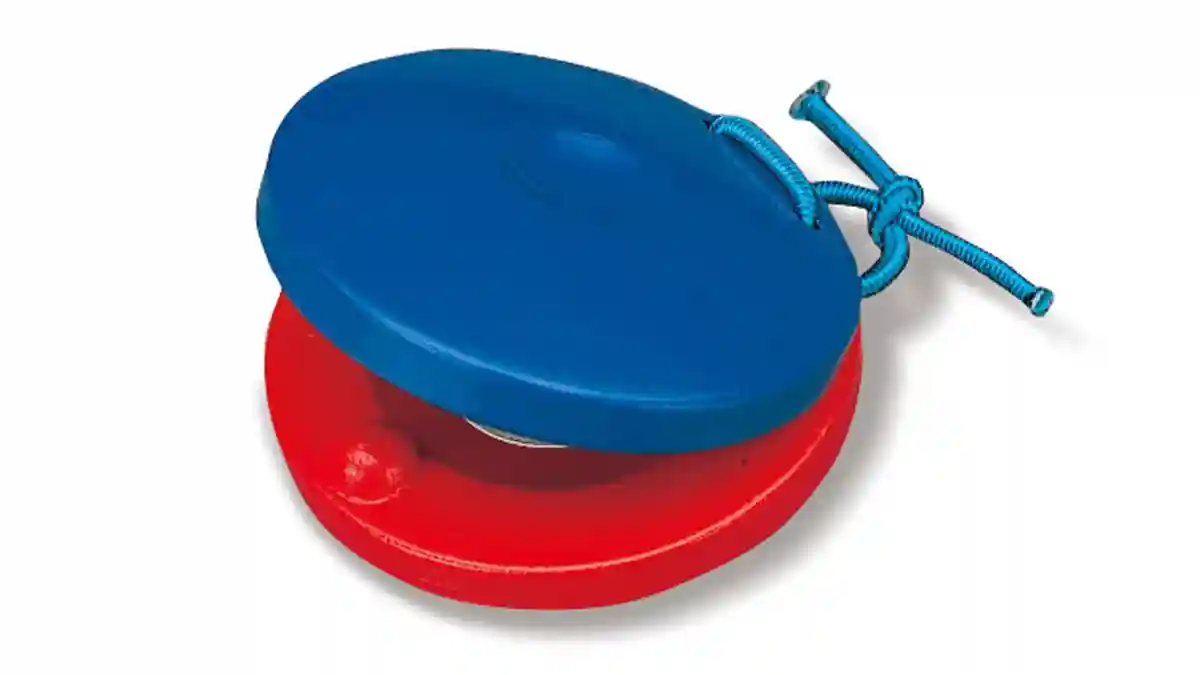
Actually, it’s packed with the basics of playing instruments. Let’s play with educational castanets!

The instruments classified as percussion include virtually anything that can be “struck,” so their number is quite large.
Even just the instruments handled in a conservatory percussion major are considerable, but among them, the one I’ve been paying attention to recently is the “educational castanet.”
Using castanet performance as an example, I’d like to discuss how one can master percussion playing efficiently.
I didn’t know castanets were such an interesting instrument!

When I was in college in the percussion department, I had hardly ever played the castanets, and to begin with, they were an instrument I barely paid attention to.
However, just recently I happened to watch a video of castanet performance, and it completely changed my perception—“I had no idea it was such an interesting instrument!”
Educational castanets performer: Michals☆Aki (Akiko Yamamoto) — castanet performance video
I can’t believe you can do something this fun with castanets like the ones you find in kindergartens and elementary schools!
I promptly bought some castanets and practiced while watching the video over and over.
The first hurdle was a performance that involved rapidly repeating notes by using three (sometimes four) fingers of the right hand in sequence.
If you just touch the castanets with your fingers in order, the rhythm can become awkward, and sometimes no sound will come out at all.
Furthermore, because castanets are made of wood, it hurts when your fingers hit them repeatedly.
As I kept practicing, my fingertips started to hurt, and I found myself already slipping into giving-up mode, thinking, “Ugh, why isn’t this going well?”
At that moment, I suddenly wondered, “What would happen if I focused on the center of my fingerprints?” So I immediately tried to sense the center of the fingerprints on each finger that was striking the castanets.
Then...
How astonishing!
While a firm, natural pressure settled into the center of my fingerprint, the rest of the fingertip lost any excess tension, becoming soft and buoyant, creating a sensation of sticking to the instrument like a suction cup!
If that happens, you’ll be able to button-mash freely!
Educational castanets performance / Rila Takagi
Being able to play this well after about a week of practice is the result of focusing on the center of my fingerprints and relaxing the tension in my fingertips.
It can be applied to other instruments as well.
This relaxed, tension-free state is an extremely important factor in all forms of physical movement, including playing musical instruments.It is.
For example, if your posture is extremely poor, your body ends up constantly using unnecessary effort to support itself, causing various muscles to stiffen and making it difficult to move freely.
If that happens, it will interfere with physical movement, and you'll get worse at playing instruments.
Similarly, if you put extra tension into your fingertips and they become stiff and rigid, it becomes difficult to make subtle expressions on instruments like castanets.
Conversely, the more you can relax and let go of force, the more delicate and profound your expression can become.
Furthermore, this method of focusing on the center of the fingertip and relaxing the rest can also be applied to keyboard instruments such as the piano (and likely to other instruments as well, such as string instruments).
When I tried playing the piano, my fingertips glided over the keys as if they were drawn to them, and delicate expressions like pianissimo became much easier to perform.
I realized that top-class pianists have soft, fluffy fingertips and aren’t using any unnecessary force.
Otherwise, you couldn’t keep practicing the piano for hours every day, could you?
Piano majors are said to practice the piano for about 6 to 8 hours a day.
The difficulty of letting go
Now, we casually say “relax” or “loosen up,” but in fact, this act of “letting go of tension” is extremely difficult.
If you just think you’re relaxing your fingertips and let them go limp and floppy, you won’t be able to play castanets rhythmically.
While maintaining firm resilience in your fingertips, it’s necessary to release only the force that isn’t needed for playing.
However, even if you actively try to 'relax' or 'let go,' you will almost certainly fail to do so.
The state of “relaxing” (literally, “releasing strength”) means turning off the force that’s being applied; you can’t relax while it’s still ‘on.’
So what should we do?
Turning off your extra tension takes a bit of a trick.
First, focus your attention on the fingertips striking the castanets, and deliberately squeeze them tight with force.
But then, the stiffer I make it, the more awkward the performance becomes.
And here’s the important part: you stop applying the force you’ve been squeezing in by yourself—you switch it off.
Please think of putting in effort as “stepping on a car’s accelerator.”
And instead of stopping by "stepping on the brakes," you only "let off the accelerator."
Pressing the brake is an active, forced way to stop, whereas releasing the accelerator turns off the “press the accelerator” command, and as a result, the movement gradually comes to a stop.
In other words, it’s not an active act.
It’s fundamentally impossible to apply new force in a way that’s like stepping on the brakes while simultaneously releasing the force that was previously being applied.
The force being applied can only be released by turning off the command to “apply force.”
When you tightly clench your fingertips, carefully observe how you are applying force, and then switch off the command to 'apply force' as if turning off a switch.
Then you'll notice the once awkward castanet sound becoming light, smooth, and delicate.
The extra tension that had been there up to then was released, and as a result, one becomes proficient at playing the castanets.
It's an easy and simple method, so please give it a try!
However, practicing “relaxing” doesn’t come easily after just one or two tries, so it’s important to persist patiently and keep at it.
By the way, the center of your fingerprint is often quite different from where you think it is, so be sure to check it carefully with your eyes and even touch it with the tip of a toothpick or chopstick to accurately determine its position.
I also recommend using a marker to draw a small black dot in the center of the fingerprint.
You can buy educational castanets for under 300 yen, so if you're interested, pick one up and give it a try!
Note: Techniques such as “being aware of the center of the fingerprint” and “turning off the applied force” are adaptations of a method called Healing Arts. For more details, please see the website below.