

[Beginner] Start Here: Classic Practice Pieces Recommended for Adult Piano Beginners


For beginner pianists, choosing practice pieces can be a real source of anxiety.
This is especially true if you’re starting to learn on your own as an adult—you may often wonder what pieces to choose to keep practice enjoyable and progressing smoothly.
When learning piano independently, there are two main approaches: focusing intensively on a limited selection of pieces, or practicing a balanced set of pieces that include a variety of technical elements while learning the basics of piano technique and music reading from the ground up.
In this article, we’ll introduce recommended practice pieces for those who prefer the latter approach and also want to build a solid foundation.
We’ve selected a wide range of pieces, from classical to popular, so feel free to start with whichever ones spark your interest.
- Recommended for piano beginners! 10 sheet music picks that adults can enjoy too
- [Piano Etudes] Recommended for Beginners! A Curated Selection of Easy, Playable Pieces
- [Beginner] Recommended for adult piano beginners! Beautiful & stylish piano pieces
- [Piano Beginners] J-POP That Looks Hard but Is Surprisingly Playable [2026]
- Beginner to Intermediate: Chopin pieces with relatively low difficulty. Recommended works by Chopin.
- [For Piano Beginners] How to Practice “Für Elise”
- [Free Piano Sheet Music] Beginner-Friendly! Carefully Selected Pieces Available for Immediate Download
- [For Piano Beginners] Play Right Now with Free Sheet Music! A Roundup of Recommended Practice Pieces
- Even beginners can play them easily on the piano! A curated selection of popular and latest J-POP songs.
- It’s so cool if you can play these on the piano! A selection of irresistibly charming masterpieces.
- [For Piano Recitals] Simple yet Cool Classical Pieces
- A must-see for piano beginners! Recommended training videos that are great for basic practice
- [Piano Pieces] Easy for Children to Play! A Roundup of Simple Classical Works
[Beginner] Start with these practice pieces! Classic exercises recommended for adult piano beginners (21–30)
Love is a flower, and you are its seed.Amanda McBroom

Many people were likely moved by the deeply resonant vocals that play over the ending of the film “Only Yesterday.” The song is widely known through Bette Midler’s performance and won a Golden Globe in 1980.
While comparing love to harsh things like a river and a knife, it ultimately portrays it as a hopeful flower—a truly wonderful, universal message.
The melody line is exceptionally beautiful, so even with simple accompaniment, you can fully savor the warm world the piece embodies.
The key is a relaxed tempo, playing the melody with tenderness.
By putting your heart into each and every note, you’ll create a rich performance that resonates deeply with listeners.
Nocturne No. 2, Op. 9-2Frederic Chopin

A renowned piece said to have been composed around the age of 20 by the Polish-born genius composer Frédéric Chopin.
It’s also known as the theme song from the 1956 film “Autumn Leaves.” Its smooth melody flowing at a relaxed tempo fits naturally under the hands, making it relatively approachable among Chopin’s works.
However, mastering the left-hand leaps requires careful practice! First practice hands separately to firmly grasp the distances of the shifts, then combine both hands slowly, dividing the piece into sections.
To perform it beautifully, it’s important to practice steadily without rushing.
Turkish MarchLudwig van Beethoven

One piece often counted among the songs beginners dream of playing is Ludwig van Beethoven’s “Turkish March.” While the left hand keeps a steady rhythm, the right hand delivers a bold melody that evokes the march of brave soldiers.
Because the tempo remains composed, rapid finger movements aren’t required; however, mastering proper hand posture and finger shape is essential for executing the grace notes cleanly when they appear.
It’s a perfect study piece for smoothly leveling up from beginner to intermediate.

Harpsichord Pieces and Fingering, No. 1 (Suite No. 2), TambourinRameau

A work by the French composer Jean-Philippe Rameau, a contemporary of Johann Sebastian Bach, who represents the Baroque era.
In Rameau’s time, the piano had not yet been invented.
Therefore, this piece is an etude for the harpsichord (also known as the clavecin), the predecessor of the piano.
If you want to improve your trills and ornamentation, or if you’d like to take on Baroque-era repertoire, definitely give it a try!
When the Saints Go Marching Inkokujin reika

Originally performed as an African American spiritual and also known as a jazz number, When the Saints Go Marching In has been adopted as a sports cheer song and is frequently used as background music on TV and in commercials.
Because its melodic range is narrow and its repeated phrases are easy to remember, beginner-level piano method books often include gentle arrangements of it.
You only need five notes to play the melody! Practicing while singing will also help you connect note names with the keyboard.
Mysterious Adventureiketakeshi

Many people who want to play anime songs on the piano probably want to play “Makafushigi Adventure.” The manga and anime Dragon Ball, epitomized by Akira Toriyama, has now become a Japanese anime loved around the world.
When it comes to popular anime songs, many tracks from Dragon Ball are frequently mentioned, and alongside “CHA-LA HEAD-CHA-LA,” this “Makafushigi Adventure” is indispensable.
Even beginners who have just started playing the piano will be highly motivated if they love Dragon Ball.
The key to performing this piece is to clearly contrast the calm and the energetic parts.
After firmly taking the rest in “Tsukamō ze! DRAGON BALL,” let it flow into “Sekai de itto—.” Since the B melody repeats many of the same notes, practice so that it aligns well with the left-hand bass.
Once you can play it perfectly, your sheet-music battle power will surely exceed 530,000.

againHisaishi Joe
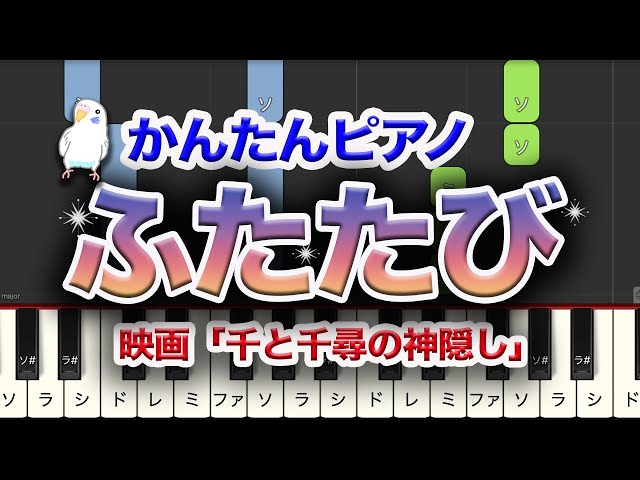

It’s a grand and beautiful piece that plays during the climactic, dreamlike flying scene in the film Spirited Away.
Beginning with a quiet melody and gradually building in emotion, it evokes the hope that lies beyond hardship and the strong bonds with those we hold dear.
A later version with lyrics also exists, expressing a bittersweet yet warm longing for reunion.
This piece was included on the album Spirited Away Soundtrack, released in July 2001.
It’s a perfect choice for those who want to bring this sweeping world to life with their own hands.
As you recall the story’s moving moments, aim for a performance that richly shapes dynamics and stirs the hearts of listeners.