

[Beginner] Start Here: Classic Practice Pieces Recommended for Adult Piano Beginners


For beginner pianists, choosing practice pieces can be a real source of anxiety.
This is especially true if you’re starting to learn on your own as an adult—you may often wonder what pieces to choose to keep practice enjoyable and progressing smoothly.
When learning piano independently, there are two main approaches: focusing intensively on a limited selection of pieces, or practicing a balanced set of pieces that include a variety of technical elements while learning the basics of piano technique and music reading from the ground up.
In this article, we’ll introduce recommended practice pieces for those who prefer the latter approach and also want to build a solid foundation.
We’ve selected a wide range of pieces, from classical to popular, so feel free to start with whichever ones spark your interest.
- Recommended for piano beginners! 10 sheet music picks that adults can enjoy too
- [Piano Etudes] Recommended for Beginners! A Curated Selection of Easy, Playable Pieces
- [Beginner] Recommended for adult piano beginners! Beautiful & stylish piano pieces
- [Piano Beginners] J-POP That Looks Hard but Is Surprisingly Playable [2026]
- Beginner to Intermediate: Chopin pieces with relatively low difficulty. Recommended works by Chopin.
- [For Piano Beginners] How to Practice “Für Elise”
- [Free Piano Sheet Music] Beginner-Friendly! Carefully Selected Pieces Available for Immediate Download
- [For Piano Beginners] Play Right Now with Free Sheet Music! A Roundup of Recommended Practice Pieces
- Even beginners can play them easily on the piano! A curated selection of popular and latest J-POP songs.
- It’s so cool if you can play these on the piano! A selection of irresistibly charming masterpieces.
- [For Piano Recitals] Simple yet Cool Classical Pieces
- A must-see for piano beginners! Recommended training videos that are great for basic practice
- [Piano Pieces] Easy for Children to Play! A Roundup of Simple Classical Works
[Beginner] Start with these practice pieces! Classic exercises recommended for adult piano beginners (21–30)
Beyer Piano Method No. 81Ferdinand Beyer

The Bayer Piano Method has long been a staple textbook in Japanese piano education.
While research into teaching materials has advanced and a variety of new texts have been published, it is still widely used as a technique workbook and is also known as an essential resource for those aiming to become childcare workers.
Not just No.
81—each piece is compact with clear objectives.
It’s recommended to proceed by selecting excerpts that match specific practice goals, such as “grasping chords” or “playing sharp staccato.”

A Whole New WorldAlan Menken


Among the many works by composer Alan Menken, who created numerous scores for Disney films, the classic “A Whole New World” is especially popular and is frequently performed at weddings and other events.
It’s a romantic piece that evokes the image of Aladdin and Jasmine soaring through the night sky.
You might think it’s difficult because of its grand feel, but in fact the chorus melody stays within a single octave, making it quite approachable even for beginner pianists! To start, why not practice with an arrangement where the left hand plays only chords or a bass line, so you can focus on the melody?
[Beginner] Start here for your first practice pieces! Classic practice songs recommended for adult piano beginners (31–40)
Arrietty’s SongCecile Corbel

Many people have surely been captivated by Cécile Corbel’s translucent voice and the magical sound of her harp! The theme song from the film “The Secret World of Arrietty” features a beautiful melody and a relaxed tempo, making it easy to perform.
The work is also known for winning the Tokyo Anime Award for Music in 2011.
The lyrics seem to embody the earnest feelings of the tiny protagonist and a way of life in harmony with nature.
To recreate this delicate worldview, the key is to play lightly and fluidly, like harp arpeggios.
If you aim for a whisper-soft, gentle tone, you can achieve a highly polished performance even with fewer notes.
Ojamajo Carnivalike takeshi
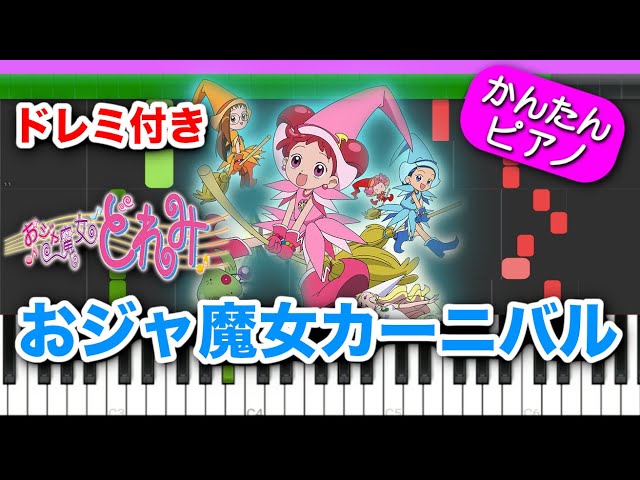
When it comes to the first opening theme of the TV anime series Ojamajo Doremi, produced by Toei Animation since 1999, it’s undoubtedly Ojamajo Carnival!! Even after the show ended, this song has remained enormously popular, and many beginner pianists surely want to try playing it.
As the saying goes, “What one likes, one will do well,” and there’s nothing quite like the joy of improving by practicing a song you love.
It may be difficult to play at full uptempo right away, but the piece is packed with many musical fundamentals: frequent flats, numerous developments, and combinations of complex rhythms.
It also modulates smoothly—such as shifting from the main key to its parallel key—without feeling out of place.
As you become more comfortable reading sheet music, you’ll start to sense the musical seasoning directly from the score and rediscover how wonderful the piece is.
It’s a fun song, so practice little by little and work your way up to playing it!

Fine On The OutsidePriscilla Ahn

Many listeners must have been moved by the crystalline vocals and acoustic resonance.
The theme song for the film “When Marnie Was There” is a deeply personal piece that Priscilla Ahn, its writer, created in 2005 based on her own experiences of loneliness during her girlhood.
While pretending to be fine on the outside, the protagonist Anna quietly carries a sense of isolation, and the song aligns with her feelings beautifully, striking straight to the heart.
The track is also included on the album “Just Know That I Love You.” To convey the bittersweet melody with rich emotion, the key is to begin playing with a soft, delicate touch.
By letting the quiet, hidden feelings surface in the sound, your performance will resonate deeply with listeners.
Someone at any timekōryū

This is the song that graces the ending of the 1994 film Pom Poko, with a melody that feels nostalgic and warm, resonating in the heart.
The acoustic, borderless sound—featuring instruments like the sanshin banjo—gently envelops the film’s finale.
The piece carries a message of not forgetting the places you hold dear even when you leave your hometown, and a hope that hardships can one day be overcome—echoing the raccoons’ story and touching the heart.
It’s a calm ballad, so the key is to play in a way that lets the melody sing.
Since the melody and accompaniment are clearly defined, it’s perfect for those who want to get used to playing with both hands.
Let the warm chords ring out carefully and try to express the original track’s comforting, embracing feel.
Minuet in F major, K. 2Wolfgang Amadeus Mozart

Composed when Wolfgang Amadeus Mozart was six years old, this piece features a simple yet charming melody and a graceful triple-meter rhythm that leave a strong impression.
Although it has few chords and is structured almost like two voices, it employs key changes and deceptive cadences, making it ideal for studying tonality and harmonic progressions.
Frequently used in lessons as a piece well-suited to early stages of piano study, it’s highly recommended for those who want to build a solid foundation in piano or who are interested in classical music.
Why not experience a glimpse of Mozart’s musical genius through this work?