

[Advanced] Piano Duet Works | Exquisite Masterpieces to Savor the Rich, Weighty Sonorities of Four Hands


The rich resonance woven by four hands, the tension of breathing as one, and dynamic expressiveness.
Piano four-hands is a performance style full of attractions you can’t experience in solo playing.
While the piano is often played by one person, a piano played by two offers a different sonority, joy, and fascination.
Many works for four hands and for two pianos have been left to us.
Here, we present masterworks for advanced players that let you pursue refined technique and expressive power.
Why not open a new door to music with a collection of gems that will command presence at concerts and recitals?
- [Piano Duets] Guaranteed to get the crowd excited! A roundup of recommended pieces
- [Intermediate] Recommended Piano Duets | A Curated Selection of Cool and Dazzling Pieces
- [For Advanced Players] A Curated Selection of Classical Masterpieces to Tackle at Piano Recitals
- [Piano Duets] Perfect for recitals! A carefully curated selection of brilliant, crowd-pleasing works
- For Advanced Players: Showstopping Classics to Play at a Piano Recital
- [Advanced] Super cool if you can play it! Selection of famous piano pieces
- [Piano Duet × J-POP] A showcase of insanely cool piano duet arrangements all at once
- [For Adults] Recommended for Piano Recitals! A Curated Selection of Impressively Sounding Masterpieces
- [Intermediate Level] Cool Piano Pieces You Can Play [Great for Recitals Too]
- Today's Piano: Masterpieces and Popular Pieces Woven with Delicate Tones
- Masterpieces of classical piano that are too beautiful for words. A gathering of delicate tones that cleanse the soul.
- [Ultra-Advanced] Even challenging for advanced players! A curated selection of highly difficult piano pieces
- Piano Masterpieces: Surprisingly Easy Despite Sounding Difficult!? A Curated Selection Perfect for Recitals
Advanced Piano Duet Works | Exquisite Masterpieces to Savor the Rich Sonority of Four Hands (21–30)
Danse macabre in G minor, Op. 40Camille Saint-Saëns

The symphonic poem Danse macabre by French composer Camille Saint-Saëns depicts the uncanny scene of skeletons beginning an eerie dance at the stroke of midnight.
It was initially conceived as an art song, then completed as an orchestral work, and today it is performed in many forms, including piano four hands, two pianos, and violin solo.
Because it is arranged from the orchestral version, performing it as a duet is naturally very challenging.
Envision each scene vividly and craft an engaging performance that draws the audience in.

typewriterLeroy Anderson

If you’re looking for a cheerful and amusing four-hand duet for intermediate players, how about The Typewriter by the American composer Leroy Anderson? A “typewriter” is a machine that predates word processors and modern computers, which prints letters on paper by striking type against it.
This piece cleverly treats the typing sounds—what we’d now associate with computer keyboard clicks—as percussion and incorporates them into the music.
Because the tempo is fast and there are many rapid runs, it’s a good idea to assign the more virtuosic passages with fast runs to the advanced player, and the lower accompaniment part to the intermediate player, and practice accordingly.
As you improve, you can switch parts; if that’s difficult, the advanced player can support the intermediate player.
It’s a delightful piece and perfect for an encore!

Advanced Piano Duets | Exquisite masterpieces where you can savor the rich sonorities of four hands (31–40)
In the MoodJoe Garland

How about a four-hand duet jazz piece for intermediate players? In the Mood, the big band jazz standard composed by Joe Garland, offers a delightful and fun time for two intermediate pianists playing a duet.
It’s a very upbeat jazz number, famously popularized by the Glenn Miller Orchestra in 1939, and is considered one of the group’s signature tunes.
While duet pieces may often evoke a classical image, choosing jazz works well too, and it’s worth adding to your repertoire.
Since it’s jazz, some improvisational skill is required; however, many scores include guides, so if you have a score with a guide, try following it first.
Unlike classical music, jazz involves improvisation, so once you’ve practiced and feel more comfortable, it might be good to study the chord progressions and challenge yourself with ad-libbing.
Sword DanceAram Khachaturian

A highly faithful, cool, and recommended piece for four-hand piano is “Sabre Dance,” used in the final act of Aram Khachaturian’s 1942 ballet Gayane.
The opening timpani and off-beat strings, followed by the xylophone’s exhilarating, fast-paced melody, are impressively recreated in piano duet form.
While there are solo piano arrangements, dividing the melody and accompaniment between two players achieves a much higher level of fidelity than a single performer can.
Although there are technically demanding passages for the performers, the cross-handed playing showcases the essence of duet performance, making it visually engaging as well as musically captivating for listeners.
Mission: ImpossibleLalo Schifrin

As the two of you become able to play to a certain extent, you’ll probably feel more eager to play and want to try a variety of pieces beyond classical, such as music from games, anime, and J-pop.
How about the well-known theme from Mission: Impossible? The original comes from the American TV drama “Mission: Impossible,” which aired from 1966 to 1973, and those with a strong association to the movie may be surprised to learn the film is not the source.
The opening wind instruments with triangle tremolo and the 5/4 bass line are unforgettable once you’ve heard them.
In 5/4 time, the key in piano four-hands is how well the melody can ride over the bass line.
Since long notes decay on the piano, it’s best if the two of you can play in a way that doesn’t let the energy of the sound fade.
Slavonic Dance No. 8Antonin Dvořák

Are you looking for a classical piano duet piece for a recital? Antonín Dvořák’s Slavonic Dance No.
8, Op.
46-8, originally composed for piano four hands, is highly recommended.
From its intensely passionate introduction to its brilliant, driving dance melody, it captivates listeners.
The ensemble can feel like it might fall apart unless the duo breathes as one, so practice is essential to keep both players steady.
The music unfolds at a whirlwind pace, so be sure to maintain the tempo and not fall behind.
Pieces like this tend to rush, so take care not to egg each other on.
Although there is an orchestral version, the original is for piano duet, making it an excellent choice for those who want to perform or are searching for original piano four-hands repertoire in classical music.
Piano Concerto “Fate”: First MovementSenju Akira
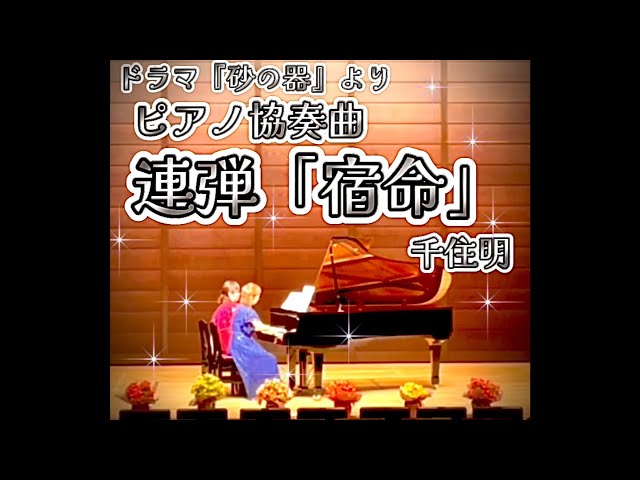
If you’re looking to play a serious piano duet, I recommend Akira Senju’s Piano Concerto “Shukumei” (Fate).
It’s the piece used in the 2004 TV drama adaptation of Seicho Matsumoto’s long mystery novel “Sand on the Shore” (Suna no Utsuwa), starring Masahiro Nakai, a story that has been dramatized multiple times.
As you’ll hear right away, this piece has none of the bright, pop-like feel; as the word “concerto” suggests, it demands a fully-fledged, classical-style performance.
In recent years, more piano teachers have allowed performances of music from games, anime, and dramas, but choosing and pulling off this piece will astonish audiences.
Its character is weighty and imposing, reminiscent of Beethoven.
The technical demands are considerable, so if there’s a pianist who wants to tackle a robust, advanced-level work, this could be a worthy challenge.
It would be wonderful for two players to rehearse deeply and bring a musical drama to life together.