

Anti-war songs that pierce the heart: Japan’s masterpieces conveying prayers for peace


Music sometimes has the power to move people’s hearts and exert a great influence on society.
Among such works, anti-war songs imbued with wishes for peace have appealed across generations, conveying both the horrors of war and the preciousness of peace to many.
The anti-war songs etched into Japan’s musical history contain profound messages that we who live today must never forget.
In this article, we highlight Japanese anti-war songs—focusing mainly on popular Japanese music—and explain the backgrounds of the tracks and the sentiments embedded in their lyrics.
We invite you to take this opportunity to reflect anew on war and peace.
- “Song of War”: A classic that sings of the tragedy and folly of war
- [Songs Praying for Peace] To Prevent Repeating Tragic History | A Collection of Peace Songs That Resonate with the Heart
- [Song for Supporting Ukraine] A moving anthem that conveys hopes for peace & songs of Ukraine
- Masterpieces of Japanese music that delve into various social issues, such as war and environmental problems
- The lyrics are profoundly good. The more you listen, the more it sinks in. Masterpieces of Japanese music, recommended popular songs.
- [2026] Anti-war songs in Western music. Songs that wish for peace.
- Japanese music themed around prayer. A song whose warm message resonates in the heart.
- Tear ducts guaranteed to burst! Heart-wrenching masterpiece songs I’d recommend to Gen Z
- [For when you want to cry or feel sad] Tear-jerking masterpieces that make you cry when you listen
- [Classic and Contemporary Hits] Emotionally Stirring, Heart-Touching Songs
- [Recommended for elementary school students] Songs that touch the heart! Moving and comforting songs of gratitude
- Timeless classics only! Showa-era hit songs perfect for acoustic sing-alongs
- Songs of anger. Western music anger songs. Recommended masterpieces and popular tracks.
[Anti-war songs that pierce the heart] Prayers for peace conveyed by Japan’s masterpieces (41–50)
We must not forgive the atomic bomb.Kinoshita Koji
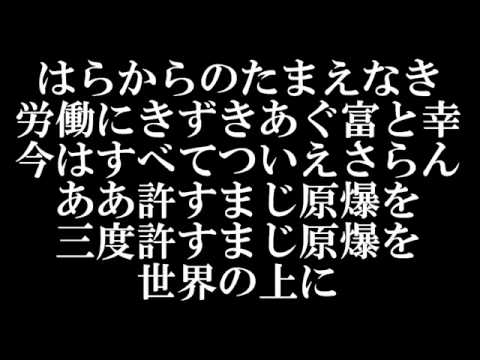
In 1954, a hydrogen bomb test was conducted over Bikini Atoll, and in the wake of the exposure of the fishing boat Daigo Fukuryu Maru, Mr.
Koji Kinoshita, who had joined the signature campaign against nuclear weapons, composed this anti-war song through self-study.
The song powerfully conveys, almost painfully, the scenes of the town after the atomic bomb was dropped and the feelings of its people.
Antiwar Songs That Pierce the Heart: Japanese Classics Conveying Prayers for Peace (51–60)
Preparation for the countrySano Motoharu

“Preparation for the Nation” is a song included on Motoharu Sano’s 2004 album THE SUN.
It’s a powerful rock ’n’ roll number with striking lyrics that seem to satirize the nature of Japan as a nation.
Though the lyrics are sparse and the track runs only about three minutes, Sano’s message is packed into those few words.
It can sound abstract, but it also feels like it’s singing about Japanese soldiers of the time who devoted their lives to the nation and went off to war.

Relay of Lifesango

This is a gem of a song that conveys a wish for peace and the preciousness of life.
The voices woven by three mothers from Okinawa resonate deeply in the heart.
Released in May 2015 as the NHK Okinawa Broadcasting Station’s theme song for the 70th year after the war, the piece is further elevated by a chorus of forty Okinawan elementary school students, creating a grand, immersive world.
The lyrics, imbued with a strong determination to never repeat past tragedies and with hope for the future, seep into the listener’s soul.
It’s a song that should be heard not only by those who know the sorrow of war and conflict, but also by anyone who, while grateful for a peaceful daily life, wishes to face the reality of the world.
Becoming a Thousand WindsAkiyama Masashi

Masafumi Akikawa’s song “Sen no Kaze ni Natte” (“A Thousand Winds”).
The song was also performed at the 2006 NHK Kōhaku Uta Gassen, and its lyrics carry a profoundly memorable message.
While it’s known for its famous melody and lyrics sung in a low register, a deeper reading of the words reveals a song imbued with compassion for the course of a human life.

From the hill with a cradleMr.Children

This is a song by Mr.Children titled “From the Cradle Hill.” It wasn’t released as a single, but among fans it’s considered a hidden gem.
It sings about the love between a man and a woman torn apart by war.
It’s a song that makes you feel that in war there’s only loss and nothing to be gained.

origami craneUmehara Shihei

This is a song by singer-songwriter Shihei Umehara, carrying a strong message themed around the atomic bombings of Hiroshima and Nagasaki.
It has been sung continuously at various peace movement venues.
Covered by children’s choirs, it has also become established as a choral piece in educational settings.
A NEW STYLE WARHamada Shogo

A socially conscious rock song that opens Shogo Hamada’s acclaimed album J.BOY, released in September 1986.
Rather than depicting armed conflict between nations, the track portrays invisible threats lurking in terrorism, inequality, and information.
Many listeners may be struck by a worldview that seems to have foretold the present day.
The album featuring this song reached No.
1 on the Oricon charts for the first time in his career and won the Excellence Album Award at the 28th Japan Record Awards.
It’s a track you’ll want to listen to when you want to reflect deeply on how society works and what true freedom really means.