

Makes you want to compose a haiku! A roundup of commonly used autumn kigo (seasonal words)

Don’t you sometimes feel the arrival of autumn in the crystal-clear sky and the slightly cool breeze?Haiku, which weave everyday, subtle changes into words, enrich our hearts.Yet when it comes time to compose a verse, you may often find yourself unsure which words to choose.In this article, we introduce common autumn kigo that are easy to incorporate into haiku.It’s full of seasonal words—about plants, flowers, and living creatures—that can inspire your expressions!Use this article as a guide and try composing your own lovely autumn verse.
Makes you want to compose a haiku! A roundup of commonly used autumn kigo (seasonal words) (1–10)
maple leaves

When composing a haiku in autumn, “momiji,” the crimson maple leaves, feels indispensable, doesn’t it? Momiji, which could be called the star of red foliage, is used as a seasonal word for late autumn, when the changing leaves look their most beautiful.
Renowned haiku poets like Matsuo Basho, Kobayashi Issa, and Yosa Buson also composed verses using momiji as a kigo.
There seem to be plenty of scenes suitable as subjects: the beautifully coloring momiji, the leaves spreading across the road after they’ve fallen, memories of going momijigari—maple viewing—with someone special.
It might also be nice to liken the red hue or shape of the momiji to something else in your verse!

Tanabata

Tanabata is often celebrated on July 7 and has a summery image, doesn’t it? However, because a different calendar was used in the past, Tanabata is treated as a seasonal word for early autumn in accordance with the old lunar calendar.
In Japan, there are regions—especially in the Tohoku area—that celebrate Tanabata on August 7 in line with the old calendar.
When using Tanabata as a seasonal word, you need to be mindful of the sense of the season as you compose.
In regions that celebrate according to the old calendar, you can depict Tanabata scenes as they are; in regions that celebrate by today’s calendar, how about using a bit of ingenuity to portray Tanabata from a different perspective?
typhoon

Summer brings sudden evening showers and even guerrilla downpours, and autumn is the season when typhoons visit even more frequently than in summer.
Typhoons have long been used as a seasonal word for mid-autumn, corresponding to the eighth month of the lunar calendar—roughly today’s September.
Incidentally, the expression “nowaki” also refers to typhoons.
There are even verses that use the character 颱, which by itself can be read as “typhoon,” to write 颱風.
Try composing a verse that captures your feelings about typhoons—be it the terrifying scene of fierce winds and rain drumming loudly on the ground, or the clear, luminous landscape after a typhoon has passed.
long autumn nights

Unlike summer, when the sun shines endlessly and the days are bright, autumn brings cooler weather and gradually lengthening nights.
The word “yonaga” (long night), which describes this state of extended nighttime, is used as a seasonal kigo for the three autumn months.
Although nights truly start growing longer in early winter, autumn may feel more nocturnal by contrast with summer.
Gazing at the moon, enjoying a good book, immersing yourself in the arts on these long nights… Why not compose a verse about your own autumn nights?
new rice; novice; newbie
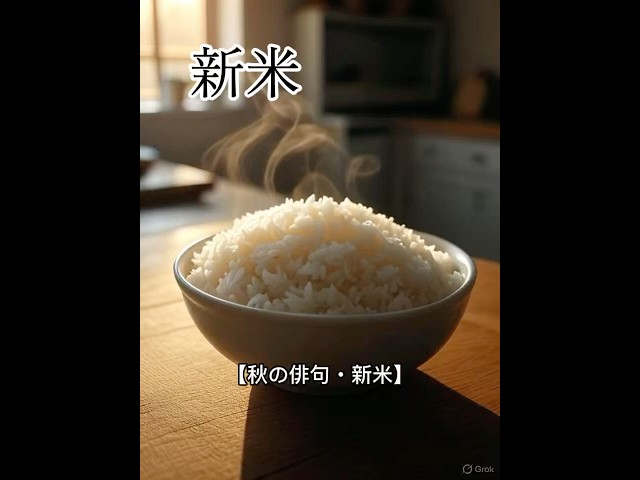
Shinmai—newly harvested rice from that year—brims with freshness and the richness of a bountiful yield.
When cooked, the grains shine with a lustrous gloss, and with the gentle steam rising, a soft sweetness and aroma spread through the air.
With the first bite, you feel a comforting warmth, as if autumn’s blessings are soaking into your body.
By adding “shinmai” to a haiku, the joy of the harvest and the warmth of everyday life seep through, evoking a simple, familiar scene.
Why not depict a moment gathered around the table, or that instant when you’re enveloped by the fragrance of freshly cooked rice?

Moon

In autumn, when the air is clear and the sky looks crisp, we can also savor the beauty of the moon.
Autumn is the season to take your time gazing at the full harvest moon.
How about composing a verse about the moonlit scene you witnessed, using “moon,” an autumn seasonal word? Famous haiku poets like Matsuo Basho and Masaoka Shiki were also captivated by the beautiful sight of the moon and wrote moon-themed haiku.
You can faithfully describe the moon’s beautiful appearance, or, like “dumplings over flowers,” write about your eyes being drawn more to the offerings of dumplings than to the moon itself.
Depending on the weather, it might also be nice to let your thoughts dwell on a moon you cannot see.
late summer heat

In recent years, especially in autumn, the lingering heat has grown more intense, hasn’t it? The kind of sweltering heat that’s no different from midsummer keeps dragging on, autumn sports days turn scorching, and there are so many troubles.
Since zansho—the lingering heat after the start of autumn around early August—is used as a seasonal word for early autumn, why not try composing a verse about the lingering heat that, in your mind, just won’t go away? Many may choose to write with a negative tone, but if you love hot summers, it might be nice to reflect on zansho as a welcome happening and let your thoughts dwell on it in your poem.