



We’d like to introduce some nursery songs to enjoy with your baby.
These days, many babies are exposed to music from the time they’re in the womb through prenatal education.
Some families sing nursery rhymes as lullabies to help put their babies to sleep.
In this article, we’ve gathered gentle nursery songs and lullabies you’ll want to listen to with your baby, along with playful songs great for childcare and popular anime tunes.
They’re all fun songs that even babies who don’t understand words yet can enjoy.
Please try listening together as a parent and child.
Also perfect for baby massage!
- Nursery rhymes to sing to your baby! Recommended songs enjoyable from 0 months
- [Children's Songs] Cute songs recommended for childcare. List of popular nursery rhymes.
- [Lullabies] Gentle songs to help babies sleep — soothing lullabies for your little one
- Baby massage song. A touch-and-play song that parents and children can enjoy together.
- [Hand Play] Popular with kids! A collection of trendy hand-play songs and nostalgic traditional children’s songs
- [For 0-year-olds] Recommended songs for babies: A special feature on bonding play and traditional nursery rhymes
- [Childcare] Summer songs: Full of fun! Summer nursery rhymes & finger-play songs
- Lullabies: children's songs, folk songs, and nursery rhymes. Nostalgic songs for putting children to sleep.
- [Parenting] Parent-child bonding! Hand-play songs and traditional nursery rhymes collection
- Lullaby Rankings [2026]
- Music you want your baby to listen to: classical, sleep music, nursery rhymes, and BGM.
- [Childcare] Play and games for 0-year-old babies: Fun developmental and educational activities
- Ranking of Popular Children's Songs [2026]
Nursery rhymes and play songs to enjoy with your baby. Gentle children's songs (1–10)
LullabyNEW!

This work, released in August 2025 as a bedtime video for infants and toddlers, fits perfectly into the calm hours of the night.
Its gentle melody and soothing rhythm quietly guide your child’s awareness into the world of dreams.
While it isn’t an explicit tie-in song for a TV anime or film, the comforting presence of Anpanman—a character beloved by everyone—offers reassurance, making it ideal for a nightly sleep routine.
With its quiet accompaniment and unhurried flow of time, this piece is also perfect for winding down after a busy day.
If you’re struggling with bedtime, try listening to it together with your child in bed at least once.
Anpanman Train★NEW!

This is a song from a video released in September 2025 on the YouTube channel NikoNiko Kids.
While it has no official tie-in, it combines two motifs beloved by children: Anpanman and trains.
It features a bright, friendly melody and a brisk rhythm, with train movements and sound effects that captivate children through both sight and sound.
It’s perfect for a calm playtime before bed, or for parents and kids to enjoy during the day while pretending to ride a train.
With easy-to-remember phrases repeated throughout, it’s a work I’d especially recommend to caregivers who want to spend peaceful time at home, gently swaying along with their babies.
Cute Hide and SeekNEW!Bonbon Akademii

This is a long-loved Japanese children’s song that sings about small animals like chicks and sparrows happily at play.
The gentle, bright vocals by Icchi and Naru from Bonbon Academy give babies a sense of comfort.
It’s one track included on the album “Bonbon Academy: Spring Songs,” released in April 2025.
Bonbon Academy is active in many areas, including performing the theme song for the anime “Mewkledreamy Mix!” As this piece is a short song of about a minute and a half, it will likely guide your child naturally into a pleasant sleep without losing their attention.
It’s perfect not only for bedtime, but also as a lead-in to daytime play.
Spend a calm moment together, expanding your imaginations.
LullabySakushi: Kitahara Hakushū / Sakkyoku: Kusakawa Shin
Cradle Song, sung by Rimi Natsukawa, is perfect for lulling a baby to sleep.
Released in 2011, this song is a beloved lullaby from the Taisho era with lyrics by Hakushu Kitahara and music by Shin Kusakawa.
In 1967, the male vocal group The Bonny Jacks performed it on the program Minna no Uta.
The song paints a gentle scene around a cradle, helping babies drift off peacefully.
In Natsukawa’s version, the melody is woven together with the soft tones of the Okinawan sanshin, reflecting her roots.
Be sure to give it a listen during those tender moments as your baby falls asleep.

Toy Cha-Cha-ChaSakushi: Nosaka Akiyuki (Hosaku: Yoshioka Osamu) / Sakkyoku: Koshibe Nobuyoshi

What if the toys that played so much during the day were free to play while we’re asleep…! The nursery rhyme “Omocha no Cha-Cha-Cha” conjures up scenes like Disney’s Toy Story.
It was originally created as an adult pop song, but was later remade with the current lyrics and became beloved by many children.
It’s also fun to take out various toys you have at home and sing while adding a little twist to the lyrics! Adding simple hand motions to match the words makes it even more enjoyable to sing.
Tanuki of Fist Mountain
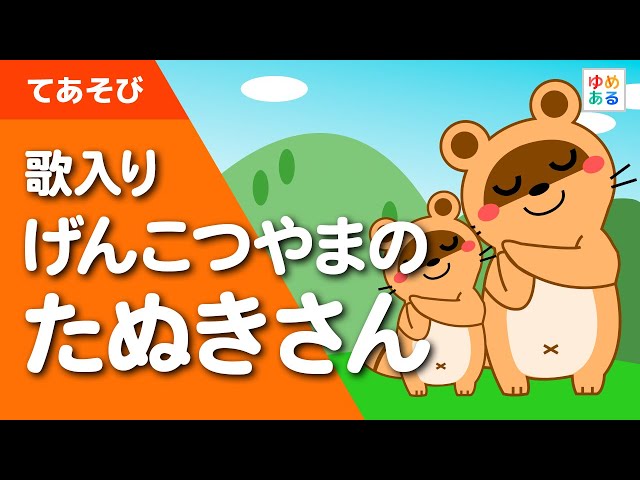
As a hand-play song, the nursery rhyme “Genkotsuyama no Tanukisan” is something children can enjoy while playing.
It depicts a baby raccoon living on a mountain called Genkotsuyama, nursing from its mother and then falling asleep in her arms.
In the hand-play, matching the word “genkotsu” (fist) in “Genkotsuyama,” you start the song by alternately tapping your two fists up and down.
After that, you move your hands according to the lyrics.
At the end of the song there’s also a rock-paper-scissors part, so if your child has learned how to play, be sure to try that together too!
Mr. ElephantSakushi: Mado Michio / Sakkyoku: Dan Ikuma

The children’s song “Zō-san” lets you feel the warm bond between a baby elephant and its mother.
The lyrics were written by Michio Mado, who also created famous children’s songs like “Yagi-san Yūbin” and “Ichinensei ni Nattara.” In this song, a baby elephant is teased by others for its long trunk, but it proudly embraces it, realizing it’s the same as its beloved mother’s.
The gentle duple-time melody would make a lovely lullaby.
Give it a listen with the wish that parents and children can stay as close as the elephant mother and child.