

A piano teacher analyzes BABYMETAL by key: Road of Resistance, Amore -Aosei-, and more

This is the third installment of analyzing BABYMETAL in terms of tonality.
Following the 1st album, this time I will analyze the first half of the 2nd album.
First album (first half):A piano teacher analyzes BABYMETAL by key. BABYMETAL DEATH, Megitsune, and more.
Second half of the 1st albumA piano teacher analyzes BABYMETAL by key. Song 4, Ijime, Dame, Zettai, and others.
Introduction
I'm really glad that the analysis is becoming more and more enjoyable, and that I've been able to learn even more about the song's appeal.
I’d be happy if readers could share in this fun, too!
It might be a lot to read, but I hope you’ll accept my love for BABYMETAL.
Please study the basic knowledge of music theory here.
But it's already too difficult, and the book above isn't enough.
I recommend that you study this using the book Comprehensive Harmony.
Well then, here begins the second album.
Road of Resistance
C-sharp minor (one of the darkest keys: cruel, sarcastic, plaintive, eerie) with four sharps → F-sharp major (possesses rich color and softness; especially evokes a romantic character) with six sharps
Alright, here it is!
It’s in BABYMETAL’s key, C-sharp minor.
On the first album, “Ijime, Dame, Zettai” has just ended in this C-sharp minor key.
Also, the first album started in B-flat minor, expressing a dark heavy metal sound, didn’t it?
By the second album, BABYMETAL had already made their presence known with the first, so starting with a mode that expresses BABYMETAL wouldn’t be a problem—in fact, it would be gladly welcomed, right?
Also, with a bold, majestic intro.
When that C-sharp minor chord goes, 'Jaaaan!' it's like, 'Whoa!' right?
I’m excited to see what key the final closing section will end up in.
Actually, the amazing part of this song starts from the chorus.
Now, the time has come!
It goes into the chorus after this.
Here, it modulates to F-sharp major.
Then, partway through the guitar solo, it modulates to D major (noble, ornate, grand, and religious; especially suited to joy; also used for lively fanfares) [two sharps], and from there it goes straight into the “As long as life goes on~” part of the song.
And then, at the “Resistance~” chorus, it returns to F-sharp major and ends as is.
From the chorus onward, it's basically in F-sharp major.
Although C-sharp major is described as “richness and softness,”BABYMETAL’s composureIt feels like it represents (something).
She’s getting used to metal, and it feels like she’s expressing femininity and flexibility.
D major is the key that was used in "Catch Me If You Can."
The cuteness of BABYMETAL and the fun of playIt had a tone that expressed it.
Here, the key of D major is sandwiched between F-sharp major keys, so a key with two sharps is enclosed within a context of six sharps.
As it is described as 'chromatic' in C-sharp major, various colors blend together, giving a sense of slightly complex coloration.
Amid all this, by briefly modulating to D major—two sharps—we evoke a connection to the first album, a sense of openness, youth, and the flexibility that comes with youth; and by promptly returning to F-sharp major, we introduce a grandeur and evolution that “Catch me if you can” did not have.
It foreshadows what will likely be strongly felt in the analysis to come: a “storm of modulations.”
Keys with sharps definitely give off a strong metal vibe.
Among these, the use of six sharp keys suggests further evolution for BABYMETAL.
Incidentally, C-sharp major is being used for the first time, but its closely related key, F-sharp minor, already appeared on the first album.
Yes, it’s the key of “Kougetsu” (Crimson Moon).
It’s important to maintain a sense of unity throughout an album.
Am I the only one who feels we mustn’t overlook its connection to the important song “Akatsuki”?
KARATE
G major (the key of youth. Sincerity, meditation, grace, a quiet pastoral feeling. Also called the key of spring) 1 sharpNote: B minor (very dark and melancholy, yet hinting at quiet expectation and patient hope) 2 sharpsNote: E minor (joy and sorrow, grief, anxiety; in fast pieces it becomes vehement) 1 sharp
I wonder what key this song is in?
At that moment, I never imagined I would end up being betrayed twice.
From the beginning of the song to the chorus, the notes B (ro, shi) dominate, so it sounded like B minor to me.
But when I listen closely, the chord is B7.
B7 is the dominant of E.
The dominant resolves to the tonic, either E major or E minor.
That's a long dominant, isn't it?
So it was just connected from the chorus’s “mada mada seiya soiya~” into E minor, wasn’t it?
So, is it in E minor?
As I listen, it seems that's not the case.
This piece is in G major.
What sounded like E minor was actually a deceptive cadence—where the music pretends to resolve to the key a sixth away. Note: “key a sixth away” means the key built on the sixth scale degree; for example, in G major, that would be the key whose tonic is the sixth note from G.
In other words, if you count as so-la-ti-do-re-mi and take mi as the tonic, then since G major doesn’t have a sharp on so, the key that treats mi–so–ti as the first degree is E minor; therefore, this piece is actually in G major.
But it doesn't sound like G major.
Because it ends with a deceptive cadence.
Therefore, instead of the youthful quality characteristic of G major, it evokes the patient hope of B minor (with a dominant that drags on forever, eager to resolve to the tonic!)—karate—and the ferocity of E minor—metal.
No, no, I just witnessed some skillful technique.
By the way, the G major key on the first album was “Nice!”.
As expected, there’s a strong sense of wanting to convey an evolution from the first album.
Awadama Fever
E major (brilliant, gentle, and joyful; a noble key) ♯4Note: C-sharp minor (one of the darkest keys; cruel, sardonic, tragic, eerie) ♯4
This song has the same tonality as “Gimme Chocolate!!.”
They were probably aiming for a similar vibe/positioning to Gimme Chocolate!!.
The way a song beginsE power chordIt gave a strong impression.
This is the same as Gimme Chocolate!!.
However, the differences are interesting.
One way it differs from Gimme Chocolate!! is evident in the keys used in both the A melody and the chorus.
In Gimme Chocolate, the A-melody has no melody—just shouts of “watatata”—to express BABYMETAL.
In contrast, in Awadama Fever the melody line is built straight from the E major scale, so it’s bursting with that sparkling E major vibe.
But as always, the Kami Band’s performance is full-on metal with E power chords.
Also, in Gimme Chocolate!!, the sparkly feel started to come out once the chorus hit.
In contrast, while the chorus of Awadama Fever remains in E major, it makes a deceptive cadence to C-sharp minor.
Constant pseudo-sentence endings.
Everything in the chorus is a deceptive cadence.
So, I feel a stronger metallic vibe than a glittery one.
I’ve said it many times, but C-sharp minor is BABYMETAL’s key.
Both 'Ijime, Dame, Zettai' and 'Road of Resistance' are in C-sharp minor.
And with a deceptive cadence, the piece comes to an end.
That’s metal—BABYMETAL, for sure!
The next three songs from here are pretty insane, DEATH!
Brace yourself (lol).
Why is it bad?/Why is it dangerous?
That’s because there’s a song I like!
It's going to get hot and go on for a loooong time (lol).
Well then, please enjoy.
Oh crap!
E minor (sorrow and joy, grief, anxiety; in fast pieces it becomes fierce) — one sharp
It's my first time in E minor.
Perhaps because it’s played in standard tuning, the sound feels strong and sharp.
“Heart-wrenching” feels exactly right.
Also, since it’s in standard tuning, it sounds familiar to the ear.
I was very curious about the musical style, so I looked into it.
When you hear that they sound very similar, the first thing that comes to mind is “Dschinghis Khan,” right?
I looked into it further.
As points I noticed, I would like to mention the following.
- Disco music of the late 1970s
- A minor
- The original is in German.
- Worldwide smash hit
First, regarding the aspect where I was conscious of disco music—despite it originating in Germany, it really...A melody familiar in JapanAnd it feels familiar, doesn't it?
But the moment it turns into “yabai!” it stops being disco music, doesn’t it?
The tempo is fast, the rhythm is tight, and it leans a bit toward metal.
Next, the fact that it's in A minor.
Regarding the key this time, I think this familiar disco music style is also related to the key of A minor.
So, like, yikes! It’s better not to use such a complicated key signature, right?
Choosing the key of E minor with one sharp in regular tuning—giving it a metal-like feel—seems to create a really nice atmosphere.
Maybe it feels like a kind of hybrid between metal and disco music.
This piece doesn’t modulate clearly.
It just gives a strong impression of going back and forth with the dominant B minor.
If anything, you could say it’s pretty metal.
We might have tried adding a playful element of “Jingisukan” in a BABYMETAL style.
When you analyze the key, the image of the piece seems to change—it's that kind of song.
By the way, my favorite thing about this song is the lyrics.
“It’s so different, it’s a problem”—I relate with my whole being.I will do it.
Amore - Azure Star -
D-flat major (captivating, serious, solemn. One of the darkest and most painful of the major keys, also capable of conveying a morbid Romanticism) — five flats– B-flat minor (suited to funeral marches along with A-flat minor; dark, melancholic, and tragic) — five flats* C major (simple, rustic, yet with a clear, definite character) — no key signature
In a sense, D-flat major and C-sharp minor are closely related keys.
Because D-flat (Db) is the same pitch as C-sharp (C#) on the keyboard.
It might be related in a way, but my impression is that it's 'completely different.'
Even though it's in a major key, if it has five flats, of course it feels dark.
Even in the characteristics of that key, it is described as 'one of the darkest and most painful keys among the major keys.'
It’s even been described as having a “pathological romanticism.”
To me, across the two albums, this key feels like the least metal-sounding.
The composer who made this piece set out on a terrifying adventure.
But this key/mode isn't just dark.
As the word “bewitching” suggests, a certain indescribable allure—like that of a mature woman—is also a hallmark of this tonality.It is.
I think it’s fine to ask Su-metal to handle this part.
I think there are people who are actually feeling this.
However, this is BABYMETAL.
It has to be metal.
So is that why you increased the tempo?
There are too many sounds, and performing is difficult.
In that sense, it really sparks my spirit of challenge, and personally, it lifts my mood and makes me happy.
Let’s get back to the song.
At the beginning of the piece, I wrote D-flat major–B-flat minor.
Broadly speaking, the piece starts its chorus in D-flat major, modulates to B-flat minor, then returns to D-flat major, going back and forth in this way and ultimately ending in D-flat major.
B-flat minor is the key of BABYMETAL DEATH.
It's metal.
The two are parallel keys that both have five flats in the key signature, so it’s easy to move back and forth between them.
Also, the tonic in B-flat minor is a deceptive cadence in D-flat major.
So we often go to B-flat minor.
By the way, the super cool bass solo is in B-flat minor (I really, really love this part), then the guitar solo ends with a cadence in B-flat major. After Su-chan collapses, you’d think the momentum would carry on into D-flat major, but it actually shifts to C major.
It’s in C major here, but after having lots of flats, the key signature suddenly disappears.
It suddenly shifts into a simple style.
This is very effective!
I feel like my mind went completely blank and I was reborn!
Yes, as pure white as Su-chan’s wing-like ones!
And then, as if remembering, the chorus comes again in D-flat major.
Ah, that's super cool.
Since the key changes right before and after Su-chan collapses, if there’s too much of a pause the impact of the modulation gets diluted, so I want them to keep it moderate and move on… and yet, as Su-chan falls over, people in the audience are shouting, “Su-chan, wake up—hang in there!”
I kind of want to shout that, so I was hoping they’d collapse during the live show.
The super-cool bass solo part is one of the sections I “totally” love in BABYMETAL’s songs, but there’s another part I like as well.
Eyes that have sworn their vow hold a dazzling future; clad in light, in a cerulean form—now, spread your wings.
The key change at that part.
This place moves me.
I like it “namara” much, right after the bass solo.
Because it makes a bold key change and then keeps modulating one after another.
It was so cool that I made a handwritten note while checking the chord progression with scale-degree notation (things like I and V).
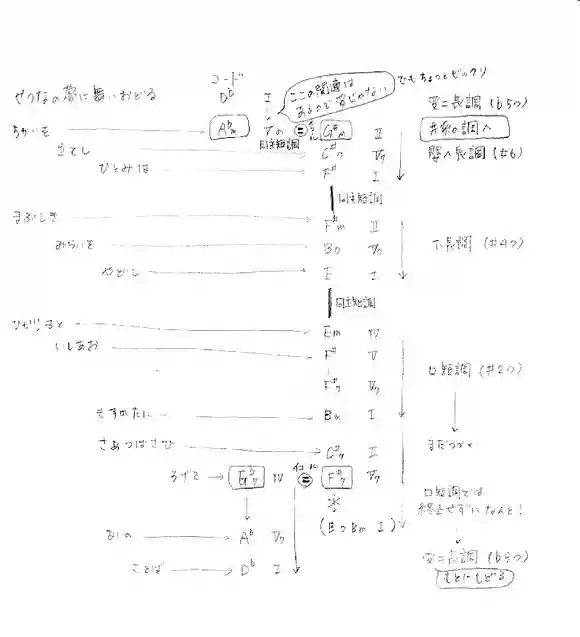
It modulates from D-flat major, which has five flats, to F-sharp major, which has six sharps, using chords from the former key.
Modulate two more times using the parallel minor key’s chords.
E major, B minor—just when you think it’s over, it uses another chord to circle back to D-flat major with five flats.
It won’t sound interesting when put into words, but please listen with the idea that it’s modulating.
Doesn't it feel good, in a nice way, to sense how the atmosphere keeps shifting, with unexpected turns that pleasantly defy your expectations?
Modulating to keys with lots of sharps or flats is really heart‑pounding.
Moreover, because the tempo is fast, you feel like you might get swept away by the flow.
I love this song, and the reason why is the voice in Su-chan’s opening line that begins with “ai no kotoba,” along with the sounds used.
The charm of that D-flat major.
And then, that surprising key change from earlier.
And then there’s the insanely cool bass solo and this ridiculously fast tempo.
Have you gotten a sense of how important tonality is to me—and how much I love this piece (lol)?
META! Meta Taro
E-flat major (said to be gentle yet majestic, with a rich resonance, suitable for expressing the grandest transformations. Often used to convey earnest emotions and a sublime or heroic mood. Also called the key of blue skies) 3 flats* Tonic minor [E-flat minor (one of the darkest, most gloomy keys. According to Schumann, a key filled with mysterious terror) 6 flats]* Relative key [C minor (gentle yet bearing earnest passion. Tragic power, supernatural feelings, intense emotions) 3 flats]- C-sharp minor (one of the darkest keys. Cruel, ironic, plaintive, eerie) 4 sharps- E major (brilliant, mild, and joyful. A noble key) 4 sharps
Suddenly, but the key of this piece is very peculiar.
When I used to listen without thinking, I simply “heard” this piece, but when I tried listening analytically, I realized that it actually modulates quite a lot.
It feels as if I've just cracked a puzzle.
There’s no sense of incongruity in how it connects from the previous piece, “Amore,” and the relationship isn’t bad (since the flat-based keys continue). Moreover, there’s no incongruity in how it connects to the following piece with syncopation either (because the dominant of A minor in the syncopation is the tonic chord of E major).
And even with the overseas closing track, “From Dusk Till Dawn,” since it’s in C-sharp minor, it doesn’t feel out of place because it’s parallel to a key with four sharps.
The connection is too good.
It's too good.
No, it's wonderful.
I can't believe it.
Everything lies in the key changes within 'Meta Taro.'
As expected, I did notice the part where it modulates upward by semitones.
The mood changes a bit during the second 'whoa-whoa,' doesn't it?
It has just modulated from C minor up a semitone to C-sharp minor.
Including other parts as well, if we look at it in terms of the overall flow, it would be something like the following.
Start with the chorus of “Meta Taro” in E-flat major.
And the A verse is in E-flat minor.
War, whether you can hear it or not, is in C minor.
And the chorus is always in E-flat major.
And then it enters a long interlude and modulates to E-flat minor.
In the following section of the waltz, it is again in C minor.
Up to this point, it connects well with the previous song, Amore.
And then what happens is... starting from the “whoa-whoa” in the second verse, it suddenly shifts up a semitone to C-sharp minor.
That semitone rise feels like the climax of the piece.
Naturally, the next “Meta Taro” is likewise a half step higher, in E major.
E-flat minor and G major are related as parallel keys with three sharps.
And it maintains the same tone all the way to the end.
As for the final note of the melody, it ends on G-sharp, the third scale degree.
Ending on the third scale degree makes it feel like it might continue.
The note that makes it feel like the piece has ended is E, the tonic of the chord.
And yet, you chose G♯.
It can be taken as a song that was made as a filler/bridge track.
It was a brilliant modulation technique.
What I found brilliant was that it doesn’t end in the key it modulates to, but rather in the parallel key of the destination.
In other words, going from E-flat major to E major and ending there is a common pattern.
This means singing “Metataro” in C minor, then modulating and singing “Metataro” in E major.
However!!
I find it interesting that, instead of doing that, it modulates between the key of the dominant and its relative minor.
By doing so, the final impression of E major remains strong.
So it ends, leaving a glorious atmosphere.
By the way, this key of E major is the same as in “Gimme Chocolate!!”
BABYMETAL’s sparkling vibe is shining here as well!
Did the craziness come across?
Maybe I didn’t get my point across very well…
But I won’t be discouraged and will do my best until the end.
One more time.
Stay tuned.