

![[Taught by a piano teacher!] Learn band-style chord playing with back number’s “HAPPY BIRTHDAY”](https://media.ragnet.co.jp/img/1200__jpg__https://www.studiorag.com/files/2020/03/ae46b1f460ee46f789c27b264a6cb421.webp)
[Taught by a piano teacher!] Learn band-style chord playing with back number’s “HAPPY BIRTHDAY”

“I want the keyboard to shine in the band!” That’s what I always hope.
Even though many people learn piano, few actually play it in bands.
However, if you listen to professional tracks, you’ll find that even when there isn’t an official keyboardist in the lineup, the keyboard plays a very important role.
So this time, I’ll talk about what you should do to play piano in a band.
To play the piano in a band
 To play keyboards like piano or organ in a band, you need to know chords, understand various styles and their backing (accompaniment), and also be able to arrange.
Even if you say you’re taking piano lessons and can play the piano, if you can’t do anything without sheet music, you can’t play keyboards in a band.
You need to be able to look at a chord chart rather than a five-line staff and play in a style that suits the piece.
Previously, "Let's learn some useful chords for piano beginners.” or “A piano teacher explains! Let's play back number's Christmas songIn that article I also talked about chords, but even if you know chords, just knowing that “C is do-mi-sol” and “G is so-ti-re” isn’t enough—you have to be able to use them within a song.
To do that, start by practicing using songs you want to play or common chord progressions.
Let's learn common chord progressions!
So this time, I chose back number’s “HAPPY BIRTHDAY,” which uses the canon progression, as a practice piece.
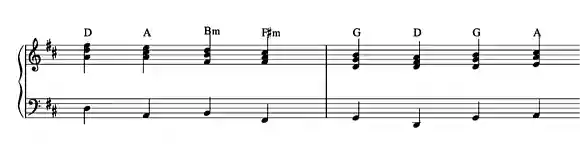
The sheet music below shows the chord progression of Pachelbel’s Canon.
Speaking of the Canon progression, many of you have probably heard of it; it refers to the chord progression used in Pachelbel’s Canon (including similar variants). It also appears in the choral piece “Believe” and in Aimyon’s “Marigold.”
Reference:Basic knowledge of chord progressions: What are dominant motion and the canon progression?
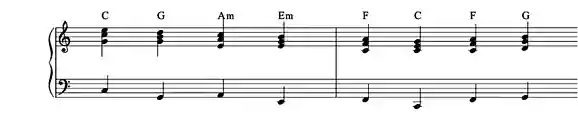
This progression is I V vi iii IV I IV V, and since Pachelbel’s Canon is in the key of D major, it becomes D A Bm F# m G D G A. If you transpose it to C major, it becomes C G Am Em F C F G.
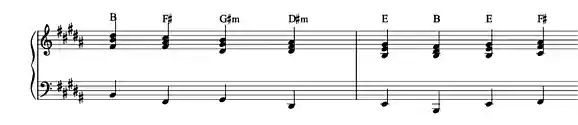
In the key of B major, Happy Birthday is: B F# G#m D#m E B E F#.
In “Happy Birthday,” the canon progression is used in both the verse and the chorus.
In the A section, the first four bars use the progression “B F♯/A♯ G♯m D♯m E B C♯m7 E/F♯,” and the next four bars use “B F♯/A♯ G♯m Bm/F♯ E F♯ B.”
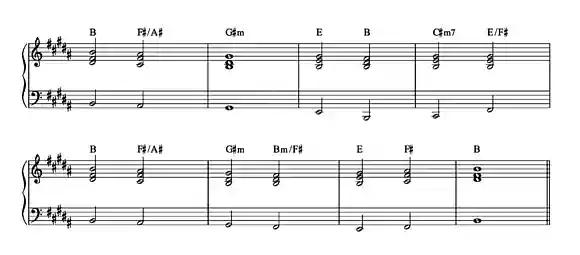
Let's compare the A melody with the Canon progression.
The first half is almost the same, and you can see that the first two measures of the second half are similar as well.
Here, we introduce only one form, but there are various ways to press the code.
Let's try various positions.

How do you learn style?
Next is the style.
By style, I mean the use of sounds, the groove, and the rhythm.
First, it’s important to listen to the music carefully and get to know its style.
In that sense, thoroughly copying your favorite artist is a good thing.
Because you can learn the artist's style.
To expand your own repertoire, let's imitate songs from genres different from our band’s and increase our toolkit—such as types of backing patterns and solo phrases.
Among those, what’s important is not only what the keyboards are doing, but also listening to what the other instruments are doing—what about the drums? The bass? The guitar?
Listen, listen—think about how to express that style on the keyboard.
Even if you play the piano with the same rhythm as the guitar backing, it won’t have the same feel.
Therefore, it is important to increase your own items as well.
Concrete examples of piano shapes
A common basic pattern for piano accompaniment is left-hand bass plus right-hand chords, and depending on the style, this basic pattern can be transformed in various ways.
In the backing parts of a song, it’s generally common to play chords with both hands like this, but the rhythm you use to play them is crucial.
In “Happy Birthday,” various commonly used accompaniment patterns appear, so be sure to master them thoroughly.
Now, within “HAPPY BIRTHDAY,” let’s take a look at what the piano is doing.
Intro
As for the intro of this song, it handles the main melody, just like the guitar.
It will be played in octaves, but beginners may use both hands to play the octaves.
However, to convey the feel of playing with one hand, it’s better to play non-legato.
Playing in octaves comes up often on the piano, so make it a habit to train regularly—for example, by playing various melodies in one-handed octaves.
Verse A
It takes a shape similar to an 8-beat drum pattern.
In the first half of number 1 the piano rests, but in the second half it is as follows.
Be mindful of how the basic form is changing, and try thinking about it in other code as well.
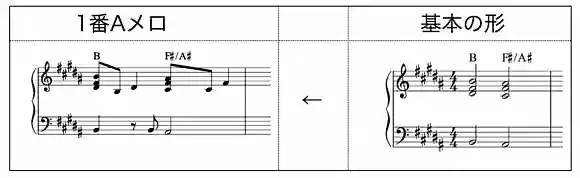
Even with the same pattern, changing the position you play it in can change the feel.
You can also rearrange the sounds of the base form to create shapes like this.
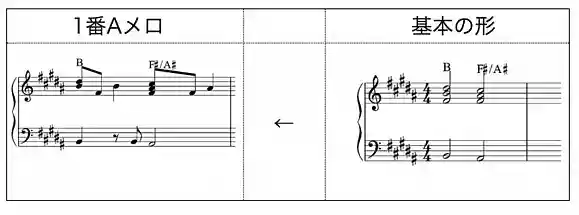
In the first pattern, the top notes are “B C# D# F#,” but in the second pattern the top notes are “C# F# B C# F# G#.” Just changing the top notes alters the feel, doesn’t it?
The chorus uses quarter notes in the right hand.
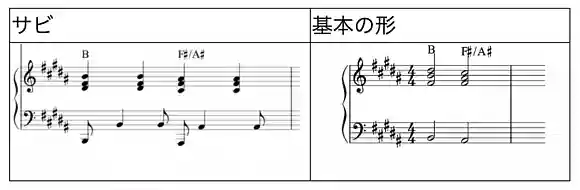
You probably see this form quite often, don’t you?
It’s also often used for solo singing with self-accompaniment.
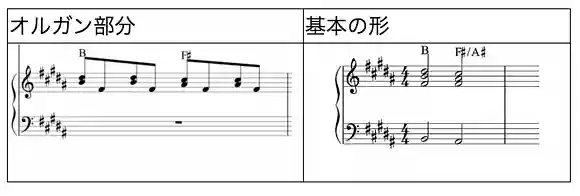
Pattern of the organ part
This pattern is also commonly used in 8-beat, so it’s good to get it down.
A form that evokes a 16-beat feel
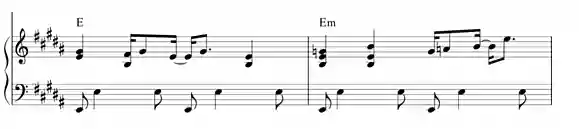
Where are the sixteenth notes included?
If you keep practicing rhythms like these, you’ll probably get a sense of how to bring out a 16-beat feel.
It’s a good idea to practice this kind of pattern with various chord progressions.
This is sheet music with melody and code for “HAPPY BIRTHDAY.”https://publish.piascore.com/scores/54645
With this type of musical score, let's think of various accompaniment patterns.
I also made a keyboard score.https://publish.piascore.com/scores/54642
The melody and chords, the piano (+ organ), and the strings parts are written out in the score.
If possible, it would be nice to be able to play using just a melody score with chord symbols.
Please try arranging the keyboard yourself, using this article as a reference.
I’m uploading videos on YouTube for practice.
I posted an image of a MIDI keyboard, and it includes backing sounds like drums, guitar, and vocals.
This is the piano version.
Here is the MIDI keyboard for the strings section.