

![[Master it in 1 month] Learn to play Gen Hoshino's 'SUN' on piano! Chord change practice edition](https://media.ragnet.co.jp/img/1200__jpg__https://www.ragnet.co.jp/files/2016/07/190bd594cbe7759a16fc7e390d8c0fc0.webp)
[Master it in 1 month] Learn to play Gen Hoshino's 'SUN' on piano! Chord change practice edition

This time, under the theme “Let’s master piano accompaniment!”, we’re taking on Gen Hoshino’s “SUN.” Once you get used to this practice style, you’ll be able to play most songs right away as long as you have the chords.
The practice method is the same for songs other than “SUN,” so try tackling various pieces.
You do need to learn the chords, but by challenging yourself with songs you like, you should be able to memorize them little by little.
It’s a curriculum you can master in one month (about four weeks), so give it a try!
[Master in 1 Month] Learn to Play Gen Hoshino’s “SUN” on Piano!
We will proceed as follows.
- Week 1We will practice code changes by dividing them into blocks.
- Second weekPractice the intro and practice by actually playing the code from week 1
- Week 3: While reviewing what we’ve covered so far, practice playing through continuously from the intro at a slow pace (in tempo).
- Week 4: Have someone sing it for you, or practice along with the song yourself and finish it.
If your progress in Week 1 is slow, spend more time on the Week 1 section.
If you move on without mastering chord changes, it won’t work out in the end, so repeated practice is essential.
Below is a video of me actually singing with piano accompaniment.
I have also prepared the sheet music, so I hope you find it helpful as well.
Due to copyright reasons I can’t make it free, but I created a sheet music file (324 yen) that includes the actual melody and lyrics, the sheet music and chords I’m actually playing, and keyboard diagrams for those chords.
The numbers written on the keyboard diagram correspond to the numbers on the keyboard diagram.
SUN/Gen Hoshino Piano Accompaniment Sheet Music with Practice Keyboard Chord Chart / DLmarket
People who can handle MIDI also sell MIDI data.
Before you practice: Know the key and listen closely to the song!
First of all, it’s important to listen to the piece carefully.
Prepare the sheet music and make sure you have the structure firmly in mind.
First, prepare the sheet music. (As long as it includes the melody and chords, that’s fine.)
If you can transcribe by ear, it's fine to pick out the chords yourself and write out the structure.
PreviouslyTips for playing Vocaloid songsAs I mentioned, the first thing is to grasp the key and the structure.
Let's include markers like Intro ~ A ~ B so that you can recognize the sections yourself.
The key of “SUN” is A♭, then it modulates to A.
People who can read sheet music might think, “Make it an easier score without flats or sharps,” but for those who can’t read music, things like that don’t really matter.
I think many people can play 'I Stepped on the Cat' even without having learned the piano, but when you put 'I Stepped on the Cat' into sheet music, it has lots of flats and is very difficult.
But if you're not looking at sheet music, black keys are easier to find than white keys, so 'Neko Funjatta' is easy.
Therefore, this time I'd like to take an approach of practicing as much as possible through coding.
First, let's make a plan for the month!
Prepare a calendar like the one below and write in your rough plans.
Either every day or every week is fine.

Progress varies depending on the challenger’s level, but I think this practice sequence works best.
Week 1: Practice code changes
First, in the first week,Check the chords and practice the pattern of left-hand bass plus right-hand chords.I will do it.
Is the ABC of the code okay?
Reference:For piano beginners: an easy-to-understand way to practice chord changes
“A, B, C, D, E, F, G” → “La, Si, Do, Re, Mi, Fa, Sol”, “A♭” → “La♭”, “C♯” → “Do♯”.
The first half is in the key of A♭, so basically you can compose the song using the chords in the key of A♭.

Since it changed to key A, it's here.
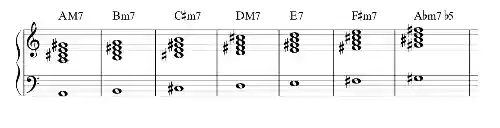
I wish I could say, “That’s all there is to it!” but this song actually borrows chords from other keys and uses so-called tensions, so you’ll encounter chords that incorporate a variety of notes.
However, for the left hand, it's basically A as 'La' and A-flat as 'La-flat.'
Both A♭M7 and A♭7 use A♭ in the left hand, so don’t worry.
The other chords that appear in this assignment piece, SUN, are provided later in the article.
The code varies slightly depending on the sheet music.
Although the sound is the same, for reasons like the names being different, I think it's fine to use either.
There are also parts where I myself write A♭M7 or A♭7 and fret them using the A♭ shape.
If you’re someone who thinks, “I don’t get this!” please skip this section without reading it.
The code shown above is the basic form, so I often play it in other voicings. For example, while “A♭M7” is written as A♭–C–E♭–G, there are many cases where I don’t actually play the G.
I also focused this time on making it easy to finger, so many notes have been omitted for that reason. If you understand chords yourself, feel free to shape them however you like.
Then, referring to the latter part of the article (Day 1 and onward), let’s start practicing from the first two measures of the A melody.
The key points are to be mindful of which notes stay the same and which change, to first check your left hand, and to decide on the fingering before you start playing.
Reference:Basic fingerings for piano beginners
If you're having trouble making progress, start by working up to the key change in the song.
If you’re unsure about the code, don’t try to practice everything in one day—proceed block by block instead.
Let's make a plan for how many blocks we will progress in a day.
Example of how to proceed
If on Day 1 you progress up to measure 2 (①), then on Day 2 review ① and work on ②, and afterward practice playing ① and ② together in sequence.
On day 3, review day 2 plus “③”… and continue like this for a week while reviewing.
Day 1 Lesson: Verse A
Intro
It starts in the key of A-flat.
(I haven’t included the keyboard part from the intro.)
The chord progression is “D♭M7 → Cm7 → B♭m7 → D♭/E♭” ×3 → C7/G♭.
Chords used in the A verse
1 → 2 → 1 → 2 (without the last E♭)
- ①:A♭M7→Gm7♭5→C7→Fm7→E♭m7→A♭7
- ②:Cm7→Fm7→B♭m7→E♭
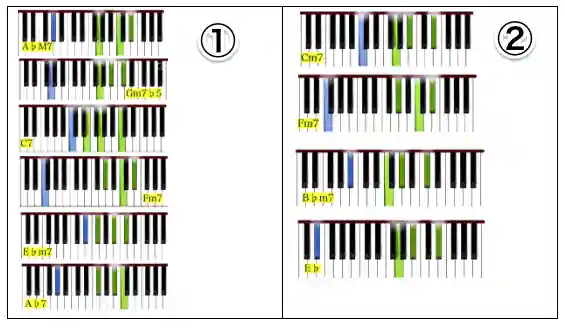
Day 2 Lesson: B-Melody
Chords used in the B section
③×2 + E♭sus4, E♭ (No keyboard diagram for this bar)
- ③:D♭M7→Cm7→B♭m7→Cm7→D♭M7→Cm7→B♭m7→E♭sus4→E♭
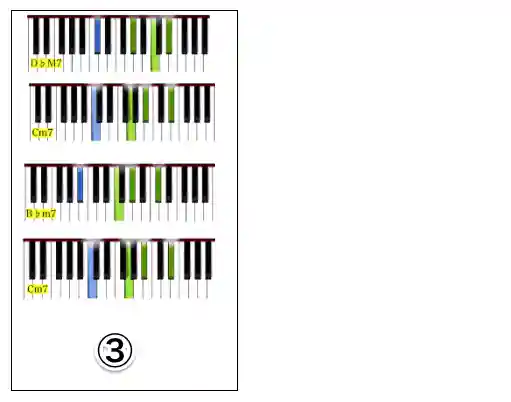
Day 3 Lesson: First Half of the Chorus
Chords used in the chorus
No.1 ④→⑤→④→⑤ first half (B♭m7, Cm7) ×2 → ⑥ → ⑦ ×4 (omit G♭ on the last repeat) → back to intro
Section 2, ④ → ⑤ → ④ → first half of ⑤ (B♭m7, Cm7) ×2 → ⑥
- ④:A♭M7→D♭M7→E♭→Edim→Fm7
- ⑤: B♭m7 → Cm7 → B♭m7 → E♭ → A♭M7 → D♭M7 → E♭ → as is → Fm7 → B♭m7 → Cm7 → (B♭m7 → Cm7)
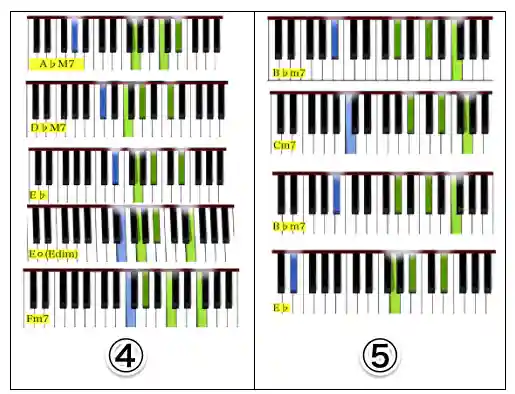
Lesson 4: Second half of the chorus
Continuing from day 3 last time ~
- ⑥:D♭→Cm→D♭→D♭/E♭
- ⑦: Fm7 → B♭7 → E♭7 → A♭ → G♭ × 4 times (omit the final G♭ on the 4th time)
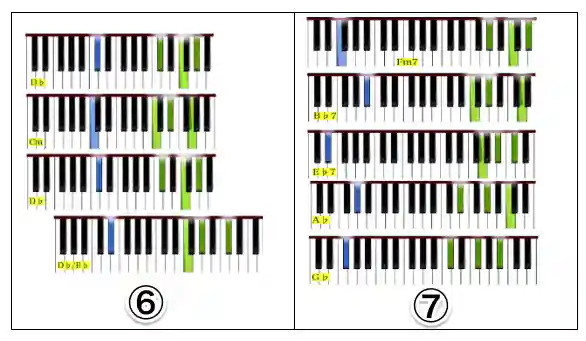
Lesson Day 5: After the chorus (second verse, latter half, before the key change)
Chords to use after the chorus (latter half of verse 2, before the key change)
⑧→⑨→⑧→⑨ (first half only) → ⑩
- ⑧:B♭m7→Gdim→Fm7→E♭m7→A♭7→D♭
- ⑨: B♭m7 → Cm7 → D♭ → Fm7 → Em7 → E♭m7 → A♭7 (only the first half on the second time)
- ⑩:E♭sus4→Esus4
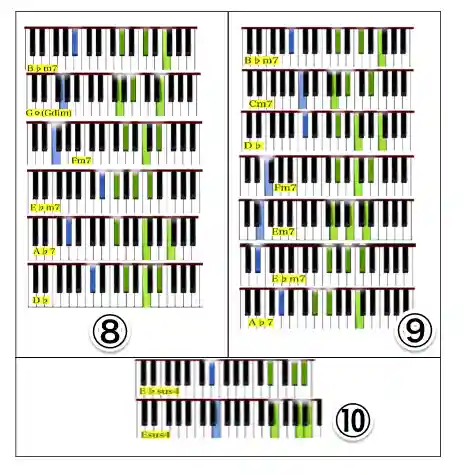
Day 6: Chorus after the key change ~
Chords used in the chorus after the key change (key of A)
1st time: ❹ → ❺ → ❹ → first half of ❺ (Bm7, C#m7) → ★
2nd time: ④→⑤→④→⑤ first half (Bm7, C#m7) → ⑤ first half (Bm7, C#m7) → ⑥ → ⑦ ×4 (no G on the last repeat)
- ❹:AM7→DM7→E→Fdim→F♯m7
- 5: Bm7 → C#m7 → Bm7 → E → Amaj7 → Dmaj7 → E → as is → F#m7 → Bm7 → C#m7
- ★:DM7→C♯m7→D/E
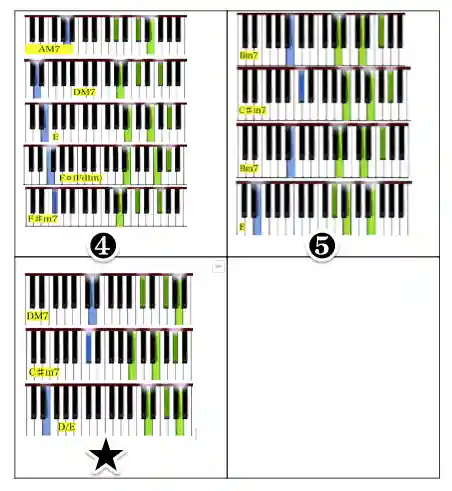
Day 7: Before the ending
- ❻:DM7→C♯m7→Bm7→Bm7/E
- 7: F♯m7 → B7 → E7 → A → G × 4 times (on the 4th time, omit the final G)
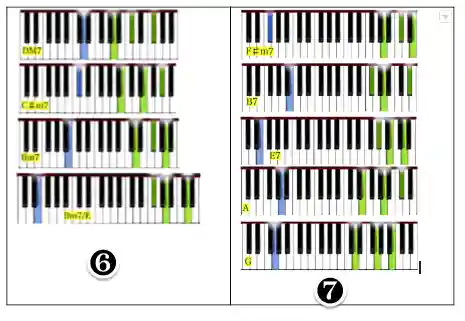
For the ending that follows, use the same pattern as the intro, in the key of A!
It goes DM7 → C#m7 → Bm7 → D/E, repeated three times, then C#7/G. However, for the intro pattern, practice it as a pattern rather than as chords.
More details later.next timewill update to
next timeThis is the intro!