

DIY science projects that elementary school boys will love: ideas you can make with everyday materials


For a summer vacation independent research craft project, you’ll want ideas that really grab boys’ interest.
In this article, we introduce craft ideas that boys can get absorbed in—like making a capsule toy (gachapon) machine out of cardboard, creating genuine fishing gear with a reel, and handcrafting air hockey or a basketball game.
They all look impressive yet can be made with everyday materials.
How about creating fun summer memories by playing with your favorite project together with friends?
- For summer vacation homework! Simple and amazing crafts for elementary school students that you’ll want to make after seeing them
- For upper-grade boys! Simple yet awesome craft project [Don’t call it lazy]
- Craft ideas using plastic bottle caps [for boys]
- Simple yet amazing crafts: craft ideas that elementary school students will want to make
- Elementary School Students: Simple One-Day Science Project and Craft Ideas
- Fun crafts using straws
- Recommended for elementary school students! Science fair topics & craft ideas
- Recommended for lower elementary school students! A collection of plastic bottle craft ideas made with everyday materials.
- Toys you can make from cardboard crafts! Authentic ideas you can build and play with
- Crafts parents and kids can enjoy together. Recommended craft ideas to keep children entertained.
- Paper cup crafts that elementary school kids will love! A collection of fun project ideas
- [Middle School Students] Easy One-Day Science Projects and Crafts Ideas
- You can make them with cardboard! Cool katanas & swords
Hands-on science projects that elementary school boys will love! Ideas you can make with everyday materials (71–80)
Easy! A chopstick rubber band gun that can even use hair ties

This rubber band gun made from disposable chopsticks is very simple—you just bundle the chopsticks together and fasten them with rubber bands.
First, stack four chopsticks and secure them in two places with rubber bands.
To catch the rubber band that will serve as the projectile, leave the top and bottom sticks of the four sticking out a bit longer.
Attach a clothespin together with the topmost rubber band at the rear.
The rubber band projectile is gripped by both the clothespin and the chopsticks; when you pull the clothespin, the band shoots out.
Try using a hair tie as the projectile—it won’t hurt much even if it hits you.

A three-step chopstick rubber-band gun

This is a chopstick rubber-band gun that you can make with a simple procedure: use chopsticks as the base and attach a clothespin with a rubber band.
Insert the metal part of the clothespin into the gap between the chopsticks, then secure the clothespin in that position with a rubber band.
After that, to keep the chopsticks from spreading apart, wrap a rubber band around the tips of the chopsticks, and it’s done.
The mechanism is that you launch a rubber band stretched from the tip by opening and closing the clothespin.
The appeal is that you can make a chopstick rubber-band gun easily with only a few materials.

How to make a chopstick gun
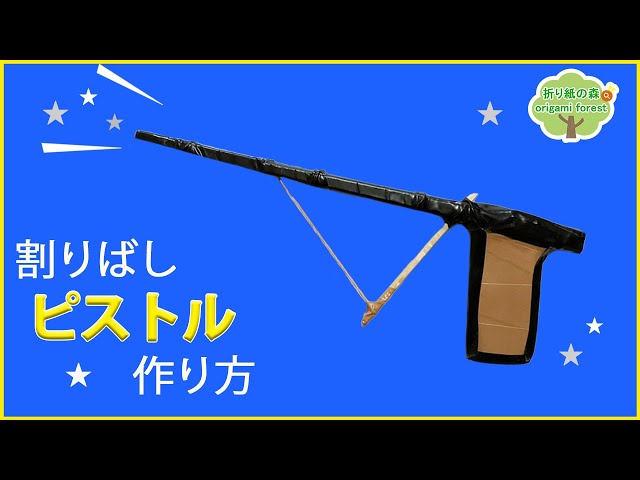
In addition to chopsticks and rubber bands, this chopstick gun uses cardboard and duct tape to combine into a pistol-like appearance.
The basic firing mechanism is assembled from chopsticks and rubber bands, and then a grip and decorations are attached using cardboard and tape.
Since you’ll end up covering the whole thing with tape so it looks like a pistol, it’s important to build a sturdy base beforehand.
Let’s also pay attention to how we decorate it to make it look as realistic as possible.
Hands-on science projects elementary school boys will love! Ideas you can make with everyday materials (81–90)
Rifle-style chopstick rubber band gun

This is a chopstick gun assembled into a shape like a rifle, clearly conveying a strong, powerful image.
Each part is made by aligning chopsticks and gluing them together, then assembling pieces of different lengths and widths into a rifle form.
The rubber band firing mechanism is simple: a rubber band hooked at the front is released by moving the trigger.
Because of that simplicity, the visual impression of strength depends on how much heft and presence you can express in other aspects.
You can showcase individuality by either making the most of the chopstick material itself or by adding solid decorative elements.
Combine a chopstick rubber-band gun with an origami throwing star!

Let’s try making a “shuriken gun” that combines a chopstick rubber band gun with paper shuriken.
It’s a lot of fun because the shuriken, which you’d normally throw by hand, comes out as the projectile instead.
You’ll need two pairs of disposable chopsticks, two sheets of origami paper, and some rubber bands.
Use one pair of chopsticks without splitting them; split the other pair.
Wedge the split sticks between the unbroken pair and fasten them with rubber bands.
Fold the paper shuriken, tuck it into the rubber bands, and launch it together.
It’s a unique twist on the classic chopstick gun—give it a try! You can probably launch things other than shuriken, too.
Even grade-schoolers can make it! Triple-shot chopstick rubber band gun
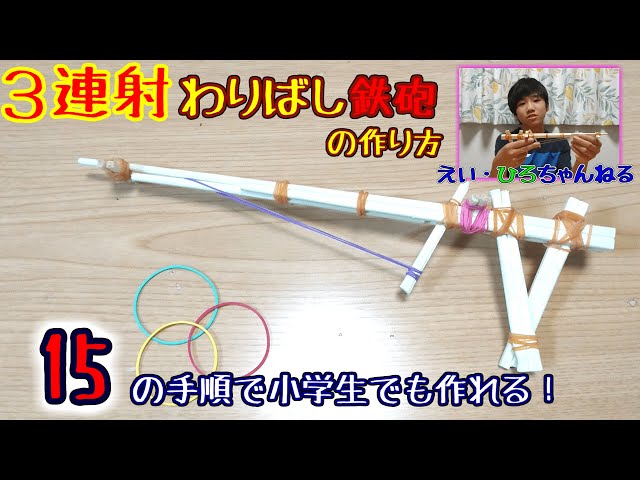
You might think it’s just a simple chopstick rubber band gun, but it actually has a feature that lets you fire three rubber bands.
The building process is straightforward: attach a handle to a bundle of chopsticks that serves as the base, then install a movable trigger so that it’s sandwiched in place.
What’s crucial here are the trigger shape and the positions where the rubber bands are hooked.
By attaching three rubber bands at different positions, they will fire in sequence.
The hooking method for each band is also intricate, so doing that accurately is a key point.
Rubber band gun with two materials
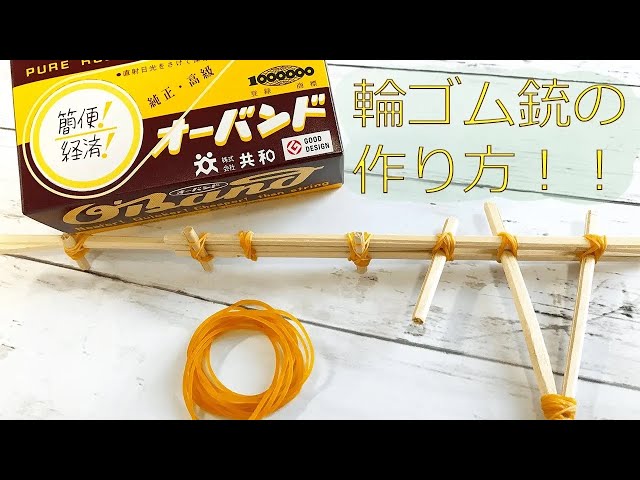
Here’s a simple rubber band gun idea you can make with about three pairs of disposable chopsticks and around ten rubber bands.
Split all the chopsticks into single sticks; leave three as they are, and cut the rest into three different lengths.
If you use a utility knife for cutting, handle it with care.
It’s also a good idea to sand the cut edges for safety.
Combine the cut chopsticks to build the body, grip, and trigger, and finally create a notch at the front end of the body where the rubber band will hook.
The body tends to be long and unstable, so reinforce it by bracing it from below with shorter chopstick pieces.
