

DIY science projects that elementary school boys will love: ideas you can make with everyday materials


For a summer vacation independent research craft project, you’ll want ideas that really grab boys’ interest.
In this article, we introduce craft ideas that boys can get absorbed in—like making a capsule toy (gachapon) machine out of cardboard, creating genuine fishing gear with a reel, and handcrafting air hockey or a basketball game.
They all look impressive yet can be made with everyday materials.
How about creating fun summer memories by playing with your favorite project together with friends?
- For summer vacation homework! Simple and amazing crafts for elementary school students that you’ll want to make after seeing them
- For upper-grade boys! Simple yet awesome craft project [Don’t call it lazy]
- Craft ideas using plastic bottle caps [for boys]
- Simple yet amazing crafts: craft ideas that elementary school students will want to make
- Elementary School Students: Simple One-Day Science Project and Craft Ideas
- Fun crafts using straws
- Recommended for elementary school students! Science fair topics & craft ideas
- Recommended for lower elementary school students! A collection of plastic bottle craft ideas made with everyday materials.
- Toys you can make from cardboard crafts! Authentic ideas you can build and play with
- Crafts parents and kids can enjoy together. Recommended craft ideas to keep children entertained.
- Paper cup crafts that elementary school kids will love! A collection of fun project ideas
- [Middle School Students] Easy One-Day Science Projects and Crafts Ideas
- You can make them with cardboard! Cool katanas & swords
Hands-on science projects elementary school boys will love! Ideas you can make with everyday materials (41–50)
leaf vein specimen

Plants have veins—like blood vessels in humans—that carry water drawn up from the ground to the tips of stems and leaves, and circulate the nutrients produced by photosynthesis.
How about turning those veins into a specimen? Heat a sodium hydroxide solution and place a leaf in it.
After about 20 minutes, take it out and gently brush the surface with a toothbrush; the leaf tissue will come off, leaving only the veins! You’ll likely think, “I can’t believe they’re spread out this much.” If you soak it with ink, it will look even more vivid!

levitating spinning top

The project involves creating a mysterious top that keeps spinning in midair, combining both experimentation and craftsmanship.
It uses magnetic repulsion, so the challenging parts are finding strong magnets and adjusting the top to the precise point where the magnetic force is just right.
Although sourcing the magnets is difficult, the other tools are easy to obtain, such as bamboo chopsticks and masking tape.
As the video shows, it takes time to complete, and persistence in repeatedly making adjustments is crucial for success.

Powerful! Chopstick Gun
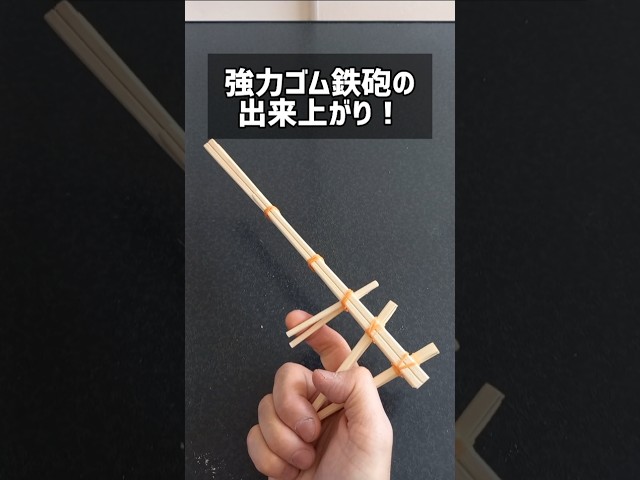
Prepare seven pairs of disposable chopsticks and plenty of rubber bands as materials.
First, use five pairs of chopsticks to make the main body.
Stack the chopsticks for the body alternately left and right so that about two-thirds overlap.
Secure them firmly at two points with rubber bands, then cut a notch at the front end to hook a rubber band.
Attach a short, cut chopstick to the rear of the body as the trigger, and glue another chopstick fixed in a V-shape behind that as the grip.
Your powerful chopstick gun is complete!

Let’s try making a rainbow

Rainbows are dreamy, beautiful, and wonderful, aren’t they? Finding one by chance after the rain really lifts your spirits.
Here’s a simple science project where you can make a rainbow using just a CD and a flashlight.
It only takes about five minutes, so it’s perfect if you’re short on time and feeling the pressure.
You might also write up an explanation of why it works and perform just the demonstration in front of everyone.
It’s an experiment that elementary school students in the middle grades can enjoy.

Water that won’t spill even when turned upside down

This is a science magic trick perfect for a summer vacation project.
Water that won’t spill even when turned upside down.
Put a sieve over the mouth of a plastic bottle, then turn it upside down…
and the water in the bottle doesn’t spill.
Next, remove the sieve lid…
and the water spills out.
It’s highly recommended for lower elementary school students, as they can experience concepts like weight, gravity, and the mass of water.
Why doesn’t the water spill even though the sieve has lots of holes? Investigate and summarize what phenomena are involved!

Cute mysterious bottle

A mysterious bottle where two liquids won’t mix even when tilted.
It’s a fun idea that works great as interior decor or a small gift.
First, fill the bottle about halfway with baby oil.
Next, add colored water tinted with food coloring.
Put in glitter or holograms as you like, cap it, and decorate the bottle to make it cute—and you’re done! The method is very simple, so even younger elementary school children can enjoy making it.
Along with the craft, try summarizing both your own ideas and the correct explanation for why baby oil and water don’t mix.
Well-spinning paper cup top
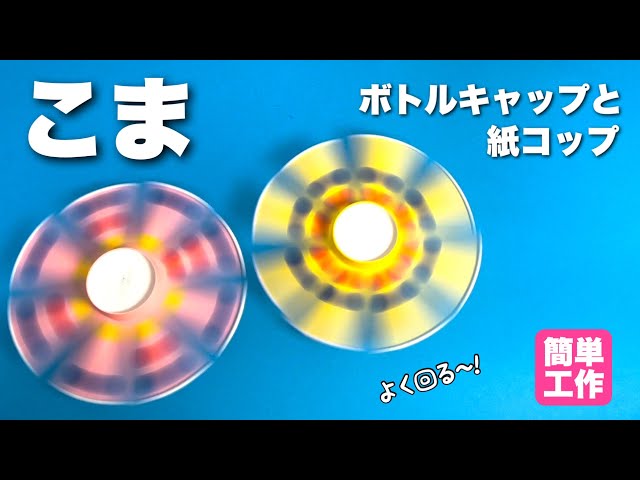
This is a spinning top made with a paper cup that spins well and is fun to watch because of its colorful look.
All you need are a paper cup and two plastic bottle caps.
First, cut slits into the paper cup and spread them out like propeller blades, then attach an axle made by combining the two caps.
That’s enough to complete the basic shape, but it’s recommended to decorate the “propellers” with an eye toward how it will look while spinning.
The impression changes depending on whether you spread the propellers before decorating or decorate first and then cut the slits, so try out various patterns.