

DIY science projects that elementary school boys will love: ideas you can make with everyday materials

For a summer vacation independent research craft project, you’ll want ideas that really grab boys’ interest.
In this article, we introduce craft ideas that boys can get absorbed in—like making a capsule toy (gachapon) machine out of cardboard, creating genuine fishing gear with a reel, and handcrafting air hockey or a basketball game.
They all look impressive yet can be made with everyday materials.
How about creating fun summer memories by playing with your favorite project together with friends?
- For summer vacation homework! Simple and amazing crafts for elementary school students that you’ll want to make after seeing them
- For upper-grade boys! Simple yet awesome craft project [Don’t call it lazy]
- Craft ideas using plastic bottle caps [for boys]
- Simple yet amazing crafts: craft ideas that elementary school students will want to make
- Elementary School Students: Simple One-Day Science Project and Craft Ideas
- Fun crafts using straws
- Recommended for elementary school students! Science fair topics & craft ideas
- Recommended for lower elementary school students! A collection of plastic bottle craft ideas made with everyday materials.
- Toys you can make from cardboard crafts! Authentic ideas you can build and play with
- Crafts parents and kids can enjoy together. Recommended craft ideas to keep children entertained.
- Paper cup crafts that elementary school kids will love! A collection of fun project ideas
- [Middle School Students] Easy One-Day Science Projects and Crafts Ideas
- You can make them with cardboard! Cool katanas & swords
Hands-on science and craft projects that elementary school boys will love! Ideas you can make with everyday materials (31–40)
Working Vehicles on a Milk Carton
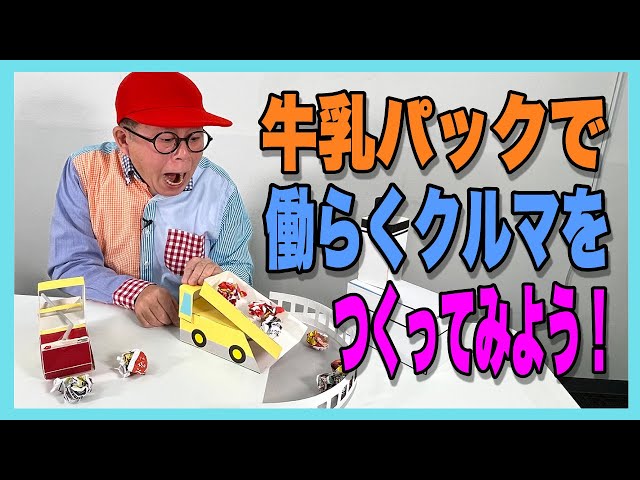
Here’s an idea for making working vehicles using milk cartons.
In this example, we’re making a dump truck and a wheel loader—both are vehicles that boys especially love! Basically, you cut the milk carton with scissors, then glue the pieces together to form the body.
For the moving mechanisms, attach straws so that pulling the straw makes the parts move.
Decorate the body with construction paper and add the tires, and you’ve got a playable toy vehicle! It’s an easy craft to make, so give it a try!

lottery drum

How about making a garapon, the familiar lottery machine where a ball pops out when you spin it? As long as you have the materials, it should be finished in about two days.
The key to making a garapon is carefully measuring and cutting each part to the correct length; if you do it haphazardly, it won’t spin smoothly.
Since the work is fairly detailed, it may be best suited for upper elementary school students.
You may be able to get cardboard for free at supermarkets, so try asking them first.

Fishing game with a realistic reel

Here’s a craft idea for a fishing rod with a reel that I’d recommend for boys who love fishing.
Materials: three paper cups, a chopstick, a straw, string, and a magnet.
First, connect the chopstick and the straw to make the rod, and glue one paper cup to the chopstick to serve as the reel.
Cut one of the remaining paper cups about 2 cm down from the rim, then insert the cut piece into the last paper cup.
Stack this onto the paper cup that’s glued to the chopstick.
Thread the string through the straw, tape one end of the string to the paper cup, and attach a magnet and a paper bait to the other end.
You’re done! Coloring it or decorating it with stickers will make it even nicer.
Cute lantern made with disposable chopsticks
https://www.tiktok.com/@mami_toys/video/7141827992879172866Let me introduce a cute lantern you can make with disposable chopsticks—fun to display and enjoy.
Prepare chopsticks, glue, and washi paper.
Cut the chopsticks and build the lantern’s frame.
The key is to keep an eye on the balance so the frame doesn’t shift out of place.
Attach washi paper from the back to create the lantern’s window sections.
Finally, glue the frames together to finish.
It’s also recommended to use your favorite colors for the window sections.
The light that leaks through the gaps between the chopsticks looks absolutely beautiful.

Colorful Koropika Mud Dumpling

If they’re boys, don’t you think many kids like making mud balls? This science project is a “Colorful Shiny Mud Ball” you can create using a special kit! When you make a mud ball, you usually harden it to some extent and then sprinkle fine powder on it to polish it, right? With this kit, you also apply colored powder at the end, so you can make a very colorful mud ball.
It’s suitable from first grade in elementary school, and a few hours are plenty for the work! Since it feels like play, it’s recommended even for kids who think, “Ugh, independent research is such a hassle!” You could also try varying the number of times you dust with powder or the length of the resting time and summarize the results!
Hands-on science projects elementary school boys will love! Ideas you can make with everyday materials (41–50)
Automatic sorting piggy bank

Making a piggy bank is a classic summer vacation craft, but an idea that takes it a step further is an automatic coin-sorting bank.
When you put money in, it automatically separates coins like 50-yen, 100-yen, and 500-yen pieces by type.
It uses the fact that coins differ in size.
Before you look up how to make one online, though, I recommend first thinking on your own about how to sort them well.
Trying out different ideas—“What about this? Maybe that?”—will be a valuable learning experience.
PET bottle filtration device

This is an experiment to try building a device that turns dirty water into clean water.
It helps us understand how the water we use in daily life is treated, and it’s also useful for disaster preparedness.
We’ll create layers of activated charcoal, small stones, and cloth inside a plastic bottle, then pour in cloudy water and filter it to make it cleaner.
It could also be interesting to research other materials that remove different kinds of contaminants and compare how they perform.
Note that to use the water for drinking, you need additional steps such as filtering multiple times and boiling to remove bacteria, so please take care.
