




When it comes to magic, classic card tricks are the go-to, right?They’re full of surprising moments that make your heart race with excitement.In this article, we’ve gathered magic tricks that use playing cards—something everyone has held at least once.I’ll introduce easy card tricks that are simple to do yet deliver a strong impact for first-time viewers once you learn them!We’ve focused on self-working tricks you can do just by following the steps, as well as tricks you can master with a little practice—perfect for beginners in card magic!
- [By Difficulty] Simple Card Magic Tricks Using Playing Cards
- [Easy] A Beginner’s Guide to Card Magic: Tricks Even Elementary School Kids Can Do Right Away
- Cool playing card magic. Card tricks of various difficulty levels.
- A fun number-guessing magic trick! A collection of easy ideas
- Super easy magic tricks kids can do! Fun tricks you can play right away
- [Easy] Magic tricks that will liven up the classroom: Recommended tricks you can do even during recess
- [Card Magic] Amazing Magic Revealed: Difficult Tricks for Advanced Magicians
- With Explanations: Easy Magic Tricks for Lower-Grade Elementary School Children — How to Do Simple Tricks
- A roundup of finger tricks: magic you can do using just your fingertips.
- Simple magic tricks that delight kids: surprising to watch and make you want to try them yourself.
- Simple magic tricks using stationery: recommended tricks for parties and performances
- Simple Magic! Fun Tricks Kids Can Do & Revealed Secrets!
- [Easy Magic] Special Feature: Big Collection of Smartphone Magic Tricks
Simple card magic. Tricks you can do with self-working methods or a little technique (1–10)
A card trick performed using only 10 cards
This is a card-prediction magic trick that uses only ten playing cards.
It’s a self-working trick, meaning that if you follow the steps exactly, it will always work.
You hand the spectator ten cards and have them choose one.
Then, following the magician’s instructions, the spectator moves cards from the top to the bottom of the packet and performs various operations themselves.
At one point, they even manipulate the cards according to a number they’re merely thinking of, which makes it seem impossible that the magician could find the chosen card.
But because it’s a self-working trick, the selected card is inevitably revealed at the end.
Give it a try!

A card-guessing trick using five red and five black cards
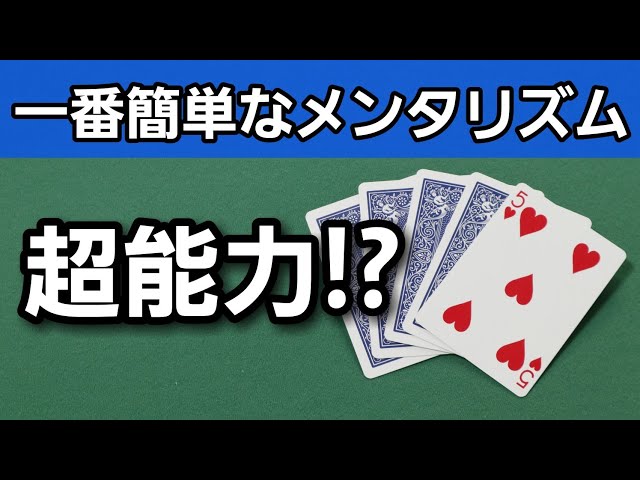
This is a card prediction magic trick using a total of 10 cards: numbers 1 through 5 in both black and red.
First, separate the cards into two piles, black and red.
Have the spectator choose and remember one card from one of the piles, then combine the two piles into one.
Next, follow a predetermined procedure to mix the cards.
In the end, the spectator’s chosen card will be the card of the opposite color to the one that’s fifth from the bottom.
The secret is to set the black and red piles in a specific order beforehand and to shuffle exactly as instructed.
As long as you don’t deviate from the steps, it will work every time, making it great for beginners.
A playing card missing from where it should be

There are magic tricks that don’t rely on complex techniques but instead exploit human assumptions.
For this trick, you prepare three cards: two blank playing cards and the Ace of Hearts.
You lay them out on the table and have the spectator guess which one is the Ace of Hearts.
There are several ways to do it, but a simple and accessible method is to briefly flash the unprinted side to make them mistakenly think it’s a blank card.

Even though the cards were mixed face up and face down, only the chosen card comes out face up.

It’s a magic trick where, even though the chosen card is returned to the deck and the cards are shuffled face up and face down, with a little “spell,” only the selected card appears face up.
After the spectator returns the card, you control it to the bottom during the mixing.
In the phase where you seemingly mix face-up and face-down cards, you use a wrist-turn style shuffle so that it’s not truly random; instead, you subtly build the deck into two packets, one face up and one face down.
Then you bring the bottom card to the top, turn the lower face-down packet back to its original orientation, and stack it so that it sandwiches the selected card—finishing the setup.
Focus on smooth shuffles that merely look chaotic, as well as clean card displays to sell the effect.

Ambitious Card You Can Do Easily

The classic magic trick where, after a little spell, the selected card that was placed into the deck appears on top—the Ambitious Card.
It’s a common trick, but beginners usually can’t perform it without difficult sleight of hand.
However, with the method I’m introducing here, you can achieve the Ambitious Card relatively easily.
The key to this trick is that you only pretend to place the selected card into the deck; in reality, you’re inserting a different card.
Specifically, the selected card remains on top of the pack, while you take a card from the bottom instead of the top.
With a bit of practice, you’ll be able to do this naturally as part of your normal movements, so give it a try.
A panini where the chosen card is sandwiched between two cards

This is a magic trick where the selected card is returned to the deck, and when you take out the Ace of Spades that was shown as the top card and sandwich it between two Jokers, it transforms into the selected card.
When returning the card to the deck, you create a pinky break, and after showing the Ace of Spades, you bring in the Jokers while secretly transferring the top packet beneath the Jokers.
Since taking the top packet leaves the selected card on top, you sandwich that card between the Jokers and then restore the packet you set aside.
Be mindful of techniques such as influencing the selection so the packet stacked with the Jokers is as small as possible, and controlling your hand angles so the audience doesn’t notice the deck has been split.
Three cards come up to the top.

A common card trick is having the selected card rise to the top, but this one looks a bit more advanced: three chosen cards, which should be lost in the deck, all come to the top together.
The secret is actually very simple, yet it’s hard for the spectator to catch, which is why it’s recommended.
Once you master the slip cut—where you keep only the top card in place while cutting the rest—you’ve basically got this trick down.
Give it some practice.
