

Recommended for seniors’ brain training! Kanji quiz workbook of fish names

Fish names often use many difficult kanji, don’t they?
On TV quiz shows, questions that ask you to read fish-related kanji frequently appear.
In this article, we’ll introduce that kind of fish kanji quiz!
In this article, we didn’t just include kanji with the fish radical; we mainly chose fish names written with two or more characters.
So that older adults can enjoy it, it’s important not to focus only on getting the right answer, but to think together with the people around you.
Doing so helps activate the brain and supports mental and physical health, so please enjoy it together with everyone.
- [For Seniors] Looks readable but you can't read it! Fish Kanji Quiz
- [For Seniors] Liven Things Up! Fun Fish Trivia Quiz
- [For Seniors] How many can you read? A comprehensive showcase of difficult food kanji
- [For Seniors] Fun and Lively! Recommended Quiz Questions
- [For Seniors] Challenging but Exciting! Kanji Quiz
- [For Seniors] Fun and Exciting! Difficult Kanji Quiz
- [For Seniors] Find daily brain training. Today’s recommended brain workout.
- [For Seniors] Lateral Thinking Game! Brain Training
- [For Seniors] Fun and Educational True-or-False Quiz
- [For Seniors] Quiz on Kanji with Many Strokes
- [For Seniors] Have Fun with Wordplay Characters! A Collection of Funny Puzzles
- [For Seniors] How many can you read? A kanji quiz of familiar things that look readable but aren’t
- [For Seniors] Difficult-to-Read Kanji for Everyday Items: Take on a quiz full of surprises and discoveries
Recommended Brain Training for Seniors! Kanji Quiz Collection of Fish Names (1–10)
stonefish
The fish read as “okoze” (stonefish) has a distinctive shape with a bumpy head and sharply spread dorsal fins.
While it sports drab colors that let it hide among sand and stones, most species also carry venom in their dorsal fins, so handling requires caution.
Besides 虎魚, it is also written as 鰧, and the kanji themselves convey its distinctive spiky appearance.
It also has a colloquial name, Yamanokami (“mountain god”), said to derive from a custom of offering the unattractive okoze to a jealous mountain deity as a form of tribute.

tiger fish
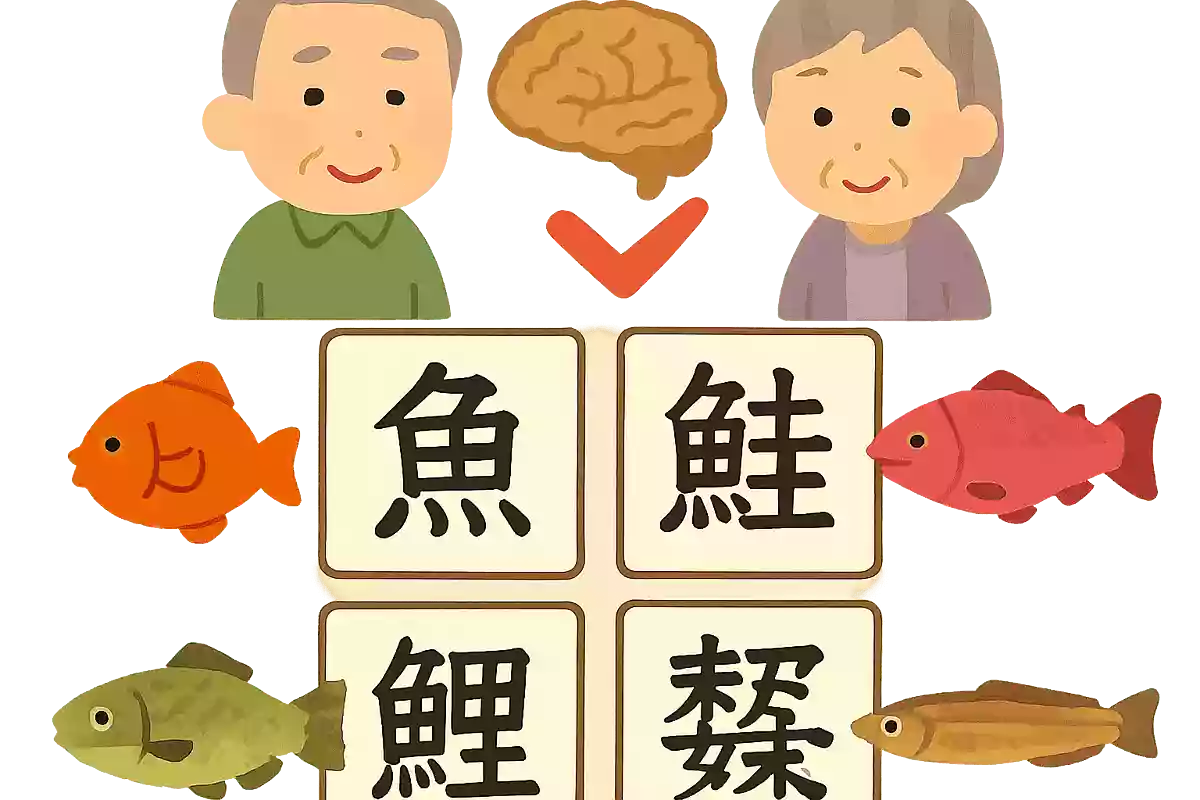
Uotora is the kanji that represents the porcupinefish (harisenbon), and it’s sometimes written as “針千本” (a thousand needles).
It’s a fish characterized by sharp, needle-like scales.
Since it’s a word combining “tiger” and “fish,” it can be grouped alongside terms like okose (the “tiger fish”) and shachi (the orca).
It has an interesting trait of inflating its body when it senses danger, and the sight of its spines protruding in all directions when puffed up is notable.
In Okinawa, it’s affectionately called “abashā,” and once the spines are removed together with the skin, it is also eaten.
squid
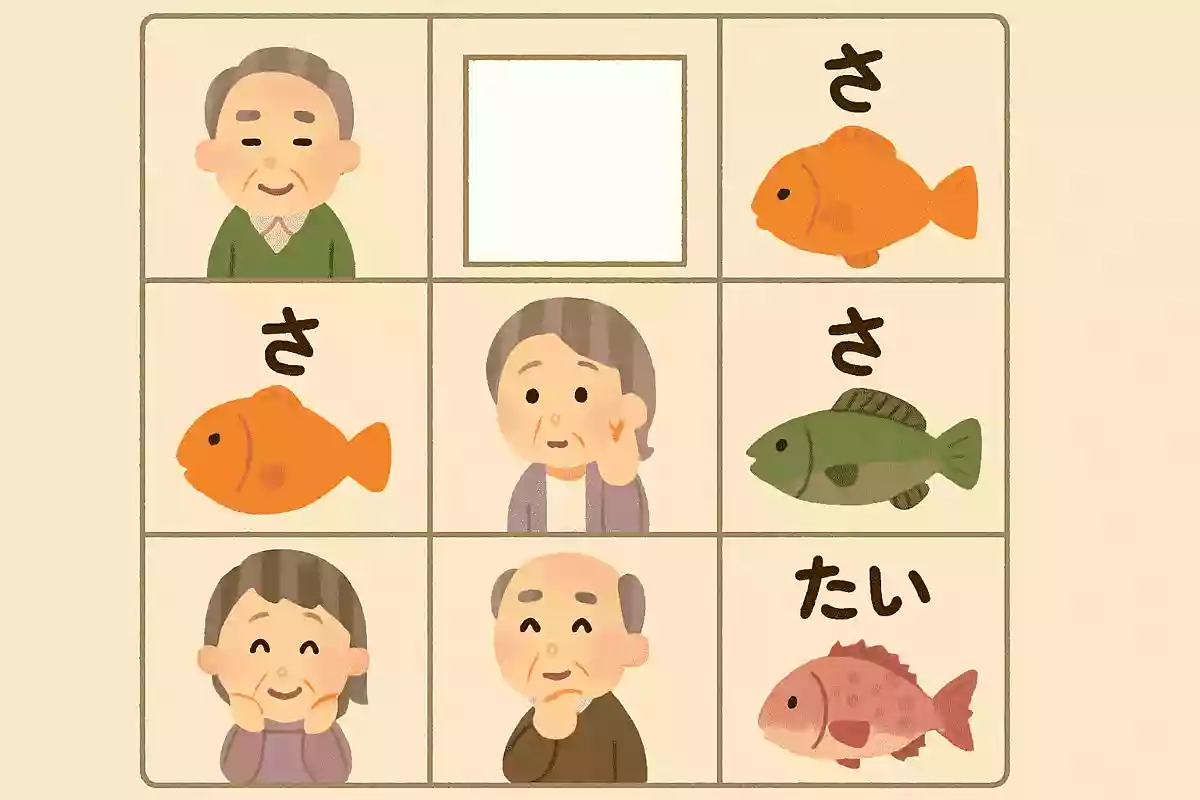
The kanji 烏賊 is read as “ika” (squid) and refers to a creature with many legs and various traits, such as squirting ink.
It’s said to derive from an episode in the ancient Chinese text Nanyue Zhi, in which a squid feigns death and floats to the surface, then drags a crow that comes to peck at it down into the sea.
The existence of many different kanji for squid—such as 鰞, 柔魚, 魷, 墨魚, and 鰂—also conveys how many distinctive features this animal has.
Squid is a traditional favorite that’s enjoyed in many forms, including dried products and sashimi.
Recommended Brain Training for Seniors! Fish Kanji Quiz Collection (11–20)
anglerfish
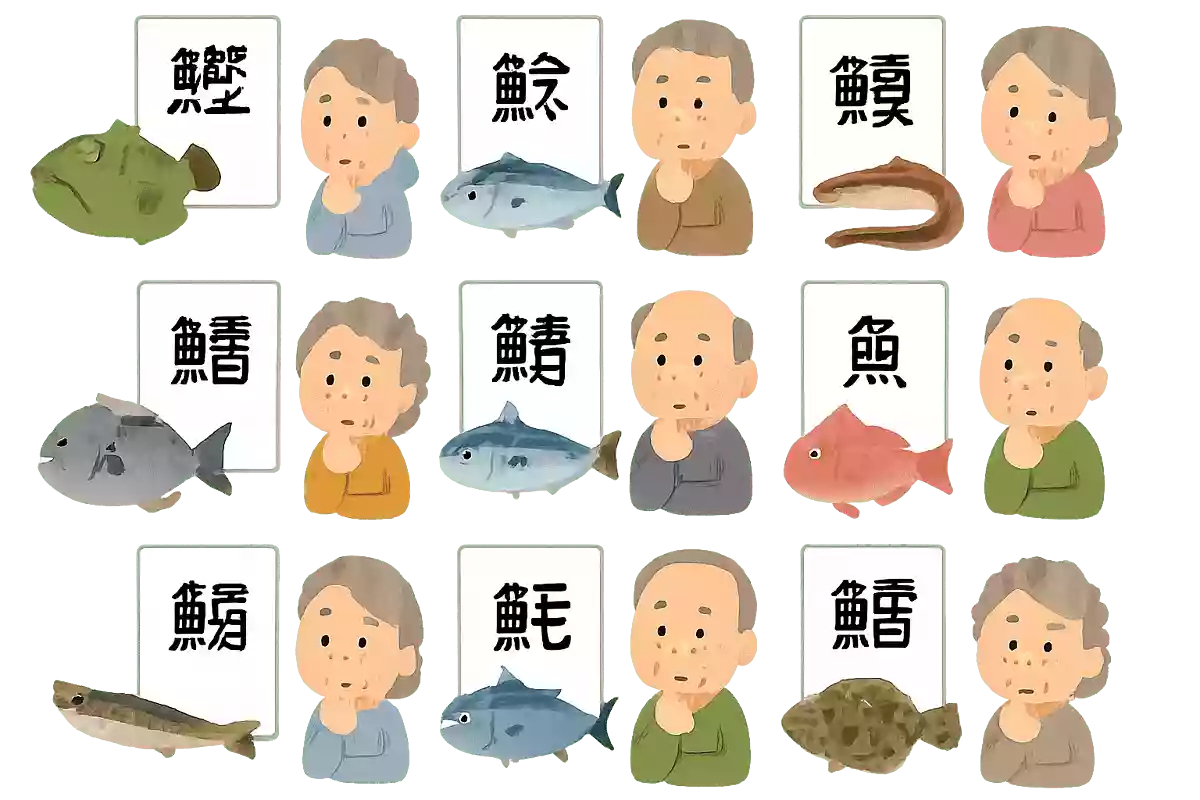
Anglerfish is read as “Ankō” in Japanese, and it’s cherished as a quintessential winter delicacy, known both as a rare treat and a high-end fish.
It is said that the sound ankō came first and that the characters meaning “peace and health” (安康) were later assigned to it, and the variety of etymological theories reflects how long it has been familiar to people.
Because its slimy, soft skin makes it difficult to fillet on a cutting board, a distinctive butchering method called tsurushi-giri—“hanging and cutting”—is often used, which is a major hallmark of the fish.
The process involves adding water into the body and rotating it while cutting, and it’s sometimes performed as a kind of culinary show.
Known for its “seven tools,” nearly every part of the fish is enjoyed as food.
ointment applied to the eyes
“Mebachi” is pronounced “mebachi” and refers to a fish commonly known as bigeye tuna, also called “bachi maguro.” It is sometimes written as 目鉢, and in English it is called “bigeye tuna,” highlighting its characteristically large eyes.
The names vary by region—“bachi” in Kanto and Tohoku, “mebuto” in Kyushu, and “shibi” in other areas—showing how widely it’s appreciated across Japan.
Compared to Pacific bluefin tuna, it has a lighter, cleaner flavor, and is especially popular from spring to summer when bluefin is considered to be at its least flavorful.
Pacific saury
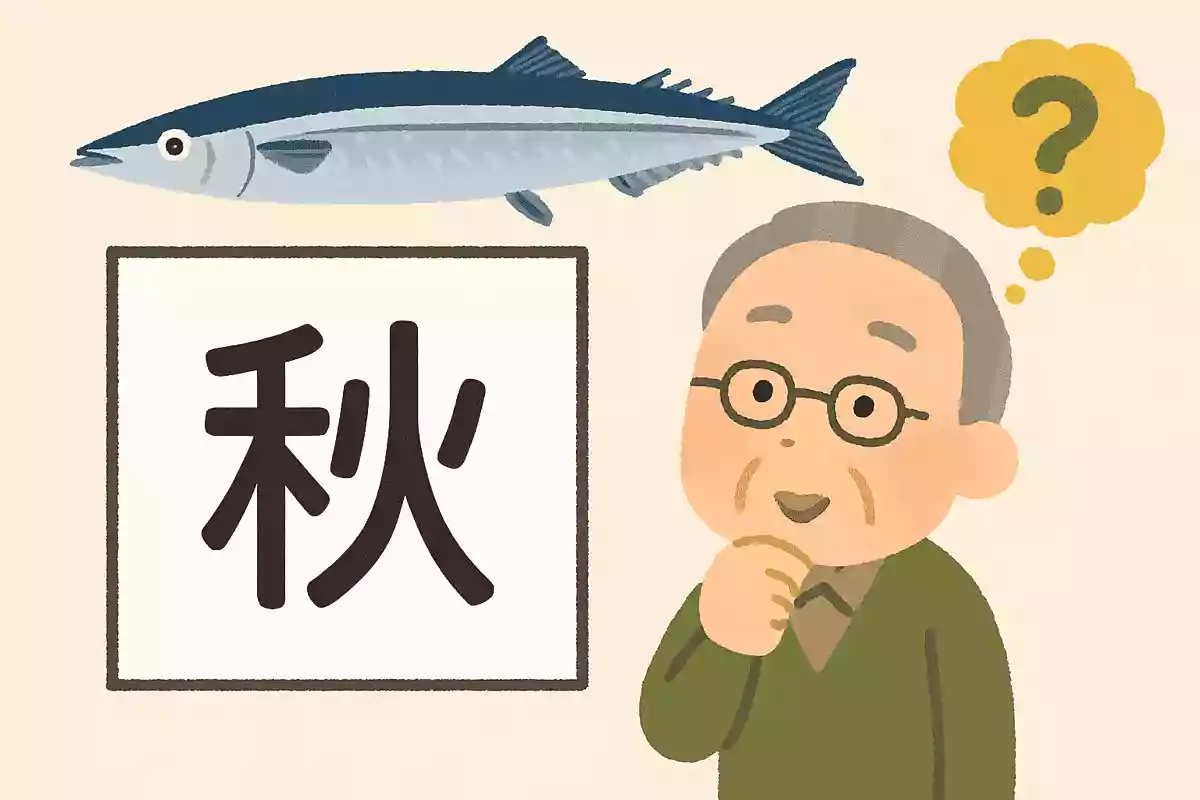
Sanma is read as “sanma” and is one of the most beloved flavors of autumn.
The kanji literally mean an autumn fish shaped like a sword, clearly reflecting how fondly people regard it.
江戸時代の記録によれば、庶民がサンマがずらりと並んで売られているのを喜んだことから、鰶という字がサンマと読まれることがあった。
しかし現在ではその漢字は「konoshiro」と読まれ、さんまは一貫して“秋刀魚”と表記されます。
Since it’s an iconic taste of autumn, you might be tempted to call 鰍 sanma as well, but be careful—this one is read kajika (sculpin).
crucian carp
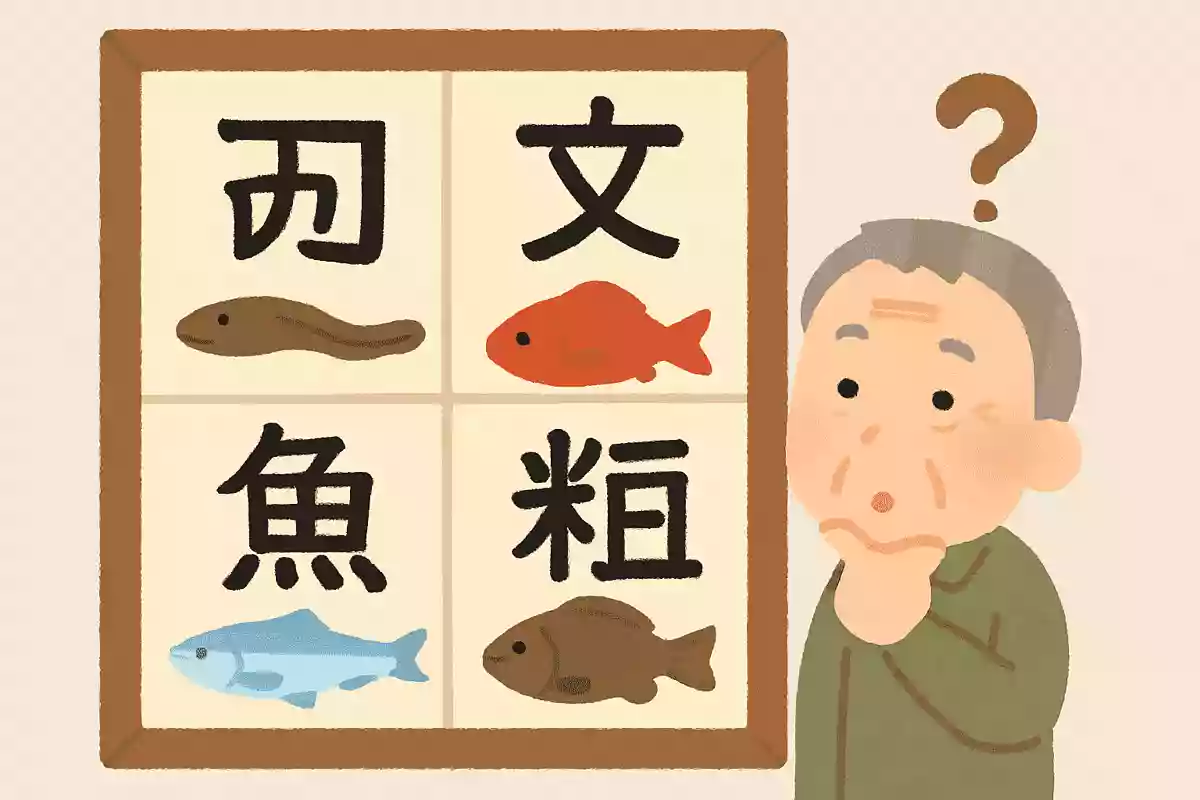
Funa is read as “funa” and is a fish that lives in freshwater with gentle currents, such as rivers and irrigation ponds.
The character 付 carries the nuance of “small,” and there is also the kanji 鯽, which depicts the fish with its dorsal fin held high.
Because it inhabits familiar environments and appears in the children’s song Furusato, we can sense its long history of being cherished.
It is also enjoyed as food, such as in Shiga Prefecture’s funa-zushi, though people often mention its characteristic muddy odor; accordingly, it tends to be prepared or seasoned in ways that minimize that smell.