

Recommended for seniors’ brain training! Kanji quiz workbook of fish names

Fish names often use many difficult kanji, don’t they?
On TV quiz shows, questions that ask you to read fish-related kanji frequently appear.
In this article, we’ll introduce that kind of fish kanji quiz!
In this article, we didn’t just include kanji with the fish radical; we mainly chose fish names written with two or more characters.
So that older adults can enjoy it, it’s important not to focus only on getting the right answer, but to think together with the people around you.
Doing so helps activate the brain and supports mental and physical health, so please enjoy it together with everyone.
- [For Seniors] Looks readable but you can't read it! Fish Kanji Quiz
- [For Seniors] Liven Things Up! Fun Fish Trivia Quiz
- [For Seniors] How many can you read? A comprehensive showcase of difficult food kanji
- [For Seniors] Fun and Lively! Recommended Quiz Questions
- [For Seniors] Challenging but Exciting! Kanji Quiz
- [For Seniors] Fun and Exciting! Difficult Kanji Quiz
- [For Seniors] Find daily brain training. Today’s recommended brain workout.
- [For Seniors] Lateral Thinking Game! Brain Training
- [For Seniors] Fun and Educational True-or-False Quiz
- [For Seniors] Quiz on Kanji with Many Strokes
- [For Seniors] Have Fun with Wordplay Characters! A Collection of Funny Puzzles
- [For Seniors] How many can you read? A kanji quiz of familiar things that look readable but aren’t
- [For Seniors] Difficult-to-Read Kanji for Everyday Items: Take on a quiz full of surprises and discoveries
Recommended Brain Training for Seniors! Fish Kanji Quiz Collection (11–20)
shrimp
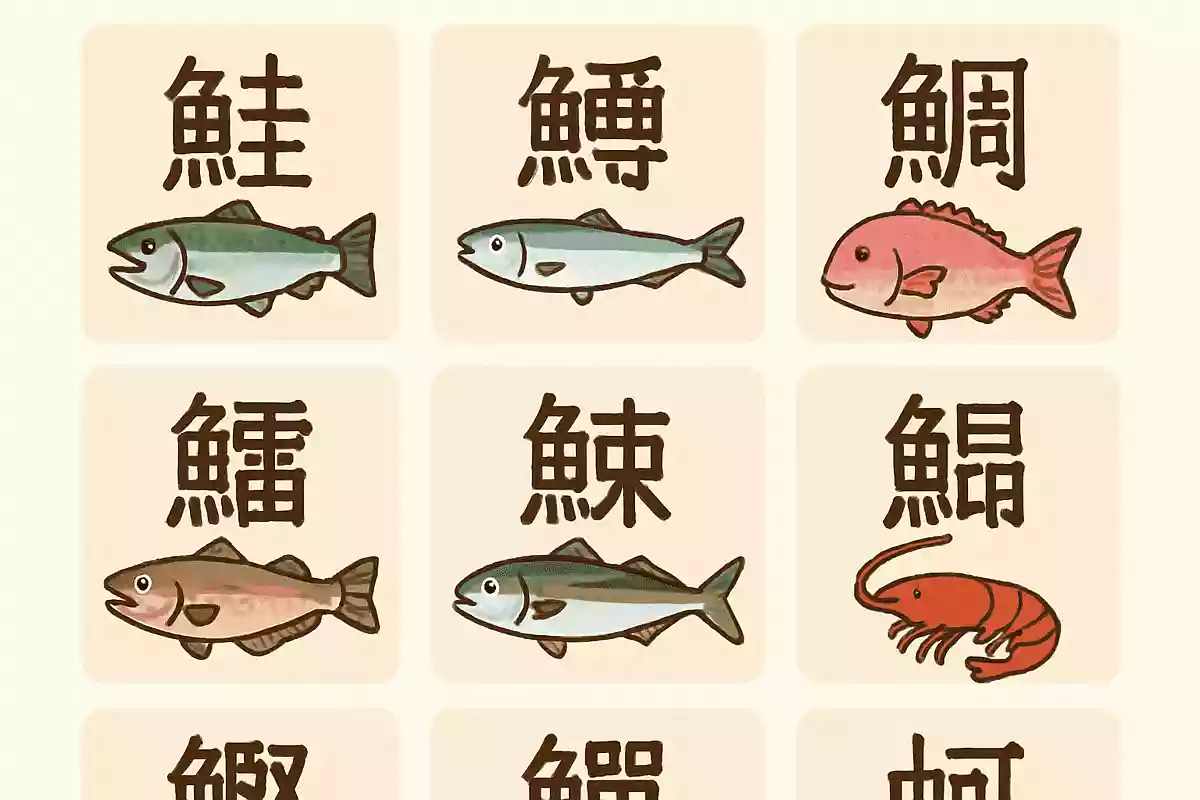
Ebi is read as “ebi” and refers to various kinds of crustaceans that are popular as food.
It is also often written with the characters for “sea” and “old man” (海老), said to derive from its bent, elder-like body and long whiskers.
When written with a single character, 鰕 or 蝦 is commonly used; because 蝦 can also denote a frog in Chinese characters, the fish-radical form 鰕 is often preferred to distinguish it.
Many types of shrimp inhabit all kinds of environments, from rivers to the deep sea, and they can be considered a profoundly interesting organism essential to understanding our planet.

loach
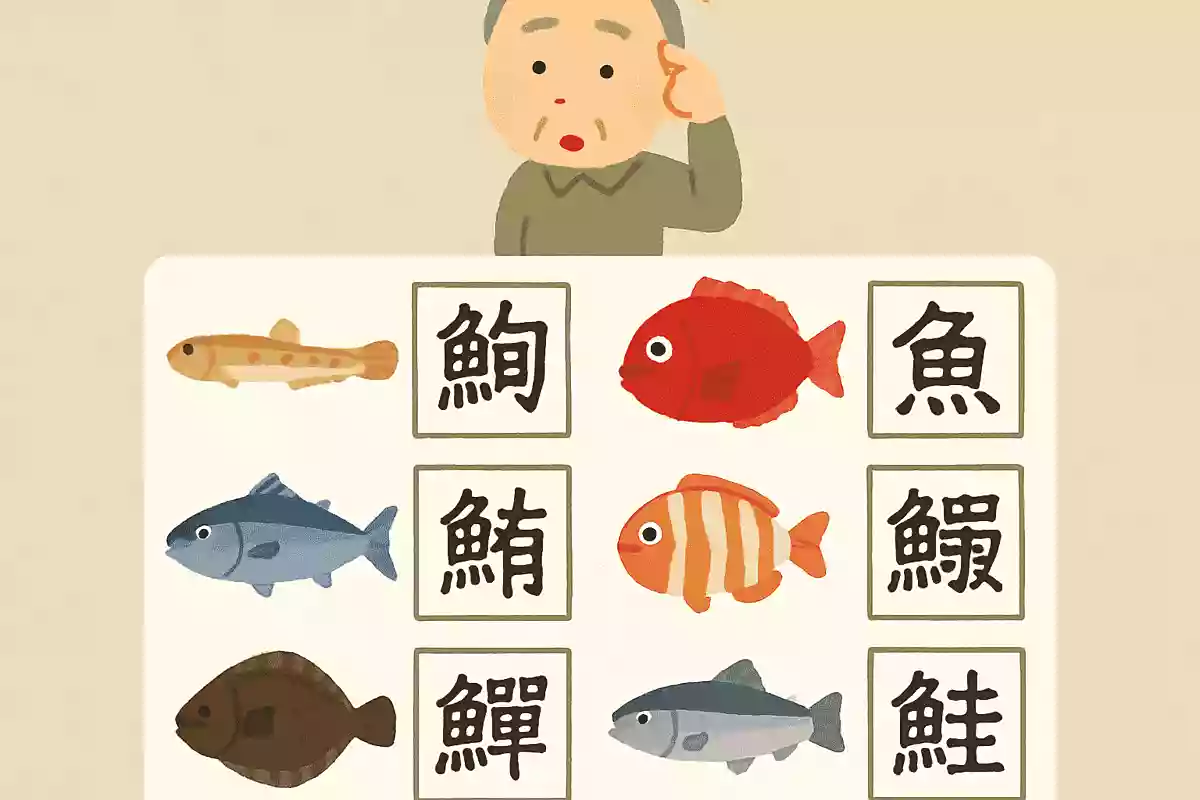
Even among elderly people with a wealth of knowledge, there may be quite a few who are seeing the kanji “鰌” for the first time.
Since it contains the fish radical, you can at least guess it’s a type of fish that lives in rivers or the sea.
They’re found in rice paddies and irrigation channels, and some older folks may have caught them as children.
They’re edible, and the hot pot dish “Yanagawa nabe” is especially famous.
So what does this kanji represent? It’s dojo loach! Dojo is even healthier than eel while offering comparable nutrients, so it might be nice to go out for a dojo dish as part of a dining activity or recreation.

horse mackerel
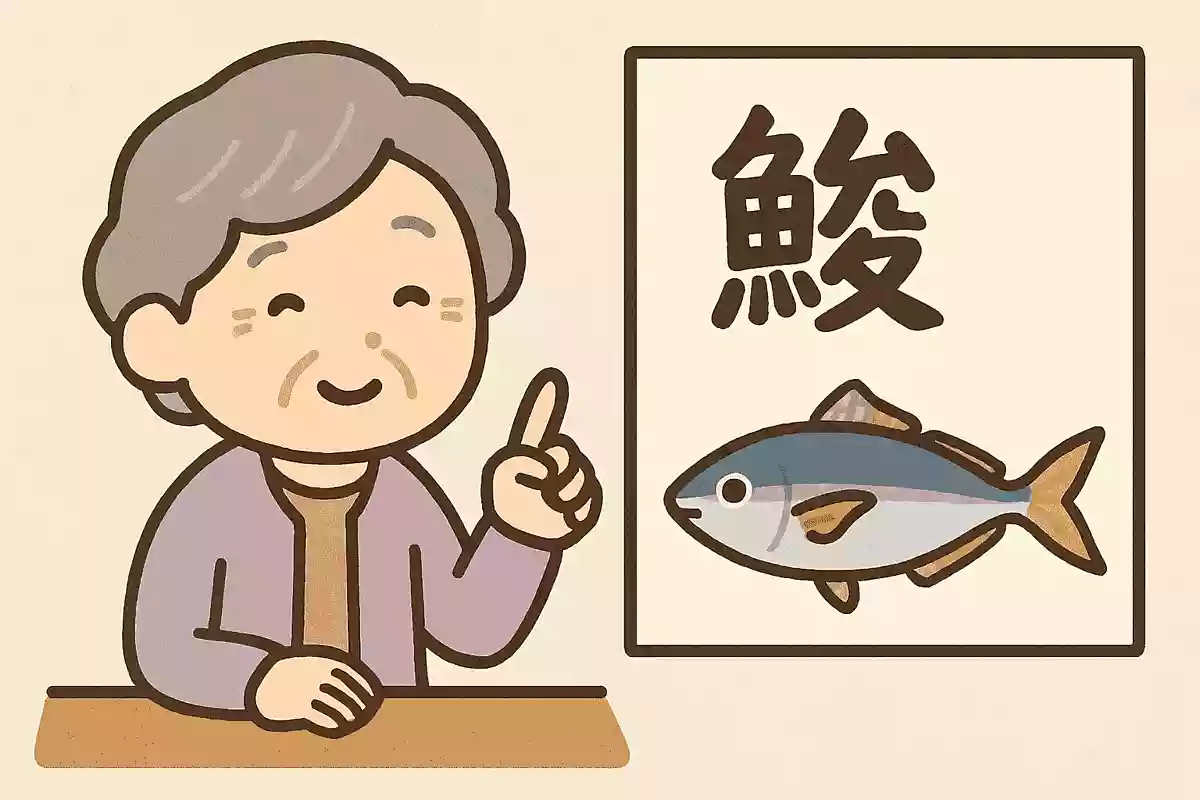
There are fish names written with a single kanji character, such as “鮪” (tuna), “鯛” (sea bream), and “鰻” (eel).
同様に、「魚」という漢字に「参」という漢字を組み合わせると、「アジ(鯵)」と読みます。
The word’s etymology is simply “aji” meaning “taste,” said to come from how good it tastes.
Regarding the kanji, there are a couple of theories: one is that the peak season for aji is the third month of the old lunar calendar, hence the numeral 参; another is that it suggests “it’s so delicious you’re overwhelmed” (maitte shimau).
Speaking of aji, what comes to mind is fried aji (aji-fry).
For those who enjoy alcohol, perhaps aji namerō.
sea urchin

The word for sea urchin is written in kanji as 「海栗」 and read “uni,” but sea urchin can also be written as 「雲丹」 or 「海胆」.
“海栗” refers to live sea urchins in the ocean, while “雲丹” and “海胆” refer to processed sea urchin as a food product.
The use of the characters for “sea” and “chestnut” comes from the fact that a sea urchin’s surface is covered with spines resembling the burrs of a chestnut.
Indeed, sea urchins living underwater do look like spiky chestnut burrs.
Incidentally, the spines on the top of a sea urchin’s body serve to protect it from enemies, while the spines on the underside are used for walking.
ocean sunfish

The kanji “翻車魚” refers to a certain large sea creature—do you know what it is? It’s displayed at some aquariums in Japan, and you might be astonished when you see how big it is.
As its classification in the order Tetraodontiformes suggests, its eyes and mouth resemble those of pufferfish, but its body doesn’t appear puffed up.
In Japan, it has various regional names derived from local dialects, such as “Uonotayū” and “Ukiki.” So, what is this creature’s name? It’s the ocean sunfish, known in Japanese as “manbō.” Despite its round, cute eyes, it has an enormous body.
If you visit an aquarium, be sure to check it out!
In conclusion
We’ve introduced a collection of fish-related kanji quizzes that seniors can enjoy casually as brain training. Rather than kanji with the fish radical, we mainly chose fish names written with two or more characters. How many could you read? When seniors do these as brain training, what matters more than getting the right answers is engaging with the quizzes themselves and communicating with others through them—both help stimulate the brain and relieve stress. Be sure to have fun tackling them together in a lively, social way!