

[February Songs] Introducing children's songs, folk songs, nursery rhymes, and hand-play songs about Setsubun and winter!


February brings Setsubun and the chant “Oni wa soto, fuku wa uchi!” In nurseries and kindergartens, there are likely many chances to sing songs related to Setsubun.
But in fact, there are plenty of songs perfect for February beyond just Setsubun tunes! In this article, we introduce songs connected to February and children’s songs that are perfect for the harshly cold season.
Many of them can be sung with hand-play motions, so children are sure to enjoy them.
Please make use of them on days when it’s too cold to play outside or during music time.
- Snow Songs to Enjoy in Winter! Children's Snow Nursery Rhymes & Hand-Play Songs
- Collection of winter nursery rhymes, folk songs, and children's songs. Includes fun winter hand-play songs too.
- [For Seniors] February Songs You’ll Want to Hum: Enjoy Winter with Nostalgic Classics
- [Childcare] Fun Songs for 2-Year-Olds to Sing! Recommended Song Collection
- [For Seniors] Winter songs you'll want to hum along to. A collection of classic tunes recommended for BGM and recreational activities
- [Setsubun Song] Demons out, fortune in! Bean-throwing songs to enjoy on Setsubun
- Timeless songs you’ll want to listen to in February: winter songs and Valentine’s songs.
- Songs for January: Nursery rhymes and fingerplay songs we want children to grow familiar with
- March nursery rhymes & hand play songs! Spring songs you can enjoy with your kids
- [Hand Play] Popular with kids! A collection of trendy hand-play songs and nostalgic traditional children’s songs
- Nursery rhymes to sing in spring: a collection of classic songs you'll want to sing with your children
- December children's songs, folk songs, and nursery rhymes: fun winter hand-play songs
- Childcare: Today's recommended fun songs
[February Songs] Introducing children's songs, folk songs, nursery rhymes, and hand-play songs related to Setsubun and winter! (21–30)
The Snow PainterSakkyoku: Ando Takashi

The snow-covered scenery looks as if the entire town has been painted pure white, doesn’t it? The children’s song “The Snow Painter” captures the sight of a town dyed in white, making it perfect for snowy February days.
Countless snow painters come down from the sky—in other words, the snow keeps falling and piling up, turning not only the town’s buildings but also the natural landscapes like mountains and fields completely white.
It’s a very calm and evocative song, yet the lyrics are unique and easy for children to sing!

A Snowstorm Nightsakushi: Kitahara Hakushū / sakkyoku: Ichikawa Gakuchi

In February, when the winter cold grows even harsher, staying indoors and quietly singing songs can be lovely on days you can’t go out.
One piece I’d like to introduce for such times is the children’s song “A Snowstorm Night,” with lyrics by Hakushu Kitahara.
The words are striking, conveying the sound of wind echoing late at night and the heart‑pounding feeling of waiting for someone to arrive.
Composed by Manatoshi Ichikawa, this song is included on the Kamome Children’s Choir album “Grilled Fish for Dinner.” Although it was released in May 2010, the children’s clear voices still feel refreshing today.
Even if there’s a blizzard outside, this work invites you to expand your imagination and enjoy it from the warmth of your room.
On a quiet night, why not gaze out the window and listen closely together with your child?
[February Songs] Introducing children’s songs, folk songs, nursery rhymes, and hand-play songs related to Setsubun and winter! (31–40)
The wind and the snow are my friends.sakushi: kobayashi jun’ichi / sakkyoku: neruson & rorinz
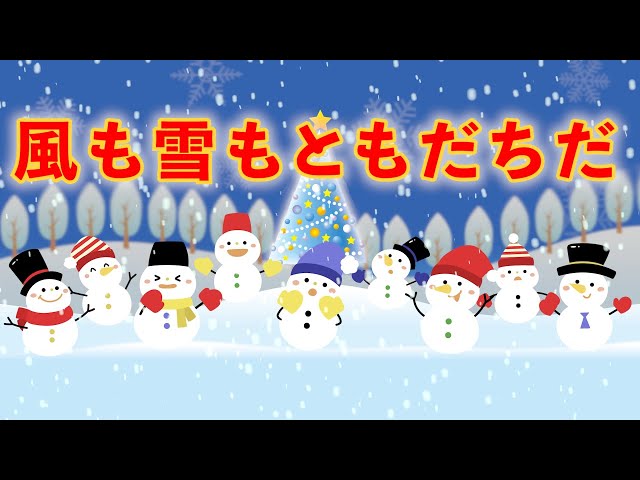
This work is based on the Christmas song “Frosty the Snowman,” beloved around the world.
Composed by Nelson and Rollins, with Japanese lyrics written by children’s poet Jun’ichi Kobayashi, it vividly portrays energetic children flying kites in the cold wind and having snowball fights.
After it began airing on NHK’s “Minna no Uta” in December 1961, it has long been cherished as a winter seasonal song.
With its light rhythm and buoyant, bouncing melody, it’s also great to enjoy as a hand-play song indoors.
Even on days too cold to go outside, singing this piece is sure to warm both heart and body.
Why not fill the air with a bright singing voice that turns winter’s chill into play?
Brr, it’s so cold.Sakkyoku: Warabe Uta

Famous as a song that evokes the harsh cold of winter is this children’s folk song, “Oosamu Kosamu.” There are various versions of the lyrics, but the well-known one features a boy who, saying he’s cold, comes down from the mountain in tears.
Perhaps this song comes to mind for you, too, when you’re faced with the chill of winter.

Mukkuri Kuma-sanSuweeden min’yō

This cheerful play song, based on a traditional Swedish folk tune, is themed around a bear’s hibernation.
You can just picture children holding hands in a circle, singing excitedly until the bear in the center wakes up.
With its simple melody and lyrics, it’s easy even for young children to remember and can be enjoyed together with hand games or tag.
It’s widely loved in nurseries and kindergartens and is often included on CDs and in songbooks.
It’s a perfect choice for playing indoors on cold winter days.
If everyone sings and moves together, they’ll warm up in no time.
MomotaroSakkyoku: Okano Teiichi

As a character associated with Setsubun, ogres (oni) are indispensable, aren’t they? When it comes to famous stories featuring oni, “Momotaro” comes to mind.
There’s a song with the same title, “Momotaro,” that tells the story of Momotaro.
This song has six verses and compactly covers the episodes from Momotaro leaving home, recruiting three animal companions, setting off to Onigashima to defeat the oni, and triumphantly returning.
Not many people may know all six verses, but since it lets you grasp the whole Momotaro tale at once, Setsubun is a great chance to listen to the entire song!
Come, springSakushi: Soma Gyofu / Sakkyoku: Hirota Ryutaro

A song that eagerly awaits the arrival of spring, “Haru yo, Koi” (“Come, Spring”).
As winter sets in in earnest, the cold can make your body shiver.
In those moments, it might be nice to sing this song and think together with your child about what you’d like to do when spring comes.
It’s a classic that has been beloved by a wide audience for many years, so be sure to give it a listen.