

Easy DIY! Introducing educational toys that can be easily made with 100-yen shop items and things around the house.

You want to provide toys that match your child’s development and changing interests, but buying new ones every time can get expensive, right?
If that sounds familiar, this is for you.
Here are some easy, handmade toy ideas you can try.
They use items from 100-yen shops and materials you likely already have at home, so they’re low-cost and beginner-friendly—another great bonus!
We’re focusing on how to make educational toys that build concentration, imagination, and fine motor skills.
Try incorporating them into playtime at home, as well as in daycare or kindergarten!
- [Educational] DIY Montessori-style toy ideas
- Fun DIY Toy Ideas You Can Make with 100-Yen Store Materials
- [Handmade Toys] Fun to Make! A Collection of Pull-Along Toy Ideas
- Make it with everyday materials! A collection of DIY toy ideas recommended for 1-year-olds
- [Let’s Make and Play!] Handmade Toy Ideas You Can Create Yourself
- A handmade collection of Anpanman ideas to enjoy
- Handmade capsule toy machines with everyday materials! Easy craft ideas you can make
- Handmade fabric toy ideas: toys that make babies happy
- [Make with Kids] Handmade Outdoor Play Toy Special
- Let's make toys with straws! Easy and fun DIY toys
- [Beginner Friendly] Easy Craft Ideas You Can Do
- Recommended for 5-year-olds! Simple DIY toy ideas
- [DIY] A Collection of Handmade Moving Toy Craft Ideas
Easy DIY! Introducing educational toys you can make easily with 100-yen store items and things around you (1–10)
Educational play with a dish stand
Here’s an idea for an educational toy using a dish rack sold at 100-yen shops.
Wrap the rack’s rods with vinyl tape or washi tape in various colors, and prepare some plastic chain links or rubber bands—you’ll be ready to play right away! Kids can match rings to the colors on the rods, or stretch rubber bands and hook them onto multiple rods—the ways to play are endless! It’s a charming toy packed with elements that will richly stimulate children’s senses, such as strengthening finger dexterity, developing the ability to align and fit rings onto rods, and fostering the skill to imagine and express shapes.
Tracing with an ice cream stick
Here’s a unique toy idea that makes tracing fun.
This time, we’ll use popsicle sticks.
Paint them in bright colors like red and yellow to catch children’s interest.
It also sounds fun to paint them together with the kids in their favorite colors.
Arrange and glue the popsicle sticks into any shapes you like on a sheet of paper cut to fit a ziplock bag, then slip it into the bag—and you’re done in no time! Use whiteboard markers to enjoy tracing right on top of the ziplock.
They wipe off easily, so you can use it over and over, which is a great plus! It’s also recommended to expand the play by drawing pictures or adding stickers to the paper where you stick the popsicle sticks.
Try creating various patterns and adjust the difficulty according to the child’s development and age.
sensory bottle
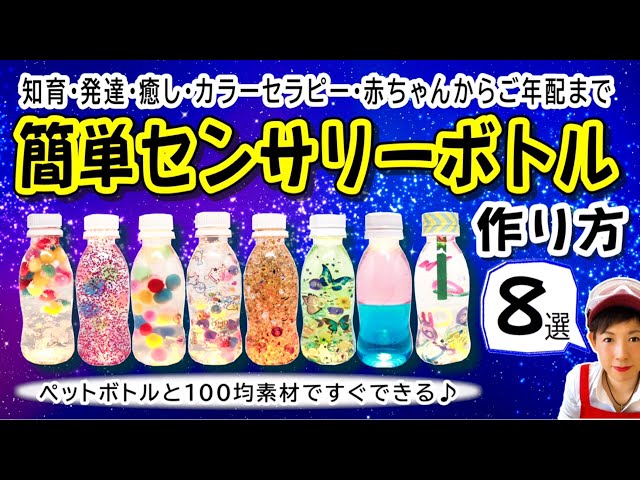
A sensory bottle is not only an item that stimulates sight with the slow movement of glittering materials, but also something children can play with by moving the bottle with their hands.
Choose a container with a smooth surface, such as an empty lactic acid bacteria drink bottle.
Fill it with cooled boiled water and liquid laundry starch (or clear glue), then add fun elements that move—like glitter, small beads, or rings—and it’s done! It’s fun to make many with different colors and themes.
To prevent leaks, secure the cap firmly with glue and tape.

Easy DIY! Educational toys you can make effortlessly with 100-yen store items and things around the house (11–20)
Tongs knob

If you prepare a pool noodle, pom-poms, and a toy pair of tongs, you can play a tong-picking game.
Using the tongs to pick up the pom-poms helps develop fine motor skills.
It also allows kids to focus, making it perfect for quiet indoor play.
If you put the pom-poms into the holes of the pool noodle and pretend it’s a cake, you can play bakery pretend play too.
You might also choose the colors of the pool noodle and pom-poms with pretend play in mind.
In addition, pushing the pom-poms out of the pool noodle to clean up is a great activity in itself.
Stacking daruma with empty bottles
Introducing a Daruma-stacking toy that’s sure to spark kids’ curiosity with a “What’s this?” First, cut the top part of an empty container to about 6 cm, and attach a strong magnet to the back of each cap.
Next, decorate the container colorfully with vinyl tape.
Finally, attach a strong magnet to the tip of a disposable chopstick, then wrap it with vinyl tape—and you’re done! When attaching the magnets, be sure to align the N and S poles correctly.
It’s a toy that might get kids hooked on the satisfying click of the bottle sticking to the chopstick.
Besides Daruma, it could be fun to customize it into animals, characters, or anything else kids love.
smart ball

You can make a smart ball game, a timeless favorite at festivals, using only items from the 100-yen shop: perforated board, square dowels, rubber bands, marbles, nails, double-sided tape, wooden dowels, and wood glue.
First, cut the lumber with a saw to fit the board and build a frame.
Attach the frame and the plunger with nails and a hammer, and fix a plastic sheet with double-sided tape to create the arch that rebounds the marbles.
Since the perforated board lets you place dowels freely, kids can have fun customizing and adding their own ideas!

Hatena Box
Let’s make a fun toy that looks like it could be in a Mario game! Keep the lid of a formula can open, and attach a drain cover that fits the opening by flipping it upside down over the top.
Since your baby will be putting their hand through it, be sure to use a soft silicone drain cover.
Draw a question mark on the surface of the can and decorate it however you like—that’s it! Put small toys or snacks inside and have your baby guess what’s in there, or let them pull out cards that match a sample picture.
Because they can’t see the contents, it helps develop your baby’s imagination.
