

![[Hinamatsuri] Handmade Costume Ideas: Perfect for First Festival and Girls’ Day Celebrations!](https://i.ytimg.com/vi_webp/iJjLbQTwaOc/maxresdefault.webp)
[Hinamatsuri] Handmade Costume Ideas: Perfect for First Festival and Girls’ Day Celebrations!

Hinamatsuri is a major event for girls, isn’t it?
Many families probably celebrate it every year, wishing for their children’s health and growth.
In this article, we’ll share handmade costume ideas we recommend for Hinamatsuri!
We’ve gathered a variety of ideas, including hakama-style rompers perfect for a baby’s first festival, easy-to-wear apron dresses, and kimonos that even toddlers can wear.
If you want to prepare a special outfit for Hinamatsuri or are looking for Hina doll–themed costumes you can use for performances and the like, please take a look for inspiration.
[Hinamatsuri] Handmade Costume Ideas: Celebrate the First Seasonal Festival and the Peach Festival! (1–10)
One-touch hakama, skirt type [70 cm–150 cm]
![One-touch hakama, skirt type [70 cm–150 cm]](https://i.ytimg.com/vi/iJjLbQTwaOc/sddefault.jpg)
Let me show you how to make a skirt-style hakama.
Since it’s a hakama, let’s use solid-colored fabric.
Cut out two rectangles and round off the top corners to create the hakama shape.
You’ll make pleats in the center of the fabric—have an iron ready for this step.
The waist ties are sewn onto the skirt portion, and there’s hook-and-loop fastener on the ends.
It’s designed so you can wear it without tying a knot.
With this, it seems like children could put it on by themselves!

[70–90 cm] No pattern needed! Baby hakama kimono
![[70–90 cm] No pattern needed! Baby hakama kimono](https://i.ytimg.com/vi/KkJCwQ7a-vs/sddefault.jpg)
Here’s an idea for a baby hakama-style kimono that a little one can wear.
It’s basically made with a sewing machine, but you won’t need a pattern—just measure the approximate sizes using clothes your baby already wears.
Prepare a favorite patterned fabric and a solid fabric, then simply cut out the pieces and sew them together.
Instead of using ties to fasten the overlap, it uses hook-and-loop tape, making it gentle on the baby and easy to put on.
Why not use this as a reference to make the kimono and pair it with a hakama in your favorite color?
Kimono for hakama (70–100 cm)
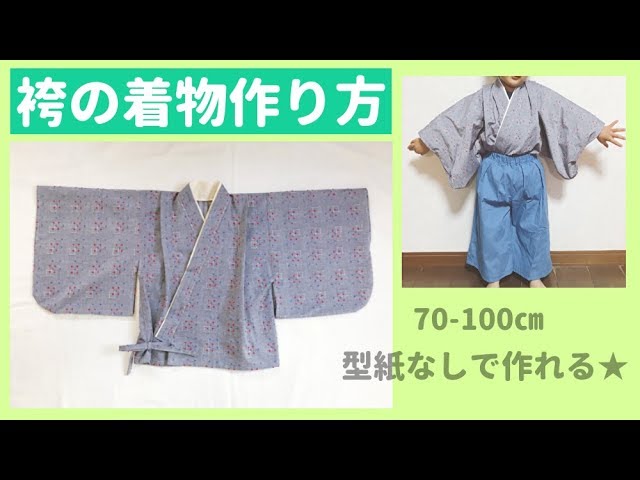
Here’s a handmade kimono idea to pair with hakama! If you’re considering traditional attire using a hakama for your child on Hinamatsuri (Girls’ Day), please take a look for inspiration.
This one comes with a pattern, so you can simply cut the pieces from your preferred fabric according to the pattern and sew them together with a machine.
There’s a step for adjusting the shoulders, but please do that to fit the child who will actually wear it.
Although it’s unlined, it has a visible collar and the tying cords sewn on, so with this alone and a hakama, it looks like you’ll be able to dress them nicely!
Hakama-style pants [70–90 cm]
![Hakama-style pants [70–90 cm]](https://i.ytimg.com/vi/e0i8DGz7O1w/sddefault.jpg)
If your child isn’t comfortable wearing a traditional hakama, how about making these hakama-style pants? They have an elastic waistband, making them easy to put on and take off, and since they’re mostly like regular clothing, they won’t restrict movement much.
While there is a step to create tucks, the basic process is simple: sew together the four pant pieces and the waistband, then thread the elastic through.
If you have the time, try making a ribbon as well.
Using colors like burgundy or navy will make them look more like a hakama, especially when paired with a kimono.
Hina doll and imperial prince hats

Here’s an idea for making hats for the Emperor (Odairi-sama) and Empress (Ohina-sama) using construction paper.
Connect two pieces of black construction paper to create a long, horizontal base, then draw tall, narrow triangles evenly spaced from end to end along the top.
Round the tips of the triangles.
Once drawn, cut away the unnecessary parts with scissors, then glue the ends of the paper together to form a tube.
Gather the triangular sections toward the center and staple them together to complete the hat base.
For the Emperor’s hat, attach a ray-shaped crest made from construction paper, and for the Empress’s hat, add a sai (hairpin ornament) to finish!
apron dress

How about making an apron dress that you can put on and take off in a snap? Many children wear traditional outfits for Hinamatsuri, but kimono can be hard to move in, and plenty of kids don’t like them.
This apron dress goes right over regular clothes, so your child might wear it without fuss.
If you use a Japanese-patterned fabric and trim the frills with white lace, it’ll look cute and give off a kimono-style vibe.
Plus, even after Hinamatsuri, it’s great for pretend play or helping out around the house.
Highly recommended!
Color vinyl bag yukata dress

Here’s an idea for a yukata-style dress made with colored plastic bags.
Many girls admire dresses, so this kimono-inspired dress idea might make them really happy.
Since it’s basically made from plastic bags, it’s budget-friendly, and after the Doll’s Festival is over, it could also be useful as a dress-up costume.
Even though it’s made from plastic bags, it’s very cute, with frilled sleeves and various patterns added with tape.
Why not try making one together with your child?