

[Winter] Let’s make them together! A roundup of handmade kites

During the long New Year’s holiday, many parents are probably thinking, “If we’ve got the time, why not get moving and play with the kids?” In that case, how about trying a traditional game! In this article, we’ve put together ideas for making homemade kites.
We introduce not only the classic kites beloved in Japan for generations, but also ones you can make with just a plastic bag or A4 paper, and even three-dimensional kites.
Watching a kite you made yourself soar freely across the sky is such a great feeling! It’s the perfect winter activity and a lucky, festive recreation.
- Handmade spinning tops with everyday materials! Easy ideas you can enjoy for New Year’s too
- [Handmade] A collection of stylish DIY koinobori (carp streamer) ideas
- Handmade ideas to create and play the traditional Japanese game “Daruma Otoshi”!
- For New Year’s! A collection of fun origami ideas to make, decorate, and play with in childcare
- [Handmade] A collection of bamboo-copter ideas using various materials
- Handmade Lottery Draws Kids Will Love! A Fun Collection of Ideas to Make and Play
- For summer vacation homework! Simple and amazing crafts for elementary school students that you’ll want to make after seeing them
- New Year party games that get everyone excited: a fun collection of ideas from classics to DIY
- [For Kids] Spins in the wind! A collection of recommended DIY pinwheel ideas
- Handmade ideas for Koinobori: easy projects using everyday materials
- New Year’s Games: Traditional Play and Fun Activities That Excite Everyone from Kids to Adults
- [For Kids] Indoor Games and Activities Recommended for Winter Break
- Enjoy in January! Origami ideas for kids
[Winter] Let's Make Them Together! Handmade Kite Collection (11–20)
train of kites

Why not try making a train of kites that boasts an overwhelming presence as the kites float one after another in the sky? First, fix bamboo skewers in a cross so they match the four corners—top, bottom, left, and right—of the plastic sheet.
The key is to attach them firmly so the plastic and bamboo don’t separate.
Next, attach the kite’s tail to the lower part of the body.
Make the tail long enough to sway gently when it’s in the air.
When making a train of kites, it’s also recommended to draw the same illustration on each one or go for vivid, rainbow-like colors.
Be sure to try kite-making as a fun activity you can create and play with together with children.

Bird kite

A bird kite that you fly by running—different from the high-flying kites many people imagine.
It’s perfect for children who would rather be active than quietly gaze up at the sky.
Just draw your favorite picture on colored construction paper with crayons, cut it into a bird shape, attach a string, and it’s done—so you can enjoy it from the making stage, too.
On windy days, you can also tie it up and let it flutter like a carp streamer, so there are plenty of ways to have fun.
Give it a try!

kite (traditional Japanese kite, lit. “servant/henchman kite”)

This is a video showing how to make a yakko-dako (traditional Japanese kite).
First, fold the paper into a triangle with a valley fold, then fold it in half once more.
Next, open the paper and fold it into a rectangle.
This time, fold all four corners inward along the creases.
Flip it over and again fold all four corners.
After that, open up the bottom triangle to form a rectangle.
Finally, fold both ends in the same way, and the yakko-dako is complete.
On a cold winter day, I think relaxing under the kotatsu and enjoying some origami is a charming way to spend the time.

Eagle Kite

Perfect for kids who want to make an original, cool designer kite—the Eagle Kite! Prepare a thicker trash bag, cut along the sketch with a utility knife, and first draw the pattern with a marker.
Attach the other cut-out parts with double-sided tape, flip it over, and secure the bamboo skewers with cellophane tape.
Flip it back again, punch a hole, thread the kite string, and you’re done! When making the hole, stick some duct tape on first to prevent the plastic from tearing.
Where the bamboo skewers overlap, use extra tape to secure them firmly.

plastic bag kite

A kite made from a plastic bag—something every household has in stock—is easy to make and highly recommended.
It’s a simple design: shape a plastic bag into a trapezoid and add a frame made of drinking straws.
Reinforce the corners with tape, punch holes there, and thread yarn or similar material through—this is the key step.
Drawing your favorite images, like anime characters, can make it even more fun! You might worry about durability, but it actually flies surprisingly well and reaches a good height.
It’s easy to roll up and store, and you can enjoy its light, fluttering dance in the sky!

spinning-top kite

The koma kite is one of Japan’s traditional kites.
As the name suggests, it’s said to be named because it resembles a koma, a classic spinning top toy.
Cut shoji paper into the shape of a koma, paint any design you like, then attach bamboo splints—and you’re done! One of the charms of the koma kite is that it flies stably even without a tail, so you don’t need special flying skills.
If you’ve ever felt, “I made a kite but it didn’t fly well,” or “I couldn’t enjoy it because I didn’t know how to fly it,” give the koma kite a try!
[Winter] Let's make it together! Handmade Kite Roundup (21–30)
Blue tarp kite
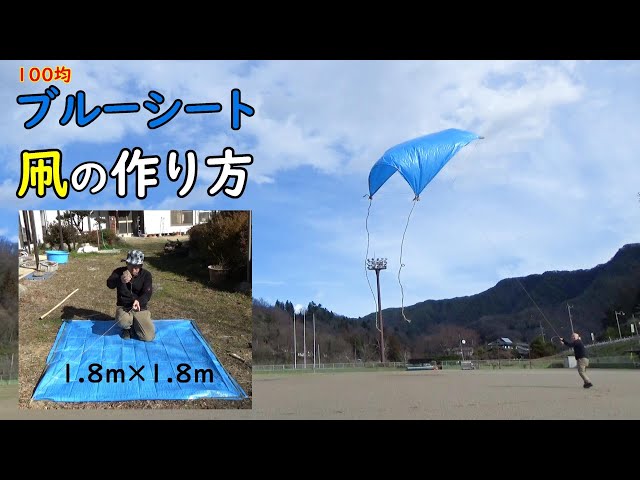
Let’s try making a kite with a small blue tarp.
We’ll use a relatively small 1.8-meter square tarp, but as a kite it will be quite large, so please be careful.
First, prepare some hemp twine and four pieces of split bamboo.
Tape the four bamboo pieces along the edges of the tarp with duct tape.
Stretch the hemp twine across, and tie a knot of the twine directly at the intersection point.
Make sure to firmly secure the ends of the bamboo to the tarp so they won’t come loose.
That’s it—your kite is complete.
Try flying it on a windy day.
