

A handmade PythagoraSwitch video. A collection of my DIY Pythagora devices.

PythagoraSwitch is an educational program for young children broadcast on NHK E-Tele.
Alongside introducing content themed around rules and phenomena found in everyday life, the show features a popular segment called the Pythagora Device, which helps nurture children’s rich thinking skills.
Some people may be looking for homemade videos of Pythagora Devices packed with complex contraptions.
So in this article, we’ve gathered DIY PythagoraSwitch videos that use a variety of items.
From creations that use familiar household objects to works brimming with numerous gimmicks, be sure to check out these PythagoraSwitch videos that offer plenty to enjoy.
- Kids and adults alike will be captivated! A collection of DIY marble run ideas
- A handmade PythagoraSwitch video. A collection of my DIY Pythagora devices.
- It's fun to spin! A collection of DIY toy ideas
- Handmade games: DIY craft ideas you can make and play
- [Let’s Make and Play!] Handmade Ideas for a Target Shooting Game
- Simple yet amazing crafts: craft ideas that elementary school students will want to make
- Moving! Spinning! Flying! Fun handmade toys made with rubber bands
- Handmade ideas to create and play the traditional Japanese game “Daruma Otoshi”!
- [DIY] A Collection of Handmade Moving Toy Craft Ideas
- [For Kids] Today’s Handmade Craft Ideas
- [Handmade Toys] Fun to Make! A Collection of Pull-Along Toy Ideas
- [For Kids] DIY Snowman Craft Ideas!
- DIY Hula Hoop Ideas for Kids
Handmade PythagoraSwitch video. A compilation of my original Pythagora contraptions (1–10)
LEGO brick

Have you been to LEGOLAND in Aichi yet? The more than 1.5 million LEGO bricks are simply breathtaking—there’s a level of awesomeness you just can’t capture in photos or videos.
I’m sure even non-LEGO fans will be impressed! It also sounds fun to build a PythagoraSwitch-style Rube Goldberg machine at home using LEGO.
Try combining large and small bricks to make inclines, stairs, and bridges.
If you’re good with LEGO, it could be fun to pick a theme—like space, an underground empire, or a jungle—and build around that.
Of course, you can also just use LEGO as part of your Pythagora machine.
Please think of ways to bring out the full charm of LEGO!
Plarail

Do you know the toy “Pitagora Goal No.
1” that uses the exact same “Pitagora Switch” sound effect you hear at the goal on the show? I wonder if there are already fans using it.
This “Pitagora Goal No.
1” seems to be made of a material that pairs well with Plarail, so it might be a good idea to incorporate Plarail into your Pitagora Switch contraptions.
Just thinking about it a bit, lots of ideas come to mind: having it carry marbles, give marbles a push, or using Plarail to start a line of dominoes.
Plarail tracks are handy in all sorts of ways, too—so if you have Plarail, definitely give it a try!
daily necessities

The wildly popular PythagoraSwitch never fails to impress with its stream of inventive ideas and sharp points of focus.
Everyday household items often appear in PythagoraSwitch.
For anyone trying their hand at building a PythagoraSwitch-style contraption, they’re basically essential.
For example, toilet paper and its cardboard tube can be used in countless ways—rolling the roll itself, or sending a marble through the tube.
You can also use disposable chopsticks: place two side by side to make rails for marbles or balls.
Beyond that, try starting with familiar items like books, tissues, pencils, and more—experiment with whatever you have around you!
Handmade PythagoraSwitch videos. A compilation of my DIY Pythagora devices (11–20)
Domino

Domino TV shows are the kind you just end up watching, aren’t they? In the 2023 New Year’s Eve Kōhaku Uta Gassen, there was a performance that used a lot of dominos, too.
I bet many people also use dominos as part of a Rube Goldberg-style setup like PythagoraSwitch.
So here are a few ideas for domino-based performances.
First, try substitutes: instead of dominos, show off a domino topple using erasers or books as a quirky twist.
TV and air conditioner remotes or CD cases might work as substitutes as well.
I also think “using a fall to play an instrument” is a great idea—for example, having a falling domino drop onto piano keys to make them sound.
laboratory equipment

This is a PythagoraSwitch-style contraption that uses various tools employed in science experiments along the way.
Many lab instruments have unique shapes—such as rounded bottoms—and the setup leverages these forms to impart intriguing motions to a marble.
It also uses not only marbles but steel balls, which are drawn to magnets placed along the path, adding another point of interest.
The sequence is sprinkled with curious phenomena, making it a device that can spark interest in topics learned in science class.

In the style of B-Dama and B-Suke
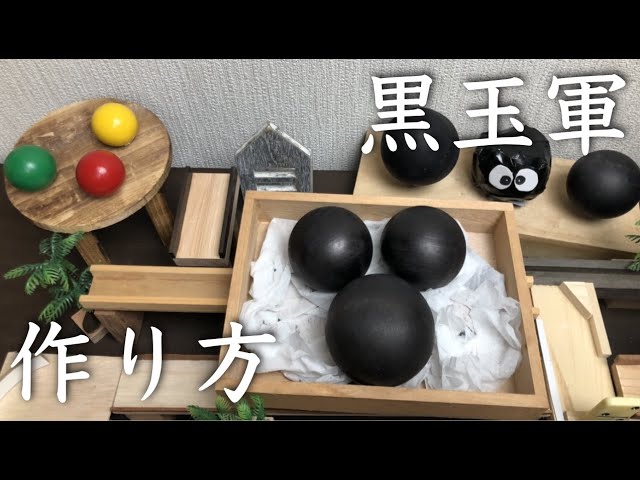
Have you ever seen “The Great Adventure of Beadama and Beasuke,” featuring the green Beata, the red Beasuke, and the yellow Beagoro getting into action? Even though they don’t have faces, I find them really appealing.
How about making a PythagoraSwitch inspired by those marble characters? It might be easier to create if you imagine scenarios like a chase using a black marble as the rival, or a fun race with a white marble.
Mechanisms where the order gets dramatically reversed or suddenly reset would make viewers feel excited!
stair return
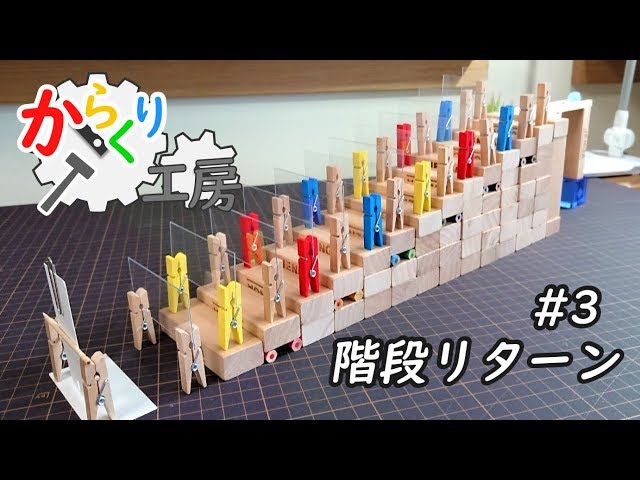
This is a Pythagora-style contraption that’s fun for its stairway return, made with 54 Jenga pieces, 30 clothespins, colored pencils, paper clips, a word-card ring (flashcards), toothpicks, and more.
First, build a staircase with two Jenga blocks per step.
Next, remove one Jenga block from every other step and insert two colored pencils in its place.
Then line up flashcards clipped with clothespins along the stairs, and at the turnaround point, set up a flashcard fitted with a clipped clothespin, a paper clip, and a toothpick with the tip cut off as a handle.
The clothespins absorb minor misalignments and give you a satisfying domino effect!
