

Handmade hair accessories for Shichi-Go-San! Ideas using tsumami-zaiku and artificial flowers too


How about adding a splash of color to your child’s special Shichi-Go-San day with a handmade hair accessory? Hairpieces that make a kimono outfit even more festive are actually surprisingly easy to create! In this article, we introduce a variety of recommended DIY hair accessories for Shichi-Go-San—from traditional designs made with tsumami-zaiku to modern styles using artificial flowers.
Many can be made easily with materials from 100-yen shops, so try choosing your favorite supplies together with your child.
Celebrate your child’s big day in grand style with a one-of-a-kind hair accessory found nowhere else in the world!
- Let's make handmade hair accessories for Coming-of-Age Day! Heartfelt DIY ideas
- [Hinamatsuri] Handmade Costume Ideas: Perfect for First Festival and Girls’ Day Celebrations!
- Handmade Christmas Hair Accessories: A Collection of Ideas Using Ribbons and Resin
- Handmade ideas for Tanabata decorations: from classic ornaments to creative variations
- [Handmade] Stylish Handmade Headbands You’ll Want to Use for Your Baby
- [Handmade] A handmade Christmas present you’d like to give to a 3-year-old girl
- Handmade display ideas for Hinamatsuri (Girls' Day) decorations
- [Handmade] Simple DIY brooch ideas
- [Handmade] A collection of bamboo-copter ideas using various materials
- Cute and Easy with 100-Yen-Shop Items! DIY Christmas Costume Ideas for Kids
- A roundup of cute handmade kids’ clothing ideas
- Cute hairstyles for a school festival. Easy hair arrangements
- Fun to make! A collection of simple handmade doll ideas using a variety of materials
Handmade hair accessories for Shichi-Go-San! Ideas using tsumami-zaiku and artificial flowers (1–10)
Hair ornament made with Tsumami Kanzashi (sword-pinch style)

Here’s an easy hair accessory idea for beginners using square fabric and a technique called “ken-tsumami.” Prepare fabric squares that are 2.5 cm.
While gluing, fold the fabric into a triangle twice, then fold it once more.
Pinch the 90-degree corner and glue only the part where the corner splits into two.
Once you shape it, the petal piece is complete.
Simply attach these to a base to create a flower.
Add wire to the base, then assemble the half-kusudama or small flowers you made to finish.

Manicure flower hair accessory

Manicure flowers are made by shaping blooms with wire and coloring them with nail polish.
For Shichi-Go-San hair ornaments, tsumami-zaiku is the mainstream choice, but this is recommended if you want something a bit more sophisticated and unique.
Once you’ve created your favorite flowers with wire, color them to match the kimono.
Using beads and other components will make them even more glamorous.
You don’t have to stick to flowers—beautiful creatures like butterflies also make lovely motifs.
Try making them together with your child!
Hair ornament with small flowers and silver bira-bira

Let’s try making a hair ornament like a kanzashi with tiny flowers and silver bira-bira, featuring cute little round petals.
You might think tsumami-zaiku—pinching and folding small pieces of fabric—seems difficult, but if you take your time and work carefully, you’ll be fine.
It’s delicate work, but once you’re done, let it dry and use fabric glue to attach the parts together to form the flower shape.
Adding the silver bira-bira gives it a striking luster, making it a perfect match for traditional Japanese attire.
Try making one to match the color of your kimono.

Handmade Hair Accessories for Shichi-Go-San! Ideas Using Tsumami Zaiku and Artificial Flowers (11–20)
Rabbit and ribbon hair accessory

I think many moms and dads want to dress their children in authentic traditional Japanese clothing, but kids tend to prefer wearing items featuring cute characters.
In times like that, a handy option is a hair accessory with a rabbit and a ribbon.
This way, you can keep a touch of Japanese style while adding cuteness.
You can also customize it to suit your child’s tastes by changing the rabbit’s color or even switching to a different animal.
In particular, simply making the rabbit pink is easy, and it instantly makes the overall look much cuter.

Kanoko’s Hair Ornament

For Shichi-Go-San, some children wear their hair in traditional Japanese styles.
A well-known hair accessory that matches these styles is the kanoko.
You’ll need to purchase the kanoko, and there are many colors and tying methods to choose from.
Pick one your child will love, and have Mom or Dad tie it for them.
Adding a kanzashi hairpin together makes it even more glamorous.
The chinkoro, a hair ornament used at the forehead or for bangs, is also recommended.
Using only a kanoko gives a more grown-up look, while only a chinkoro creates a cute impression.
For children, wearing both might be adorable!
Hair ornament with a Japanese-pattern ribbon
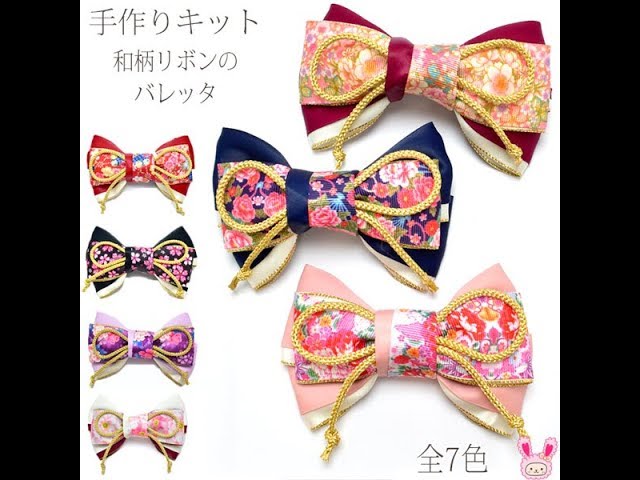
The idea behind a Japanese-pattern ribbon hair accessory is to layer several ribbons as you finish it.
The key to achieving a well-balanced look is to be precise about how much to overlap and at what lengths.
So use a ruler or measuring tape to take accurate measurements.
It’s also wise to test different arrangements beforehand to see how the patterns will ultimately appear.
While this guide explains how to make it with Japanese-pattern ribbons, you can absolutely use kimono fabric scraps as well.
With a bit of creativity, the cuteness is endless!

Rabbit and flower hair ornament

When it comes to hair accessories for Shichi-Go-San, tsumami-zaiku is a classic choice.
The item I’d like to introduce is a hair ornament featuring a rabbit and flowers.
You can make the flower petals—the star of the accessory—and the rabbit’s ears using tsumami-zaiku.
For the tsumami-zaiku parts, use chirimen crepe fabrics in the necessary colors; the rabbit’s face can be made with a half-sphere of Styrofoam, and other decorations can be created with beads, etc., so it’s great that you can get all the materials at a local craft store.
When you make it yourself, it’s also a lovely idea to match the flower colors of the hair ornament to the color of your child’s kimono.
Tsumami-zaiku may look difficult, but there are many tutorial videos on YouTube and elsewhere, so why not take this opportunity to give it a try?
