


When it comes to piano recitals, don’t you often find yourself unsure which piece to play?
Even if you have a vague image like “I want to play a piece with a certain mood,” it can be hard to come up with specific titles.
Many famous classical pieces in minor keys are cool and impressive, but they tend to sound a bit dark, don’t they?
So in this article, I’ll introduce a wide selection of bright, upbeat pieces that are perfect for a piano recital.
From well-known favorites to hidden gems that sound great on stage, I’ve picked pieces across a broad range.
Try choosing one with a difficulty level that suits your playing.
- [For Elementary School Students] Brilliant, Showy Masterpieces That Sound Impressive at Piano Recitals
- [For Intermediate Players] Challenge Yourself! Recommended Masterpieces That Shine at Piano Recitals
- [For Adults] Recommended for Piano Recitals! A Curated Selection of Impressively Sounding Masterpieces
- [For Advanced Players] A Curated Selection of Classical Masterpieces to Tackle at Piano Recitals
- [Piano Recital] Recommended for Middle Schoolers! A Comprehensive Introduction to Classical Masterpieces
- [Intermediate Level] Cool Piano Pieces You Can Play [Great for Recitals Too]
- [Piano Recital] Recommended for Boys! A Curated Selection of Cool, Impressive, and Popular Pieces
- Recommended for junior high school students! A selection of pop songs perfect for piano recitals
- For Beginners: Easy to Play and Sounds Impressive! Pieces That Shine at Piano Recitals
- [For Piano Recitals] Simple yet Cool Classical Pieces
- [Beginner] Recommended Piano Pieces to Play at a Recital
- [Piano Recital] Carefully Selected Classical Pieces Recommended for Upper Elementary School Students
- [Piano Recital] Carefully Selected Classical Pieces Recommended for Upper Elementary School Students
Recommended for piano recitals! A collection of bright pieces (1–10)
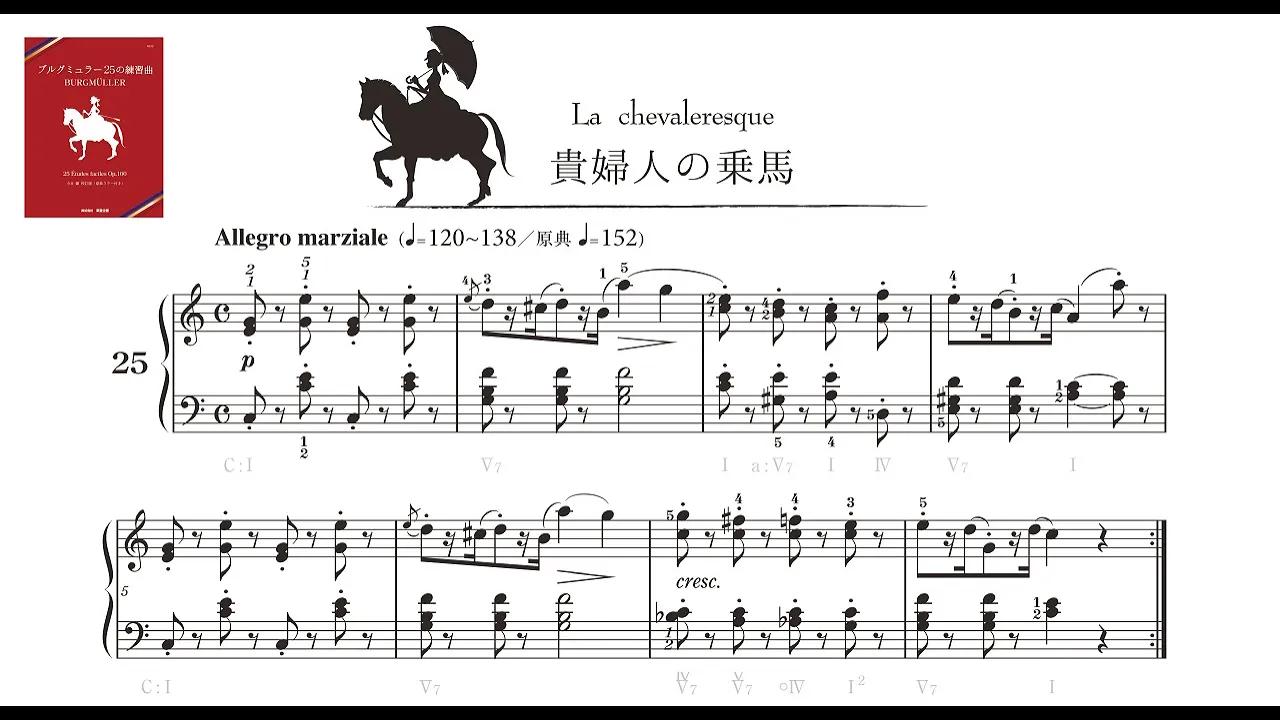
Etudes, Op. 25 No. 25 “Ladies on Horseback”Johann Burgmüller

Johann Burgmüller, active during the Romantic era, was a German composer known for his piano etudes for children.
Born in 1806, Burgmüller moved to Paris in 1832, where he established a light, elegant performance style.
This piece evokes the image of a brilliant horseback ride and incorporates a variety of techniques, including staccato, slurs, and triplets.
Written in 4/4 time and in C major, it carries a bold and sparkling character and is popular at recitals.
For piano learners, it is a highly educational work aimed at improving technique and developing musicality.
The Field Day of the House MiceHirayoshi Takeshu

Takayasu Hirayoshi is known for his gentle musicality that resonates with children’s hearts.
Born in 1936, Hirayoshi studied composition at Tokyo University of the Arts and left many choral works and piano pieces for children.
This work is a short piece of about one minute, included in Hirayoshi’s piano collection “Niji no Rhythm” (Rainbow Rhythm), with a lively and cheerful atmosphere.
Depicting a fun sports day of little white mice, the music features a rhythmic, bright melody.
It sparks children’s imaginations and lets performers feel the joy of playing.
It’s a recommended piece for beginners at the piano or anyone looking for a light, upbeat tune.
Golliwogg’s Cakewalk – Children’s CornerClaude Debussy

This is a piece from a piano suite composed in 1908 by Claude Debussy, a leading composer of French Impressionist music, for his beloved daughter Chouchou.
Drawing on the then-popular Black doll “Golliwogg” and the American Southern dance “cakewalk,” it is a work brimming with humor and creativity.
It features lively syncopated rhythms and playful melodies, and even includes a quotation in the middle section from Wagner’s music drama.
It is noted as a pioneering attempt to fuse Western classical music with African American musical elements.
Highly recommended for those wishing to perform at a piano recital—the light, cheerful atmosphere will brighten the hall.
Piano Sonata K. 545 in C majorWolfgang Amadeus Mozart

This is a masterpiece by Mozart, the genius composer who represents 18th-century classical music.
It consists of three movements, each creating a different atmosphere.
The first movement features a bright, lively tune; the second offers a calm, lyrical melody; and the third is a cheerful rondo, making for a richly varied structure.
Mozart mentioned this work in a letter to his sister Nannerl on August 2, 1788, suggesting it is a piece imbued with his personal feelings.
It is an approachable work recommended for piano learners and newcomers to classical music.
Invention No. 8, BWV 779J.S.Bach

Let me introduce a keyboard piece composed in 1723 by the Baroque master Johann Sebastian Bach.
Written for educational purposes, this work is widely cherished as an exercise to refine contrapuntal technique.
Set in F major and written in two-part counterpoint, it features distinct melodies in the right and left hands that resonate together as a unified harmony.
Showcasing Bach’s masterful counterpoint, it incorporates rhythmic shifts and syncopation, resulting in a dynamic and compelling structure.
It’s a highly recommended piece for anyone—from piano beginners to professionals—seeking to deepen their understanding of counterpoint.
Sonatina No. 8 in G major, Op. 36 No. 2Muzio Clementi

This work, composed by Muzio Clementi—often called the Father of the Piano—features a bright, accessible character that makes it especially appealing.
Published in 1797, it consists of three movements, each with its own distinct expression.
Listeners can enjoy the lively rhythm of the first movement, the graceful melody of the second, and the energetic tempo of the third, all within a structure rich in contrast.
Designed with educational intent, it helps develop technical fundamentals while refining musical expression, making it an important piece for piano learners.
With its cheerful atmosphere and abundant musicality, it is highly recommended for performance at piano recitals.
The EntertainerScott Joplin

Scott Joplin, known as the King of Ragtime.
Active from the late 19th to the early 20th century, Joplin sought to fuse African American music with classical traditions, and this cheerful, sprightly piano piece is one of his representative works.
Published in 1902, it is characterized by its vibrant rhythm and approachable melody.
It gained renewed attention when it was used in the 1973 film The Sting, contributing to a revival of interest in ragtime music.
Structured in an A-B-A-C-D form, it features a modulation from C major to F major and the fun of raising the octave on repeats, making it a joy to perform.
It’s a recommended piece for those seeking a bright and festive atmosphere.