

Recommended for high school students! A collection of easy one-day science project ideas


High school students who are struggling to choose a topic for their summer vacation independent research project, this is for you.
If you’re looking for an easy project—like “an experiment that can be done in a short time” or “a research project that looks impressive”—good news! This article introduces independent research ideas packed with the fun of science, focusing on experiments and hands-on builds.
From steam engines to planetariums, these are all projects that will make viewers exclaim, “Wow!” And surprisingly, many are easier to tackle than you’d think.
Find a wonderful project that will become a lasting summer memory!
- [I don't want to be like everyone else!] Recommended independent research topics for high school students
- [Middle School Students] Easy One-Day Science Projects and Crafts Ideas
- For upper-grade boys! Simple yet awesome craft project [Don’t call it lazy]
- [For Adults] Simple yet Impressive Crafts: A Stylish, Eye-Catching Collection
- Simple but awesome! Craft ideas for upper-grade girls
- Stand out with your junior high school independent research! A collection of fun experiment and craft ideas
- DIY science projects that elementary school boys will love: ideas you can make with everyday materials
- For summer vacation homework! Simple and amazing crafts for elementary school students that you’ll want to make after seeing them
- Simple yet amazing crafts: craft ideas that elementary school students will want to make
- Simple and cute summer project crafts! A collection of ideas for girls that will make you want to create
- Recommended for elementary school students! Science fair topics & craft ideas
- Adults will be hooked! A collection of craft ideas using toilet paper rolls
- Recommended for middle school students! A collection of quick science project ideas you can do in a short time.
Recommended for high school students! A collection of simple one-day science project ideas (31–40)
A science project you can just leave alone
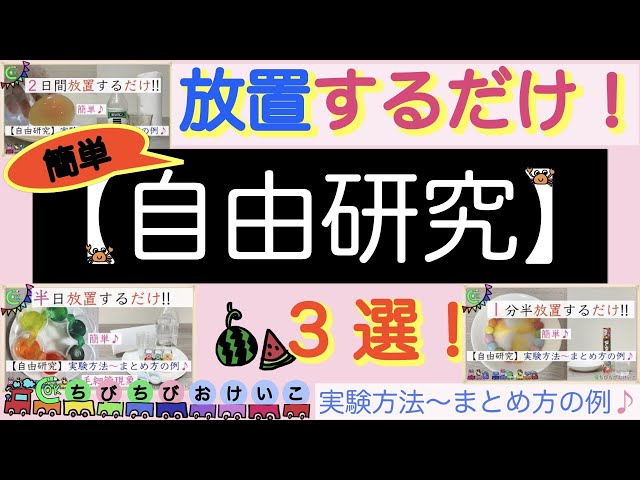
It’s hard to decide what to do for an independent research project, and you don’t want to spend too much time on it, right? So why not try some ideas that you can basically just set and forget? Here are three simple projects.
The first is to line colorful candy-coated chocolates around the rim of a plate, pour in water, and observe what happens.
The second is to soak an egg in vinegar to make a “skeleton egg.” The third is to dip kitchen paper into colored water and observe how it absorbs and changes color.
All of them are very easy, so give them a try!

Make insect repellent spray

Summer is the season of bugs like mosquitoes.
They’re a concern when you go to the sea, the mountains, or the river, right? So how about making your own insect repellent spray? All you have to do is mix suitable amounts of peppermint oil, purified water, and rubbing alcohol.
It’s very simple.
Try it yourself to see how effective it is, then write up a report and submit it.
It might be even better to test it with several people so you can collect some statistics!

elephant toothpaste

Let’s make elephant’s toothpaste using potassium iodide, hydrogen peroxide, dish soap, and food coloring! That said, we’re not actually making a special toothpaste for elephants.
That’s just what we call the chemical reaction caused by the decomposition of hydrogen peroxide.
Be careful when handling hydrogen peroxide, as it can cause burns.
You’ll be amazed at how much change you can see with just a small amount of chemicals!

Let’s make a leaf vein specimen

Let’s make a leaf vein specimen using leaves you can find around you.
First, bring water with 3 tablespoons of baking soda to a boil and add the leaves.
Simmer for about 15 minutes, then when the water turns brown and the leaves become limp, remove the leaves.
This softens the pigments other than the veins.
Next, rinse the leaves under running water and gently tap them with a toothbrush to scrape away everything except the veins.
Be sure to choose sturdy, relatively tough leaves for this experiment.
Snow globe making

When you move a bottle filled with liquid, it looks just like snowfall.
How about making a snow globe using materials you can get at a budget-friendly 100-yen shop? The steps are all simple, so it won’t take much time.
How cute you can make it look is where your skills really shine.
With that in mind, you’ll want to be particular about what you put inside the jar.
Recommended for high school students! A collection of easy one-day independent research ideas (41–50)
Primary colors of light

When it comes to the three primary colors of pigments, we have cyan, magenta, and yellow—essentially blue, red, and yellow—but for light, the three primaries are red, green, and blue.
When you mix all the pigment primaries, you get black, whereas mixing all the light primaries yields white! It’s quite mysterious… Let’s try experimenting with glowing liquids.
There must be a reason why mixing equal amounts of the three primary-color liquids of light doesn’t produce white.
Let’s analyze the experimental results and summarize why this happens! It seems there are experiment kits available, so it should be easy to try.

Making cotton ball lights

Make a ball by hardening cotton thread and put a light inside… that’s all it takes to complete a cotton ball light.
You can get all the materials at a 100-yen shop, so it’s easy and budget-friendly! Once you’ve turned it in as your homework project, you can use it as room decor—two birds with one stone.
You can keep it simple, or use small accessories to decorate it cutely.
It’s a great independent research idea, especially recommended for girls.