

Children’s songs, folk songs, and nursery rhymes about insects

We’ve put together a collection of children’s songs about insects.
Don’t worry—by insects we don’t mean the kind everyone dislikes, like cockroaches, but rather the beloved ones such as butterflies, ladybugs, honeybees, and red dragonflies.
The selection includes a variety of songs: newer children’s tunes, folk songs, traditional nursery rhymes, and classic playground songs.
Many boys in particular seem to love insects, so teaching them these songs might make them happy.
Cute insect songs are also popular with toddlers, so they’re definitely worth learning.
- [Children’s Songs of Autumn] Autumn songs, school songs, and traditional children’s rhymes. A collection of classic pieces to sing in autumn.
- [Childcare] Recommended songs and nursery rhymes for November: Fun autumn fingerplay songs
- Nursery rhymes and fingerplay songs to enjoy in May! Songs perfect for the fresh green season
- A collection of classic nursery rhymes and hand-play songs for September! Enjoy autumn with your child through songs.
- Children’s songs and nursery rhymes about the moon
- [Sea Nursery Rhymes] Fun children's songs themed around the sea
- Snake Song: Children's song, nursery rhyme, and hand-play song
- [Children’s Songs for June] Fun finger-play songs and traditional nursery rhymes perfect for the rainy season
- Get pumped with kids’ favorite songs! A memorable collection of classics that will make you want to sing along
- March nursery rhymes & hand play songs! Spring songs you can enjoy with your kids
- Song of the Maple Leaves. An autumn children’s song/nursery rhyme/folk song
- Nursery rhymes I want to sing in July: fun summer songs
- Children’s Songs You Can Sing in August: Summer-Friendly Kids’ Songs and Fingerplay Rhymes
Children’s songs, folk songs, and nursery rhymes about insects (1–10)
Mr. Ant on an errand

Lyrics were written by Eiichi Sekine, and the music was composed by Ikuma Dan.
As NHK prepared to resume a children’s program that had been suspended due to the worsening war situation, the piece was announced in 1950.
This marked Sekine’s debut as a children’s song writer, and afterward Dan went on to create works such as “Yagi-san Yūbin” and “Zō-san.”
To the Sun in the Palm of Your Hand

Lyrics by Takashi Yanase, music by Tak Izumi.
It was played in the music segment of NET News Show, for which Takashi Yanase handled the script composition.
The following year, in 1962, it was broadcast on NHK’s Minna no Uta, and in 1965 The Bonny Jacks covered it and it became a hit.
It was included in sixth-grade elementary school music textbooks and was selected as one of Japan’s 100 Best Songs.
Incidentally, “amenbo” (water strider) was originally sung as “namekuji” (slug).
snail
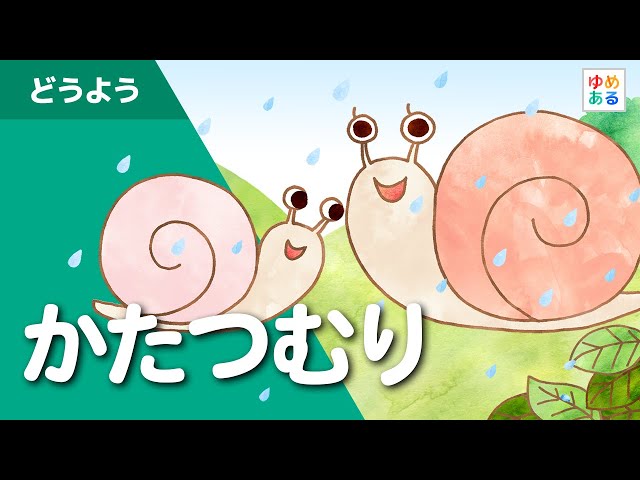
The traditional children’s song “Katatsumuri” (Snail) is one that almost everyone has sung at least once! With its relaxed tempo and lyrics that are almost the same in the first and second verses, it’s easy to remember.
It’s also great for indoor play during the rainy season, when snails are commonly seen! Singing with piano accompaniment is fun, but you can also enjoy it as a hand-play song or a gesture game.
You can even make snail hats together as a craft—there are lots of ways to enjoy it!

Children’s songs, folk songs, and nursery rhymes about insects (11–20)
From the choral suite for children “Picture Book of Insects”: “Cranefly”

This is a piece from a choral suite for children.
The composer is Hiroyuki Yoshioka, who is also known as a conductor and has created many choral works, and the lyrics are by Michio Mado, a poet renowned for children’s songs such as “Zō-san” (Elephant) and “Ichinensei ni Nattara” (When I Become a First Grader).
The suite consists of four songs—“Ladybug,” “Butterfly,” “Crane Fly,” and “Cicada”—and takes nearly 15 minutes to perform in its entirety.
Butt-biting bug

It was broadcast on NHK’s “Minna no Uta” in 2007, became popular, and was released on CD.
In the same year, at the 58th NHK Kouhaku Uta Gassen, a special segment featured a stage performance with children and a performer in an Oshiri Kajiri Mushi costume.
Although the artist name is “Oshiri Kajiri Mushi,” in reality five people, including Uruma Delvi (lyrics/composition) and Hirotaka Matsumae (co-composer/arranger), sang using a voice changer.
Come, firefly

It is a traditional children’s song of unknown authorship, or a call-and-response song, that sings about catching fireflies (a firefly hunt).
Other children’s songs about fireflies include Natsu wa Kinu, with lyrics by Nobutsuna Sasaki and music by Sakunosuke Koyama, and Hotaru, a Ministry of Education school song with lyrics by Takeshi Inoue and music by Koichi Shimofusa.
Song of Insects

The song “Konchū no Uta” (Insect Song) is one you’ll definitely want to enjoy together with the video! It’s also educational, teaching about the structure of insects’ bodies.
Adults take it for granted that “if it has six legs, it’s an insect,” but for kids it’s a mystery—“What about spiders? Aren’t pill bugs insects?” The song and illustrations explain it clearly.
In a kindergarten or nursery setting, adapting it into a picture-story show would likely delight the children! It seems like it would spark their curiosity too, with questions like, “So is this an insect?” spreading one after another.