

Word games you can enjoy with your kids. Let’s learn through play with words!

Children are exposed to many words every day and absorb a lot of things.
While it varies from child to child, around the age of three their vocabulary grows, and you start to see them enjoying conversations with adults and friends.
So this time, we’ve gathered wordplay ideas we recommend for kids like these.
In addition to classics like shiritori and riddles, we’ve packed in fun word games that make you want to speak out loud, such as tongue twisters and opposite-word games!
Wordplay offers lots of benefits for children—building vocabulary and expressive skills, and improving communication—so be sure to give it a try.
We hope that in a fun atmosphere, children’s interest in words will deepen!
- [Childcare] Letter and word games: Introducing fun activities using hiragana
- [Childcare] Wordplay and game ideas everyone can enjoy together
- [For Toddlers] Fun Trick Questions! Recommended Gotcha Riddles
- [Play Right Away!] Exciting Recreation Games Recommended for Elementary School Students
- [Trick Quiz] Quiz Questions That Excite Everyone from Kids to Adults
- [Riddles] Have Fun with Kindergarten Seniors! A Collection of Riddles
- [Kindergarten] Let’s Play with Quizzes! A Collection of Recommended Quizzes for Older Kindergarteners
- [Childcare] Have/Have-Not Quiz for Toddlers! Let's Play with Words with the Kids
- Popular quizzes at daycares and kindergartens. Perfect ideas for performances/activities.
- Let's play with a big group! A collection of fun children's recreational activities
- [Quiz] Recommended for preschoolers! A collection of fun quiz ideas
- [For Preschoolers] Thinking Is Fun! Riddle Special
- Useful for childcare! Today’s recommended recreational activities, including fingerplay and games!
Word games you can enjoy with your children. Learn through language-based play! (1–10)
What does it become if you remove one character?

The correct answer to the question, “What do you get if you remove ‘a’ from ‘aisu’ (ice)?” is “isu” (chair)! It’s a perfect game for expanding children’s vocabulary.
For example, removing “ru” from “kuruma” (car) makes “kuma” (bear).
It seems fun if you choose the words to match the child’s age.
Since it can be hard for adults to come up with questions on the spot, it’s a good idea to prepare them in advance.
Who am I?

It’s a game where you describe the features of something and, in the end, guess what it is.
For example: “I am an animal,” “But I can’t be a pet,” “I have big ears,” “I also have a long nose” … You keep giving hints like that until you reach the correct answer: “an elephant.” It’s actually harder for the person giving the clues, so if kids are playing together, it might go more smoothly if they prepare the questions in advance by writing them down on paper.
tongue twister

It’s a simple game where you just speak quickly, but it naturally gets people excited.
It might even help sharpen your thinking.
If you can handle famous tongue twisters like “Nama-mugi, nama-gome, nama-tamago” (raw wheat, raw rice, raw egg), why not try humorous ones like “Bas gasu bakuhatsu” (bus gas explosion) as well?
Word games you can enjoy with kids. Learn through play with words! (11–20)
Word Search Game

If you make cards for the 50 Japanese syllables (a, i, u, e, o, etc.), spread them out so they don’t overlap.
Then freely choose cards to form words like “あさがお” (morning glory) or “おかあさん” (mother).
It’s a game you can enjoy once you’ve learned hiragana.
Once you get used to it, you can add rules like “you can’t reuse a card you’ve already used.”
Let’s find words that sound the same!
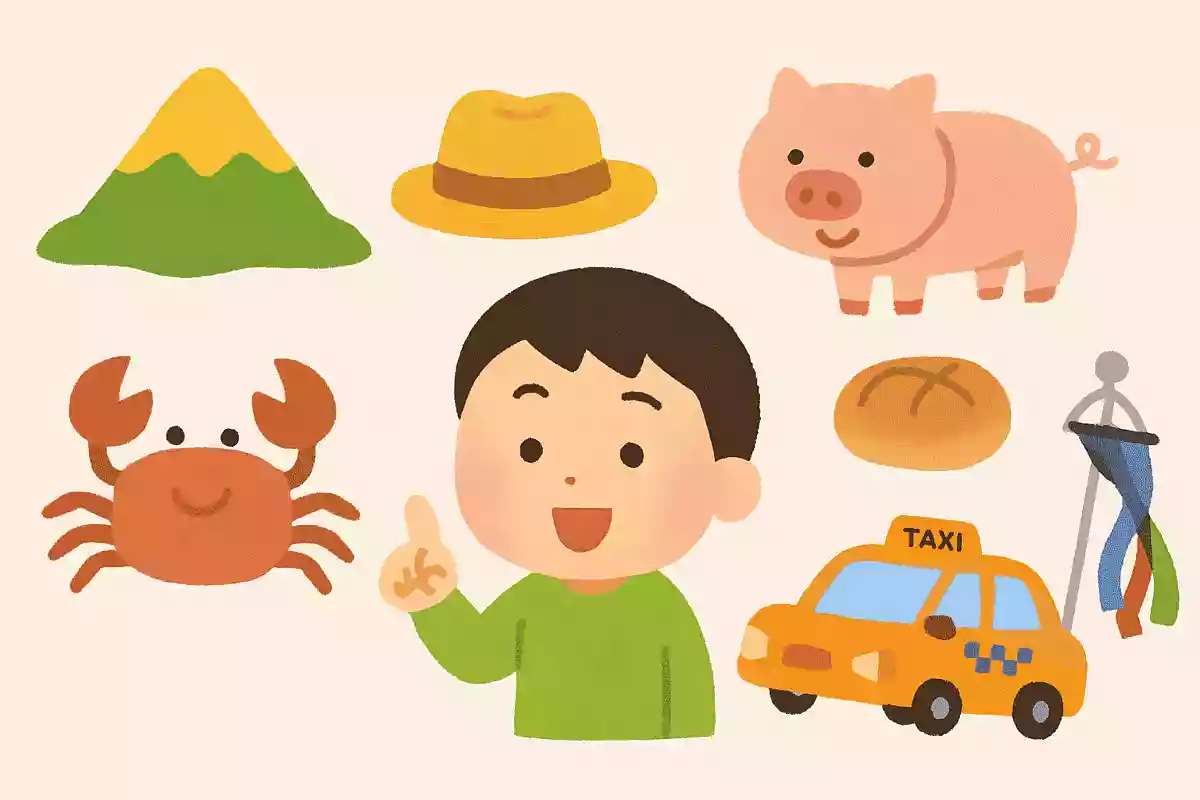
There are words like “hashi” meaning both “chopsticks” and “bridge,” or “ame” meaning both “rain” and “candy,” where the pronunciation is the same but the meaning is different.
Have you ever played a game where you look for such words together, or guess which meaning someone intended? Some words like “kami” can mean “hair,” “paper,” or “god,” so the impression changes depending on intonation and dialect.
It’s fun to have the person posing the question draw a picture in advance and then have others guess! For preschoolers, it’s a great way to practice learning words.
Once kids are in elementary school, you can make sentences and guess which meaning is intended—like “Kuruma de matō” (Shall we wait in the car?) versus “Kuru made matō” (Shall we wait until they come?), or “Pan tsukutta” (I made bread) versus “Pantsu kutta” (I ate underpants).
It really livens things up.
Enjoy this brain teaser time with your child!
acrostic using the Japanese syllabary (aiueo poem)

It’s a writing game that’s also featured on NHK TV.
You create and present original sentences that start with A, I, U, E, O in order.
For example: “Akai, iro enpitsu de, usagi o kaita ra, e ga, okashiku narimashita,” where the initial sounds of each phrase connect to form A-I-U-E-O.
You can enjoy it daily with the K, S, and other consonant rows too, and it’s a fun way to build writing skills.
Shiritori

While shiritori is nothing special for adults, it’s an entertaining game for children whose vocabularies are still limited.
You can also add conditions to match their age, like “Let’s play using only foods” or “Let’s use only three-letter words.” It’s a game that not only builds vocabulary but also sparks interest in a variety of things.