

Word games you can enjoy with your kids. Let’s learn through play with words!

Children are exposed to many words every day and absorb a lot of things.
While it varies from child to child, around the age of three their vocabulary grows, and you start to see them enjoying conversations with adults and friends.
So this time, we’ve gathered wordplay ideas we recommend for kids like these.
In addition to classics like shiritori and riddles, we’ve packed in fun word games that make you want to speak out loud, such as tongue twisters and opposite-word games!
Wordplay offers lots of benefits for children—building vocabulary and expressive skills, and improving communication—so be sure to give it a try.
We hope that in a fun atmosphere, children’s interest in words will deepen!
- [Childcare] Letter and word games: Introducing fun activities using hiragana
- [Childcare] Wordplay and game ideas everyone can enjoy together
- [For Toddlers] Fun Trick Questions! Recommended Gotcha Riddles
- [Play Right Away!] Exciting Recreation Games Recommended for Elementary School Students
- [Trick Quiz] Quiz Questions That Excite Everyone from Kids to Adults
- [Riddles] Have Fun with Kindergarten Seniors! A Collection of Riddles
- [Kindergarten] Let’s Play with Quizzes! A Collection of Recommended Quizzes for Older Kindergarteners
- [Childcare] Have/Have-Not Quiz for Toddlers! Let's Play with Words with the Kids
- Popular quizzes at daycares and kindergartens. Perfect ideas for performances/activities.
- Let's play with a big group! A collection of fun children's recreational activities
- [Quiz] Recommended for preschoolers! A collection of fun quiz ideas
- [For Preschoolers] Thinking Is Fun! Riddle Special
- Useful for childcare! Today’s recommended recreational activities, including fingerplay and games!
Word games you can enjoy with kids. Learn through play with words! (11–20)
Counting Song: “Ten Little Indians”

We learn counting units to the tune of “Ten Little Indians.” For apples, the counter stays ko as the number increases—1 ko, 2 ko, 3 ko—but for dogs, the reading of the counter changes: 1 piki, 2 hiki, 3 biki.
This can be hard for children, but if they learn it along with a fun, rhythmic song, I think they’ll pick it up quickly.
Let’s find the fruits with hidden numbers

It’s a game where you look for numbers hidden inside the names of fruits.
If the question is “Which fruit has the number 1 hidden in it?” then “ichigo” (strawberry) is the correct answer, because it contains “ichi” (one).
For the number 3, besides “san,” you can also accept “mi” from “mittsu” (three), widening the range of readings—that’s the trick.
For 6, there are various readings like “roku,” the “ro” from “rokko,” or the “mu” from “muttsu.” It’s one of those games that lets you interact with numbers while playing.
Do-Re-Mi Song Game

This is a game that uses the famous song “Do-Re-Mi.” Since you can’t play unless you remember the song itself, let’s first learn it while having fun.
The first player sings, “Do is the do in donut,” and then gives the next player a prompt, for example, “La.” The next player must sing the “La” part of the song: “La is the la in trumpet.” It’s a game better suited for slightly older children, but if you keep the chain going smoothly, it gets very exciting.
Arunashi quiz

It’s a game where you solve problems by finding a common word.
For example: “What is something that appears with ‘makura’ (pillow) but not with ‘futon,’ and with ‘sumo’ but not with ‘judo’?” The answer is “ude” (arm).
You can say “ude-makura” (arm pillow) and “ude-zumō” (arm wrestling), so the word “ude” fits both of the former terms.
Since you search for various words in your head, it seems good for training children’s mental agility.
opposite words

It’s one of those games that lets you expand your vocabulary in a fun way.
For the question, “What’s the opposite of ‘long’?” the answer is “short,” right? It might be more enjoyable to play while looking at a picture book so it doesn’t become just a back-and-forth of words.
“Tall/high” has multiple opposites like “low” and “cheap,” so it seems like it would really spark a child’s curiosity.
The “Don’t show your teeth” game
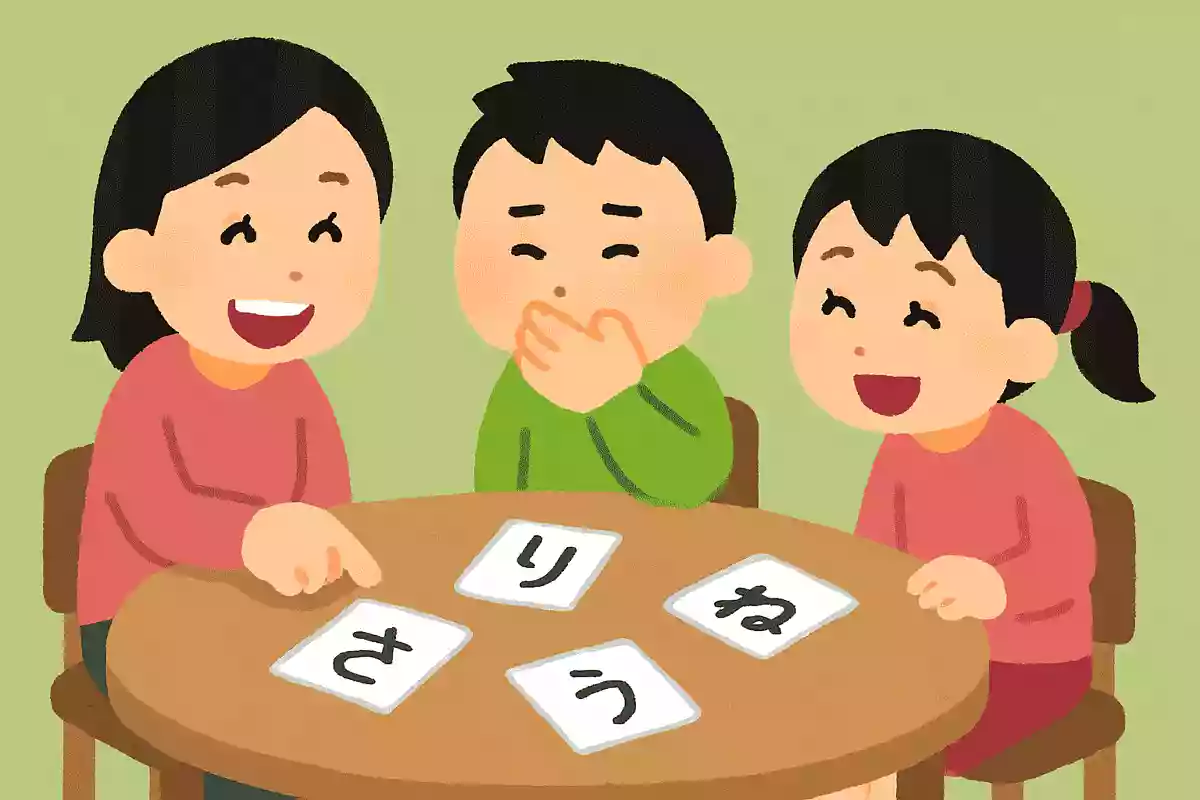
The rules are simple: just don’t show your teeth! It’s a very fun game precisely because it’s so simple.
For example, if you choose “fruits” as the topic, you then take turns saying any fruit you like—like “peach,” “mandarin,” “banana.” Whoever shows their teeth while answering loses.
It’s also fun to have people who aren’t playing act as judges.
Word games you can enjoy with children. Learn through language-based play! (21–30)
Fruits Basket

By the time children are three years old, they’re able to play while following basic rules.
That’s when “Fruit Basket” is a great activity to introduce.
One of the charms of this game is that it can be enjoyed in a lively, large group.
The rules of Fruit Basket are very simple: the “it” player shouts the name of a specific fruit, and only the people sitting in chairs who belong to that fruit move to a different seat.
During this time, the “it” player tries to take a seat.
It’s ideal if the teacher can really set the mood so that children who are just learning the rules can have fun too!
