



Children are exposed to many words every day and absorb a lot of things.
While it varies from child to child, around the age of three their vocabulary grows, and you start to see them enjoying conversations with adults and friends.
So this time, we’ve gathered wordplay ideas we recommend for kids like these.
In addition to classics like shiritori and riddles, we’ve packed in fun word games that make you want to speak out loud, such as tongue twisters and opposite-word games!
Wordplay offers lots of benefits for children—building vocabulary and expressive skills, and improving communication—so be sure to give it a try.
We hope that in a fun atmosphere, children’s interest in words will deepen!
- [Childcare] Letter and word games: Introducing fun activities using hiragana
- [Childcare] Wordplay and game ideas everyone can enjoy together
- [For Toddlers] Fun Trick Questions! Recommended Gotcha Riddles
- [Play Right Away!] Exciting Recreation Games Recommended for Elementary School Students
- [Trick Quiz] Quiz Questions That Excite Everyone from Kids to Adults
- [Riddles] Have Fun with Kindergarten Seniors! A Collection of Riddles
- [Kindergarten] Let’s Play with Quizzes! A Collection of Recommended Quizzes for Older Kindergarteners
- [Childcare] Have/Have-Not Quiz for Toddlers! Let's Play with Words with the Kids
- Popular quizzes at daycares and kindergartens. Perfect ideas for performances/activities.
- Let's play with a big group! A collection of fun children's recreational activities
- [Quiz] Recommended for preschoolers! A collection of fun quiz ideas
- [For Preschoolers] Thinking Is Fun! Riddle Special
- Useful for childcare! Today’s recommended recreational activities, including fingerplay and games!
Word games you can enjoy with your children. Learn through language-based play! (1–10)
Rearrangement Quiz
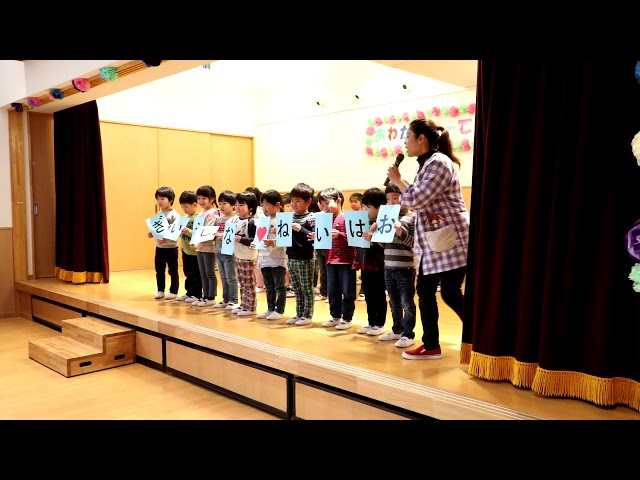
It’s a game where you answer “randoseru” (school backpack) from the jumbled characters “do,” “se,” “n,” “ru,” and “ra.” It seems like it could help develop creative thinking.
If you write it on medium-sized paper, it can be used as a recreation activity; if you write it on a large sheet, it could even work as a stage presentation.
It looks like it would get exciting if you gradually make the questions more difficult!
Ten Times Game

It’s a game loved not only by children but also by adults.
The host says, “Say ‘pizza’ ten times,” the player goes “pizza, pizza…” ten times, and then the host points to their elbow and asks, “What’s this?” trying to trick the player into saying “knee” by mistake.
Since the famous ones have their answers exposed, it seems best to look for prompts that aren’t so well known yet.
Party-gathering game

It’s a game where you give the first letter—like asking, “What words start with ‘a’?”—and then collect words that begin with that letter.
This game helps with learning vocabulary and memorizing words.
There aren’t many words that start with “ru,” such as “roulette,” “rule,” and “ruby,” so “ru” might be considered a tough one.
Reverse word game

It’s a game where you say words backward and guess the original word.
For example, if you ask, “What’s the reverse of ‘netsuki’?” and someone answers “kitsune,” that’s correct.
It naturally builds memory skills, so it’s good for brain development, too.
It’s a bit tricky, so start with two-letter words like “inu” or “yume.”
Telephone game

The first person hears the prompt word or phrase and passes it on to the next person exactly as they heard it.
This continues down the line, and the last person says the word or phrase out loud.
The more the final answer differs from what the first person said, the more exciting it gets.
The key to making it fun is to use a longer, imaginative prompt, such as “Mi-chan the stuffed animal overslept by three whole hours.”
Word association game “Iroha ni Konpeitō”

It’s a classic word-association game.
Starting from “konpeitō,” you go to “sweet,” from “sweet” to “sugar,” from “sugar” to “white,” and keep linking words like that.
Because the game moves along to a distinctive rhythm, a good sense of rhythm is important.
If you play it standing rather than sitting, it could even be incorporated into a simple rhythmic exercise.
Color Search Game

It’s a game where you connect colors and objects with words, and “wear” the color itself.
For the prompt “What is something yellow?” players might answer “a banana” or “an egg yolk.” Once you get used to it, you can add conditions like “among the things you can see right now” or “something in this room.”