

Traditional Games: Fun Old-Time Play. Popular Activities Useful in Childcare

Traditional folk games that have long been loved in Japan are packed with timeless charms that captivate children across generations.
Because folk games let us experience old cultures and local traditions, we want to pass many of these games from adults down to children.
In this feature, we’ll introduce a wide variety of such time-honored folk games.
We’ve gathered many activities kids can truly get absorbed in—everything from physical games, to ones using traditional toys like ohajiki (small playing pieces) and stilts, to word- and song-based games like karuta and chachatsubo.
We hope you’ll incorporate them in nursery schools and kindergartens and enjoy them together with the children.
- Nostalgic games that were popular when we were kids
- Let's play with a big group! A collection of fun children's recreational activities
- Games using beanbags (otedama)
- [January Childcare] Traditional New Year’s Games! A Collection of Ideas to Enjoy with Children
- [Children’s Club] Easy and fun indoor games. Exciting party games
- [For Preschoolers & Kids] Game, Play, and Craft Ideas to Enjoy on Hinamatsuri (Girls’ Day)
- Recommended for upper elementary grades! Exciting indoor recreation and games
- [Play Right Away!] Exciting Recreation Games Recommended for Elementary School Students
- [Hand Play] Popular with kids! A collection of trendy hand-play songs and nostalgic traditional children’s songs
- [Elementary School] Quick and Easy! Indoor Recreational Activities Perfect for Lower Grades
- A collection of ideas for infant/toddler play, recreation, and games
- [Parenting] Parent-child bonding! Hand-play songs and traditional nursery rhymes collection
- Handkerchief and Towel Play! A Collection of Fun Play Ideas
[Traditional Games] Fun Old-Time Play: Popular Activities for Childcare (11–20)
I wonder if the rice crackers are done.
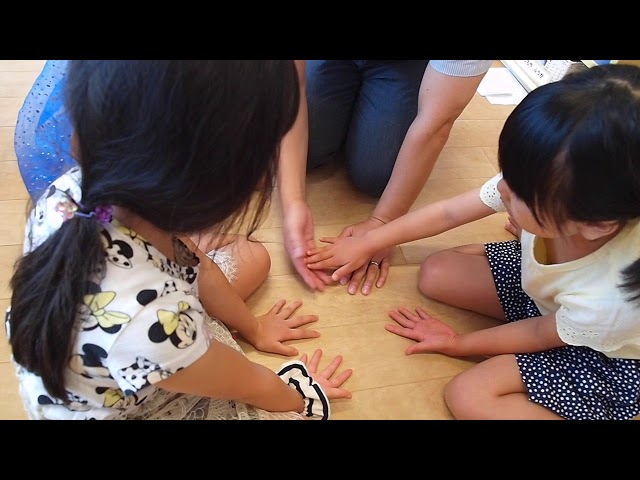
A traditional game where you pretend your hands are rice crackers is called “Has the rice cracker finished baking?” Face your friends and hold out both hands facing down.
One person points to each player’s hands in turn while saying, “O-senbe yaketa kana?” (Has the rice cracker finished baking?).
The person whose hand is pointed at on the last syllable “na” flips that hand over.
Then, starting with the next person, repeat the action in order.
If a person whose hand has already been flipped is pointed at again, their rice cracker is done! Anyone whose both hands (both rice crackers) are done is out of the game.
It’s perfect for indoor play—try it at home, in kindergarten, or at daycare during indoor activities.

chacha jar

“Chacha Tsubo” is a simple yet surprisingly challenging hand game even for adults.
Its appeal is that it needs no equipment and can be enjoyed indoors.
You pretend your left hand is a tea jar and, in time with the song, quickly switch between your right and left hands—great for brain training, too! Once you get used to it, you might speed up the tempo.
Be careful not to get your hands tangled and give it a try! It also sounds fun to compete for speed with friends or family.
It’s a traditional game that people of all ages—from children to seniors—can enjoy.
origami

Origami, which can be called a part of Japanese culture, is also popular with people from other countries! All you need is a single sheet of paper, and its depth is part of the charm—there are countless folding methods, to the point where it feels like you can make almost anything.
Young children can start with simple motifs and gradually try more difficult folds as they get older.
It helps develop fine motor skills and creativity! There are also many YouTube videos that explain how to fold characters, dinosaurs, animals, plants, weapons, and more in detail, so be sure to use them as a reference!
Fukuwarai (a traditional Japanese “lucky laugh” face-making game)

“Fukuwarai” is a traditional game that families can enjoy together during the New Year.
You play by blindfolding yourself and placing facial parts—eyes, mouth, nose, eyebrows, and so on—onto a sheet of paper with an outline of a face.
The funny part is that, because you’re blindfolded, the face rarely turns out the way you intended! In addition to the classic analog version played on paper, the game has evolved in recent years to include web-based versions and even ones included in robot toys.
So why not try it with your family or friends—not just during the New Year, but anytime?
bamboo-copter
Take a nostalgic trip back to childhood with the “taketombo,” a traditional toy modeled after a dragonfly.
It’s so popular that there are even competitions to see who can make it fly the farthest.
You can actually make one by cutting bamboo yourself, so crafting and flying one with your child could be a great activity.
Playing with a taketombo you made yourself makes it all the more special! Of course, you can also buy them online in folk craft sections or as DIY kits, so be sure to check those out.
Don’t miss the modern versions, too—safe plastic models and even ones that light up!
stilts

Takeuma, or “bamboo horses,” are traditional toys that use bamboo poles as makeshift stilts.
Many people may remember playing with them in elementary school.
They’re a fun way to develop balance and core strength, so why not incorporate them into everyday play? For children, steel or aluminum models with high durability, or lightweight bamboo versions that are easy for kids to handle, are recommended.
In any case, choosing the right size to match your child’s height and build is best.
Beginners can play more safely with models that have support feet.
[Traditional Games] Fun Old-Time Play. Popular Activities for Childcare (21–30)
A picture-matching card game playable from age 3
https://www.tiktok.com/@hoiku.labo/video/7182103671222652162This is a “picture matching card” game that even small children can enjoy.
Beforehand, prepare several pairs of cards by drawing the same picture on two sheets of paper and mounting them onto colored cardstock.
It’s nice to use New Year’s motifs for the designs—for example, kadomatsu, spinning tops, lion dance, Mt.
Fuji, osechi cuisine, and mochi.
Place all the cards face down and turn one card face up.
Players take turns choosing one card to flip over; if it matches the revealed picture, they win that round; if not, it’s the next player’s turn.
It’s a fun way to build observation skills, memory, and communication!
